Thursday, April 11, 2019

Shazam! TV Show - The Joy Riders

No Shazam-themed week would be complete without a glance at the 1970s TV show. Between the 1941 movie serial and the 2019 big-budget movie sat the small-screen exploits of Captain Marvel

The Introduction for Many a Kid


For most kids of my Gen-X Generation, the Shazam TV show was the first time we figured out who Captain Marvel was. Coming just a year or so after DC Comics started publishing the Shazam comic, the TV show starred Michael Gray as Billy Batson and Les Tremayne as Mentor. They travel the country (at least California) in an RV righting wrongs and helping kids make good decisions. I had a little Tonka-brand RV in the same color scheme and I imagined it was Batson's RV. But it didn't have that cool Shazam lightening bolt on the front.


In season 1, Jackson Bostwick starred as Captain Marvel and he's the one I remember. Heck, I even had the treasury-sized edition of Shazam with Bostwick standing on that rock. Yeah, I made that pose more than once, thank you very much.


I loved this show, and while I can't say I was there from day one, I certainly remember many a Saturday morning anchored in place to watch the Mightiest Mortal do his thing.

Filmation produced Shazam, the company that brought many a smile to kids' faces. You'd recognize a Filmation program by the spinning circle with the names of Lou Scheimer and Norm Prescott going round and round.


Plus there was the same Saturday morning music cues, something I picked up on when I watched episode 1, "The Joy Riders."

The Premise of the Episodes


With each episode, the intro features a voice-over with "The Saturday Morning Cartoon Guy" (you'd recognize the voice if you're of a certain age) giving you the premise of the story, who Billy is, and who Captain Marvel is. Boom, you're good to go. Speaking of boom, when Michael Gray says the magic name, there's a huge lightening bolt that looks not too dissimilar from the bolt that you see in the "Gilligan's Island" intro. When you get the flash, the music changes and there, in front of your eyes, in color, is Shazam himself. Marvelous

The Joy Riders


I actually chuckled to myself when four young teenaged boys meet up at hamburger shack and talk about "borrowing" a car in which to ride around. Just imagine: in September 1974, that was one of the worst things you could do, or at least show on TV. It came across as quaint, in a kind of old-fashioned sitcom-y way, until I remembered I was the target audience at the time. Gulp.

One of the four boys, a red-headed kid named Chuck, isn't too keen on joining in on the stealing. He says what it is, but the other three laugh at him, call him chicken, before they careen away in the stolen car.

Moment before, Billy gets a message from The Elders. He's signaled via...the light ball? There, he hears about his task: he'll meet someone who will have trouble standing up to others, including his friends. The Elders are all animated, with only their mouths moving. How cool it was to hear Adam West's voice coming from one of them!

As you can imagine, Billy and Mentor try to help Chuck with the latter's feelings of inadequacy and fear of being labeled an outsider and his trio of friends turning their backs on him. Chuck's bike is even stolen, giving all four boys a tangible reminder of what they did with the first stolen car.

When the  boys boost another car and force Chuck in with them, it's time for Captain Marvel.

Captain Marvel on Screen


Look, I've only seen two episodes of the 1941 movie serial and this episode of the 1975 TV show, but if I'm being honest, the flying sequences in the old serial are better. Granted, the TV show has to operate on a TV budget, but you'd think there'd be some improvement.

Bostwick gets around some of the quirks of editing by having Shazam land feet first. He is shown in the air actually changing his trajectory, so that when you next see the hero on the ground, he's already standing. One fantastic thing they did was film many of his close-ups outside, so you get to see the sunshine on Shazam's face, hair, and cape while the wind machine is cranked up.

The boys take refuge in an old van in a junk yard, and dang if there wasn't a giant claw crane angling to pick up the van. It does, and the boys yell. The Captain hears it and, with his super strength, pulls the van back down, allowing the boys to escape.

Now, it's lecture time.

The Moral of the Story


Look, I was the target audience. I was supposed to know right from wrong. I had great parents, but what about those kids that didn't. Well, the episode ends in two ways. One, Shazam singles out Chuck for his courage in saying no. Even the other three admit that. When the lead troublemaker asks if they're going to jail, Shazam doesn't have an answer. It's up to the juvenile authorities. Have to admit: love that. There's no getting out of jail free card here.

After the commercial break, Shazam is there and Bostwick gives the moral of the story: it's really hard to do the right thing, especially if other people--or your friends--start calling you names. The producers knew their audience and, perhaps encouraged by law, made sure to drive home the message. Cheesy? Perhaps, but not necessarily bad. Cartoons and kids' programming is one way to teach young people about life, and if they listen to Captain Marvel instead of their parents and stay out of trouble, then we're all good.

Conclusion


I have good memories of this show, including the time when it was paired with Isis for a full hour of live-action superhero goodness. Come to think of it, CBS also aired the Tarzan cartoon and, later, the Adventure Hour with Zorro and the Lone Ranger. The network had a good amount of action cartoons. Makes me wonder if I was primarily a Channel 11 guy (the Houston affiliate) on Saturday mornings.

I thoroughly enjoyed re-watching this episode and going back to that simpler time. As I mentioned when I reviewed the movie serial, I hold degrees in history, so I'm always fascinated to research something, especially something I experienced and see it from a difference perspective. I'll certainly watch more episodes of the Shazam TV show.

Wednesday, April 10, 2019

The Charm of Zachary Levi

Clearly, this impromptu Shazam-themed week is a direct result of me seeing the film and wanting more with the character. There's the movie review, a review of one of my comics, and I wrote a little about the movie serial. Today, it's about the man himself.

I think it goes without saying that a large chunk of what makes the character Shazam work in the new movie is how you think thirty-seven year old Zachary Levi actually comes across as a fourteen year old boy. It's charming. It's wish fulfillment. It's what I said is one of the movie's greatest strengths.

But from what you get in Levi's various interviews, Levi is a down to earth guy happy for his turn in the superhero ring.

Men's Journal


I've read this magazine for years, and it's rather entertaining to see the different types of photos the publish of Levi. On the cover and inside, you see the stern, superhero visage staring either at the camera or off in the distance. Yet when they follow Levi on a tandem skydive, you see the true Levi: mouth open, grinning from ear to ear, excited for life and his opportunity.

Of all the things I've seen and read, this feature article by Mickey Rapkin digs into the man himself. I knew about the TV show "Chuck," and while I'm a fan of Amazon's "The Marvelous Mrs. Maisel," I haven't watched season two yet (Levi's in it). I basically had the impression Levi did a lot of work, but in things I hadn't seen. Turns out, he wasn't working quite as much as I thought--or he wanted. The article explores both this part of his career as well as some of the mental health issues he experienced, especially after he narrowly missed out on the role of Star-Lord from Guardians of the Galaxy. To quote from Levi himself: "You wouldn't talk to your friends the way you talk to yourself. So knock it off."

I really appreciated his insights into what's important in life, and he's grateful for the opportunity given to him. He took it and gave it his all. It shows on screen. Give the story a read.

Late Show with Stephen Colbert


Levi's manic energy comes out as two comic book readers--Colbert is known for his love of all things formerly known as geeky--discuss the origins of the original Captain Marvel and having his own action figure.


How Levi Got in Shape


The Looper video goes into detail here, including a short discussion on the internet trolls issue I frankly first learned about in the Men's Journal article.

Levi and His Teenaged Co-Stars


If you need any more evidence Levi is just a big kid, here he is with Jack Dylan Grazer and Asher Angel for Teen Vogue as they are quizzed on their superhero knowledge.

Levi and Director David F. Sandberg


For the technical and storytelling aspects of the film, I recommend this joint interview with lead actor and director.


Empire Podcast

Episode 358 of the Empire podcast interviews Levi, and I was struck not only by the ebullient spirit Levi has, but the gratitude about this opportunity. And his feeling of responsibility about the eighty-year-old character of Shazam. Really enjoyed it. Listen Here..

Tuesday, April 9, 2019

Shazam: Serial Part 1 and 2

I am a comic book reader and a degreed historian, and being in a Shazam mood (both the new movie and a favorite comic), I thought I'd take a look at the 1941 Shazam serial, The Adventures of Captain Marvel. It's a 12-part serial, all available on YouTube (here's the first episode). From what you can read on the internet, this serial by Republic Pictures was the high-water mark of the form and serves as the first live-action depiction of a super-hero.

Far-Off Mysteries in a Smaller World


The story starts in the Valley of the Tombs in Siam. An expedition by white men (and one woman, Betty) is posed to open the ancient tomb. The natives do not want this to happen and attack. The expedition fends off the attack with the agreement to leave the area at once. Naturally, they don't.

They strike into the tomb and uncover the Golden Scorpion inside a sealed crypt. Young Billy Batson (twenty-five year old Frank Coghlan, Jr.) heeds the warning and leaves. That act of propriety earns Billy a visit from the Shazam wizard. Like he does in every incarnation of the character, the wizard imparts his powers to Billy as long as the lad can say the magic name: Shazam. But the old man has a warning: Billy must only use the power to help people.

Coghlan portrays young Billy with a lot of gee golly gosh youthful enthusiasm you'd later see in Jimmy Olsen in the Adventures of Superman TV show. But he's still a man of the times. He carries a gun and returns fire when the natives, led by Rahman Bar, again attack the expedition.

Captain Marvel comes to the rescue.

The 1941 Special Effects


Here in 2019, we are used to our super-heroes looking like real people even when they are CGI. Gollem was the first CGI character who was so good, you often forgot he wasn't really there. We've come a long way, just in my lifetime. Heck, just in the last eighteen years.

The movie makers in 1941 had none of that, but dang if they didn't work with what they had and make a pretty darn good convincing super-hero.

When Shazam (Tom Tyler) flies, the actor jumps, often diving into a bush or behind a rock. With a quick cut, you see what is in reality a paper mache mock-up of Shazam, ramrod straight, with the costume and flapping cape. The figure is attached to wires, allowing Captain Marvel to fly in the daytime. Then, with another quick edit, you see the actor again landing or smashing into fleeing bad guys. It was pretty good, at least giving the viewer the verisimilitude of watching a super-hero in action. Frankly, it's better than the 1950s TV Superman.

Similarly, when the bad guys shoot at Shazam, the bullets ping off the costume, leaving little pock marks that are, naturally, gone in the next scene.

When Billy and Captain Marvel say the magic word to transform back and forth, there is enough flash powder to mask what's really going on behind the smoke.

The Cliffhanger


This is a movie serial and it's designed to bring viewers back week after week. As such, when the bad guys dynamite the wooden bridge with one of the two cars containing members of the expedition fleeing, you want to know what happens. As soon as the car begins to fall, there's a title swipe and the admonition to come back next week for Chapter 2.

Knowing what I've seen in other serials, I expected to get a new scene of Shazam actually having flown up to the car, snatched out his two friends, and fly off to safety. Nope. The car crashes into the river below...and only then does Shazam save the day.

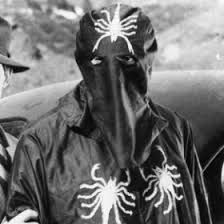
Later, after everyone has come back to America, the plot of the serial takes shape. A masked man, complete with a dark hood and robes with the scorpion symbol stitched on his clothes, is in command. He's the Scorpion. He directs standard-issue suited gangsters to start capturing the members of the expedition. You see, inside that crypt was a golden metal scorpion. In the legs of each were crystals that, if you line them up in a certain way, can turn stone to gold or create a weapon. The members of the Malcolm Expedition divvy up the crystals, dividing them so that only all of them in agreement can use the power of the scorpion.

Naturally, the Scorpion wants to collect the missing crystals. Boom! You've got your plot.

In Episode 2, the guillotine is introduced. It's a conveyor belt (natch) that electrically stuns a person who is then carried along to the guillotine. They introduced it early in the episode with a wooden chair being the victim as a threatening means to get one of the expedition members to cough up the location of his crystal. You know Captain Marvel's going to find himself on that belt.

He does. Right before the title swipe to remind viewers to come back next week for Chapter 3, "Time Bomb."

And I will. Might be a two-episodes per week thing, but I'm in, both for the historical nature of the serial, but the story is pretty good. It also easy to see how the 1966 Batman series--with its two-part episodes, the first ending with the Dynamic Duo in some elaborate trap--is indebted to the movie serials of the 1940s. Who knows? I'll likely watch the Batman serials this year, too.

Monday, April 8, 2019

Shazam: Power of Hope

Naturally, after I watched the new Shazam movie, I reviewed it. Then, I scoured some of my comic boxes for some Captain Marvel material to re-read. I didn't deep dive into the boxes, but came away with a handful of World's Finest from the late 70s and early 80s and this wonderful treasury sized one-shot.

Oversized Issues for Big Stories


From 1999 to 2001, artist Alex Ross and writer Paul Dini teamed up for a series of one-shots featuring Superman, Batman, Shazam, and Wonder Woman. Unlike your typical comic book with word balloons, Dini's words were presented purely as text in the panels, paving the way for the beauty of Ross's painted images to come alive on a larger canvas. I think we all know Ross's art and can recognize it instantly. I showed my wife this issue and even she was impressed by the majesty of the art. Ross's comic book art makes you almost believe these heroes are real.

But the art is only half the story. Dini's tale digs deep into what makes Shazam special: his youthful spirit. What's missing on these pages are battles with super-villains.Yes, they're there, but all told in flashbacks. The Captain's focus here are kids in the hospital with ailments even his great power cannot overcome. It grounds him, making him even a more powerful hero because he knows where the real battle is.

A Template for Grounding Stories


Most movie goers and comic book fans appreciated the early movies from DC's movie universe. I'm thinking of the Christopher Nolan's Dark Knight series. I, for one, loved it. These films came to be the template for all subsequent films, with the governing philosophy of this is how these super-heroes interact in a "real world."

But there are other ways of doing it, and Power of Hope is a different template. You can still have super-heroics with a story that's grounded in reality but not be so grimdark. This comic shows the way and, frankly, the new big-budget movie does as well. There can be a sense of wonder with smiles while still fighting the bad guys.

Let's hope DC picks up on what it stumbled upon and keeps going. Because the answer to how you make a real-world super-hero movie was staring them in the face with this gorgeous tale by Paul Dini and Alex Ross.

Sunday, April 7, 2019

Movie Review: Shazam! Has Its Own Superpower

At one point in Shazam!, Jack Dylan Grazer's Freddie Freeman asks his new foster brother, Billy Batson (Asher Angel) what superpower he would choose if given the opportunity. Freddie mentions most people select flight or invisibility. The movie itself, showcases another superpower altogether.

The Long Road Back to the Big Screen


For many of the heroes who show up on the big screen in this century do so for the first time. Others, like Batman, Superman, and Shazam, it is a return. For Captain Marvel--the character's real and original name--it has been 78 years since Shazam was a movie serial. Many critics and film historians consider that 1941 Republic serial to be a high-water mark of the genre, and I'll admit, I'm curious.

But now, we're in 2019 and the big-budget, color glorious film starring Zachary Levi as the Big Red Cheese is on the silver screen. And it is so good.

A New Story for a New Century


Most of us long-time fans know Billy Batson's origins from the 1940s when he was a radio reporter. In the last decade, Geoff Johns revamped the story for a modern audience, and it is this version we see on screen.

Billy, a sullen teenager, constantly searches for his mother, who lost him at a carnival when he was a toddler. He's street-wise, able to take care of himself, but still longs to find his mother and reform his family.

His latest failure lands him in a foster home with five other foster children. One of which is Freddie, a nerdy kid in love with the DCEU superheroes, but must use a crutch to get around. After Billy stands up for Freddie against a couple of bullies, he escapes in a subway train to a magical place where the aged wizard, Shazam, seeks to pass on his powers to young Billy. All the boy has to do is say the the wizard's name and he's transformed into an adult superhero.

Instant Chemistry Between Grazer and Levi


If the first part of the film set the foundation of all the characters, it's the interplay between Zachary Levi and Jack Dylan Grazer that really shine. Grazer, who I first noticed in the short-lived show "Me, Myself, and I" and the movie, "It, Chapter One," plays Freddie as the motor-mouthed nerd who know all things superhero related, excels in this role. He brings the manic excitement of a teenager thrilled his foster brother is an adult superhero, but then can swing the other way, giving Freddie the pathos and sadness of his life's predicament. Levi is a wonderful choice for Shazam. His enthusiasm at finding his newfound grown-up self is off-set by Levi's ability to make you believe he really is still a teenager. They make a great pair, and the humor and camaraderie between them had everyone in the theater rolling with laughter. They did what just about every teenaged boys would do: figure out the powers of the new hero, buy beer, and film most of it for YouTube.

Enter the Super-villain


When it comes to Shazam's rogue's gallery, he's got a few from which to choose. With Black Adam--basically the reverse Shazam--off the table (Dawayne Johnson is playing that character in his own movie), that left the other main villain: Dr. Sivana. In the comics, Sivana is a short mad scientist. In the film, he's portrayed by tall, menacing Mark Strong. Like everything else in this movie, a good choice. Strong brings a haughty disdain to the reality Billy is a mere boy. When he was a boy, Sivana was offered the power. He was seduced and chose poorly. He's now spent a lifetime tracking down the portal back to Shazam and his power.

But Shazam is completely out of his element. Billy has no idea how to fight Sivana.

But his family does.

The Foster Family Unites


In a movie with an underlying story about the power of family, it is inevitable the rest of Billy's foster siblings comes to help. There's little they can do against the magic of Sivana--he's powered by the seven deadly sins--but they try. They divert, the flee, they think on their feet, and they distract. But by showing Billy they have his back, they also show him the power of family.

Now, there's a few spoilers I simply must write about, but if you don't want to know until you've seen the movie--and believe me, you need to experience this movie fresh--just know this:

There is so much happiness, charm, and heart in SHAZAM! Hilariously funny with a real whiz-bang vibe about it. But there is one moment that brought me—and others in the audience who applauded—so much joy it actually got me emotional. Didn’t think I’d ever see it it. And I did. SHAZAM knocks it out of the park!

The Movie's Real Superpower


Oh, and that superpower the movie delivers in spades? The power to feel young! This show did that and despite how good Wonder Woman and Aquaman were, this is the first DC movie to do so.


Now...onto the Spoilers...


Okay, so I didn't think I'd ever see a live-action Shazam film. And I didn't think it would be so good.

But I never, in my wildest dreams, would have imagined I'd ever see the Entire Marvel Family in a movie!

So, late in the film, Sivana compels Shazam to grasp the wizard's staff in order to pass the power into the bad guy. But Shazam turns the tables. His family instead runs up and grips the staff. They say "Shazam" in unison.

And there, on screen, are the entire Marvel family. The audience actually applauded. I joined in, and, truth be told, my eyes welled up with tears of joy. Goosebumps, too. I was overjoyed with what was on screen. And the adult actors, like Levi, channel their inner teenager and bring the joy to being a super hero.

It was so unexpected and so wonderful!

The Next Bad Guy


You know what else was great about this film? Director David F. Sandberg and writer Henry Gayden both realized Shazam's third-most famous villain...is a worm. Granted, Mister Mind is an alien worm, a telepathic worm, but still a worm.

I knew Sandberg and Gayden were on the right track with the fun of Shazam when I notice Mister Mind off to the side of an early scene. That he shows up in the mid-credits sequence, communicating with the imprisoned Dr. Sivana means that a worm might be the main villain in Shazam 2.

I'm a DC fan first and Marvel second. I barely knew the Guardians of the Galaxy when the show dropped in 2014, but I was stunned there was a talking raccoon and a talking tree in the movie. As a DC fan, I dreamed of them realizing they have eighty years of characters they can use and develop. And if Marvel could make you feel sorry for a CGI raccoon, then DC could certainly do something with their most esoteric characters.

With Mister Mind, perhaps we now have the first step.

Please, DC, take that step. And keep going.

Saturday, April 6, 2019

Year of an Indie Writer: Week 14

The To Do just keeps getting longer and longer

New Quarter. New Writing Cycle Begins


Monday marked the start of a new month as well as a new quarter. The entire quarter consists of ninety-two days. If you wrote 1,000 words a day for the entire quarter, you'd have 92,000 of new fiction. Imagine what you could do with that amount of new words. I wrote about it earlier this week, but here's a hint: you can do a lot. And you'd have anywhere from one to, say, eighteen items you can then offer to readers. It's an exciting time to be a writer.

To Do List Grows


I wrote what I needed to accomplish in the month of April. The more I thought about it, the more things landed on the list. Prepare AZTEC SWORD, the third Calvin Carter novel, for publication on 1 May, both the paperback and the ebook. Upload the ebook with enough lead time to land it on the first day of May. Layout both AZTEC SWORD and HELL DRAGON in paperback. Finish the novella I'm currently writing. And then keep writing.

Not complaining, but when you're a company of one, you do everything, and you have to plan it all.

Getting to a Schedule


I work for an oil and gas company, and we're gearing up for the Offshore Technology Conference here in Houston. It always is set for the first full week of May. As you can imagine, there are lots of things to do to prepare all the marketing efforts my company does. Lots of things.

I still take my lunch break and I still write. Mostly, I'm pretty good at blocking out the day job stuff for a hour so I can do some writing. However, this week, I discovered my brain didn't 100% turn off from the day job during the lunch hour.

Irritating.

But, as the week progressed, I think I might've found a solution. These blogs I have started writing every day don't always take a lot of time and I can write them without too much thought. As much as I would love to have both my 4:30-am writing sessions and my lunch-hour writing sessions both be devoted to my fiction, I'm thinking I'll let the lunch hour be the blog writing time. That'll leave the morning sessions for fiction. I'm fresh at that time, with the cares of the day not yet invading my thoughts.

So, starting Monday, that'll be the schedule I try. Hopefully, it'll work well.

Two Very Different Books


I reviewed a couple of books this week. CRASHING HEAT by Richard Castle and HAN SOLO AT STARS' END by Brian Daley. Enjoyed them both to different degrees.

The Matrix at 20


Last Sunday, The Matrix turned twenty. Yeah, really. I watched the movie again and wrote a few thoughts.

The Author Newsletter and a Surprise


I try and send out too many newsletters to the good people who have subscribed to my mailing list. I don't always get too many responses, but this week, I did. They were nice and encouraging.

What surprised me was the initial response to Chapter 1 of "Amber Alert." It's a different type of story for me. I wasn't sure how folks would respond. Judging by some of the comments, the old adage of a writer not being the best judge of his own work seems to be true.

I encountered a few issues this past week, but "Amber Alert" will be out this week.

Shazam Soars!


I saw Shazam last night. I'll write a full review tomorrow but here's what I wrote on Facebook:

There is so much happiness, charm, and heart in SHAZAM! Hilariously funny with a real whiz-bang vibe about it. But there is one moment that brought me—and others in the audience who applauded—so much joy it actually got me emotional. Didn’t think I’d ever see it it. And I did. SHAZAM knocks it out of the park!


That's about it for me. How was your week?

Friday, April 5, 2019

Forgotten Books: Han Solo at Stars' End by Brian Daley

Has it really been forty years?

That Special Pocket of Time in Star Wars Fandom


Travel back, if you will, to 1979. If you were a kid like me, your life probably revolved around comic books, Saturday morning cartoons, The Three Investigators books, and reading everything you could get your hands on regarding the 1977 movie Star Wars. You had the Star Wars action figures and, depending on your allowance or lawn-mowing money, you might've had some extra cash to spring for the additional nine new figures beyond the original twelve. You were already more than a year into reading the Marvel Comics Star Wars issues, and devoured Alan Dean Foster's Splinter of the Mind's Eye the year before.

Maybe you could easily imagine yourself as young farm boy, Luke Skywalker, because he was only slightly older than you were. But who you really wanted to be was Han Solo. And if you couldn't be him, then you wanted more adventures featuring him and his trusted partner, Chewbacca.

A Momentous Discovery on the Bookshelves


I"m sure how many young readers knew the name Brian Daley before April 1979, but they sure knew his name after. Commissioned to write three novels featuring Han and Chewie (although we didn't know it at the time), I think you can image the heart palpitations I experienced when I saw that blue hardcover book on the shelves of either B. Dalton Bookstore or Waldenbooks in Westwood Mall in Houston. My parents being readers, it was not a hard sell to at least go into the bookstores and browse. Naturally, I'd find something, then sidle up to one of them with the innocent question "Did you find something?" Because if they found something, I got a book, too.

They must have found something that day, or knew it would be a losing battle if I didn't walk out of the store with that glorious book with the blue cover.

I have no memory of reading through that book forty years ago and, to be honest, had zero memory of what happened. I don't think I ever re-read it, so last month, when it came time for me to select a novel to read, I had my choice. Perfect, since April 2019 marks the books fortieth anniversary. And, in light of the character's evolution over the decades both in the movies and comics, how would the book hold up?

A New Han Solo Story


In those heady days between Star Wars and its then unnamed sequel, the entire Star Wars universe was wide open. Darth Vader killed Luke's dad without "a certain point of view." Heck, Luke and Leia both faced off against the Sith Lord on the planet Mimban in Splinter of the Mind's Eye. The creatures in the cantina were just a small sampling of the vastness of the galaxy just waiting to be discovered. And, in Brian Daley's new novel, you got to see where Han Solo was before he met that old man and the kid.

He was in hot water. And, if you needed to know just how awesome and grown up Han Solo was to a ten-year-old mind, Han actually drops the "d-word" in the first sentence. Mind. Blown.

In his narrow escape from the ships of the Corporate Sector Authority--the stand-in baddies instead of the Imperial Empire--Han damages his ship, the Millennium Falcon. He even pulls out the maneuver he uses in the asteroid field in Empire Strikes Back when he flies the Falcon on its side through a narrow canyon. The dish atop the ship is knocked off (sound familiar) so he's now blind.  But he knows a guy. Of course he does.

Except after going through all the cloak-and-dagger maneuvers to locate Doc, he's gone. Taken by the Espos, the elite police force of the Corporate Sector Authority. His daughter, Jessa, is willing to make repairs to the Falcon in exchange for Han flying to Orron III and picking up some people. Needing the repairs, Han agrees.

And things go downhill from there.

A New Cast of Characters


Joining Han and Chewbacca on this mission to Orron III are a pair of droids. Well, the template had been set with both Star Wars and Splinter. Later, when the Lando Calrissian books are published, he also has a droid partner.  Bullox is a large, old labor-type droid who is not at all like the prim and proper See-Threepio. He's not exactly smart, but he's very loyal. Who is smart is Blue Max, a smaller, up-to-date droid. The only problem is Blue Max has no means of transportation. Thus, he travels around inside Bullox's chest cavity. When the situation calls for it, someone will take Blue Max out, hook him up to a larger computer, a la Artoo Detoo, and work computer magic.

Am I the only one who thinks this sounds an awful lot like Twiki and Dr. Theopolis from the Buck Rogers TV show?

A few other characters show up, but the discovery of them are more fun when you read the novel.

A Good Space Opera Adventure


But what about the book itself? The story cracked along fine with just enough jolts and twists to keep it interesting. Daley had to know he needed to write the book that would appeal not only to adult science fiction readers but early readers like my ten-year-old self. While there is some shooting and gunfights, the violence is kept to a minimum or described using words to hide the reality. For example: "Red beams of annihilation bickered back and forth." Didn't bother me in the least.

I assume Daley had access to the material on sale at the time--which wasn't much--and maybe a little backstory from creator George Lucas. But I also get the impression the author just imagined his way into a Star Wars universe. At the time, Star Wars wasn't too dissimilar to other far-flung space adventure novels, so Daley just ran with whatever idea came to mind. Orron III, for example, was a planet-sized agricultural farm. Like Dagobah is a planet-sized swamp or Coruscant is a planet-sized city. It's merely a piece of imagination.

As an author myself, I enjoy dropping little side notes that hint at other adventures of my characters. Daley does it here, too, but none so tantalizing to young fan than the reference to "Freedom's Sons" in the same sentence as mention of the Jedi Knights! Did Daley know something we didn't? Would Freedom's Sons get into a comic or the next movie? The possibilities were endless.

 I really enjoyed the swiftness of the story. It was a lean 183 pages in my paperback copy. There was a time, even when the property was not from a movie, where a SF author could write a book and it clocked in under 200 pages. Now, so many novels top 400 or 500 pages, if not more, that I hesitate to even start. Granted, Daley didn't need a lot of world building, but I enjoyed that which he gave, including the slang and other parts that contributed to the 'lived in' nature of Star Wars. He went on to flesh out the first Star Wars movie in his fantastic script for the Star Wars radio drama, but that is another post.

Overall, I really enjoyed revisiting this book, and I'm already moving on to the second, HAN SOLO'S REVENGE.

Best Quote of the Book


"Han made a sour face. "I happen to like to shoot first, Rekkon. As opposed to shooting second.""

Thursday, April 4, 2019

Foods From Childhood: Cap'n Crunch Cereal

If I'm going to start a new series entitled Foods From Childhood, I have to start with one of my favorite cereals from my childhood...and one I wasn't allowed to have very often.

A Hyper Kid Needs Less Sugar


I was hyper as a kid. I'm not as hyper now, but there are moments. In truth, there's likely a little ADD in my DNA, but back in the 1970s, I was just hyper. According to my parents, I was unable to sit still very well in class and I chatted with my classmates. A lot. So, instead of placing me on any  sort of medicine, the doctor suggested my parents cut back on my sugar intake.

It was the Feingold Diet by which they fed me. Gone was white sugar, lots of candy, and my beloved Dr Pepper. You know, the kind in the 6 oz. bottles that came in a 12-pack? Vanished from the pantry was also the pre-sweetened cereals like Frosted Flakes or Cocoa Pebbles. I loved those cereals--natch--and was bummed I couldn't have them anymore. What made it especially difficult was when certain cereals out of my reach would feature a toy inside the box I particularly wanted. Those were rough days.

The Blandness of Cheerios


In place of all those sugar bombs was Cheerios. Bland toasted oats. Bleech. Granted, I was allowed to add brown sugar to the bowl and, when the parentals weren't looking, I threw in more than one spoonful. Which was kind of against the whole point, right?

The Arrival of Honey-Nut Cheerios


It was a great day when Honey-Nut Cheerios was introduced. Evidently it didn't contain a lot of sugar or preservatives so I was allowed to have that. Much, much better. I ate many a bowlful of Honey-Nut Cheerios and was generally happy with the choice.

The Captain Calls


Spending the night at a friend's house was prime time to see what kinds of foods they ate. Specifically, what kinds of cereal stocked in their pantries. I remember Cocoa Pebbles (love) and Sugar Smacks (didn't love) being some I tried.

But then I tried Cap'n Crunch.

Oh my, what heaven was this? Golden corn chunks that stayed crunchy in the milk almost until the last piece was swept up in my spoon. The sweetness was there, but not overwhelming like Frosted Flakes. And the way the 'Crunch Dust' flavored the milk made tipping the bowl and drinking the last drop so rewarding.

Over the years, I ended up eating other things for breakfast. Now, I'm partial to eggs and oatmeal. But whenever I started buying my own groceries, every now and then, I'd pick up a box of Cap'n Crunch. After I got married, my wife said she and her sisters could polish off an entire box in one morning.

Now, thanks to the cereal love the TechnoRetro Dads give every week, I thought I'd try a bowl of Cap'n Crunch and see how it holds up.

The Taste Test


The one concession to age I have to state up front is my lactose intolerance. I migrated from Lactaid milk to soy milk and now to unsweetened almond milk. So for this taste test, I had a nice bowl of Cap'n Crunch with almond milk.

The crunch is still the same. The milk absorbs into the ...what do you call them? The pieces? But they don't get soggy. The taste is actually not as sweet as I remember. My wife had a few spoonfuls as well. She contends the pieces were larger back in the day, but she also didn't think it was just because she grew up. She honestly thinks the pieces were bigger.

I hopped over to the web to see if there was any truth to her claim. I didn't find any, but I did find a quote by Pamela Low, the flavorist who developed the cereal back in 1963. Based on a recipe her grandmother made, Low said Cap'n Crunch had something she described as  "want-more-ishness". Judging by how fast the family can polish off a box of Cap'n Crunch now, I'd say she hit the nail on the head.

Cap'n Crunch cereal. Still lovin' it after all these years.

Wednesday, April 3, 2019

Crashing Heat by Richard Castle

Sometimes it pays to open up those emails from GoodReads.

Would We Get Any More Books?


When the TV show Castle ended--still one of my all-time favorite shows--there was one more Richard Castle book already in the pipeline. That was HEAT STORM. As much as I enjoyed the shows and the real-life books that accompanied the series, I reckoned there would be no more.

Imagine my surprise when CRASHING HEAT showed up.

The Return of Nikki Heat


The Nikki Heat books are a good blend of twisty mysteries wrapped up in a set of characters enjoyable to be around. Where other books might draw you in based on the premise of the mystery, here, the mystery serves as a framework in which Nikki Heat and her husband, Jameson Rook, can interact. And this mystery is a doozy.

Rook, winner of two Pulitzer Prizes, has been invited to spend a semester at his old alma mater as a writer-in-residence. Seeing as how this school largely shaped his own world view and career, Rook eagerly accepts.

Much to Nikki's chagrin. As the captain of the Twentieth Precinct, she can't just hop around, going wherever her globe-trotting beau goes. She has to stay at home in New York, missing him and trying to convince her heart and brain there's nothing to worry about. Even if Chloe Masterton, a young lady, a senior at that very school, cannot wait to meet the veteran journalist at a charity event. Chloe is, as Nikki dubs her, "the president of the Jameson Rook fan club." Rook assures Nikki her fears stand on nothing.

Then the call comes.

The Call That Changes Everything


A few weeks after his departure, Rook, with his usual bluster evaporated, calls Nikki and lets her know he's in trouble. It seems Chloe is dead, in his house, in his bed, naked. What would you think were you in Nikki's position?

Well, the trained detective is not going to let her husband's fate rest in the hands of small town cops, so she heads upstate to help.

What follows is a pretty standard mystery, the likes of which you'd have found on any random episode of the TV show Castle, from which these characters emerge. There's not a lot of twists and turns, but enough to make this book an enjoyable and welcome read. Narrator Robert Petkoff again nails the Nathan Fillion-like quality to his voice so much so that you'd almost guess it was the actor himself reading the novel.

Again, it's the interactions between the two leads that you're reading this book. Heck, you could probably just follow them around on a typical day, seeing them play off each other, and you'd probably enjoy the experience. In all these Nikki Heat novels, I've loved seeing their interplay, how it's grown and matured--mostly. Rook is still Rook, which means he's like the character Castle from the TV show, which means he's like star Nathan Fillion. And if Rook's Fillion, then Nikki's co-star Stana Katic. There's no point in trying not to see them at their charming best when reading this new novel.

CRASHING HEAT is a welcome surprise to the books of 2019, and I hope--just as I hoped when the last Nikki Heat novel was published--that there are a few more in the future. I'll always buy them on Day One, just as I have since 2009 when HEAT WAVE hit the shelves.


Click icon for more
book review blogs
@Barrie Summy

Tuesday, April 2, 2019

Overlooked Movies: The Nice Guys (2016)

Chemistry. It’s when two things go together that can make something greater than the whole. Sometimes, chemistry can help you fall in love, maybe get married. Sometimes, bad chemistry can do the opposite. Then you get the chemistry of two actors you’d likely not put together and you get gold.

The Nice Guys star Russell Crowe and Ryan Gosling. It’s a crime story/buddy comedy/neo-noir movie set in the the 1970s that’s definitely at home with the summer crowd. I love superhero movies as much as the next guy, but there was something refreshing about seeing a movie like The Nice Guys when it was released in June 2016. It’s counter programming for the summer.

The Plot May Sound Standard...


If you’ve seen almost any Shane Black movie, you know what to expect. Russel Crowe plays Jackson Healy, an enforcer, who all but hates himself for the job he does. But he’s good at it and effective. Private eye Holland March (Gosling) is down-on-his-luck (natch) and an alcoholic (also natch). He has a philosophy of how he treats his customers (read: get as much as possible) but he’s also a bit of a wimp. That particular brand of character is somewhat unique in movies like this. Well, the wimp part, that is. His wimpiness becomes evident whenever he sees blood as that typically makes him sick. The two initially meet when Healy is asked to pay March a visit. This part’s in the trailer so it’s not a giveaway to say that Healy fractures March’s arm.

...But the Actors' Chemistry Make the Movie Awesome

It’s in this initial scene where the chemistry between Crowe and Gosling blossom. Their tet-a-tet is instantly charming and the small Sunday night crowd at the theater laughed out loud all throughout the movie. As you could imagine, the case March is working on—the disappearance of an adult actress named Amelia—gets tied back to a job Healy is working. Healy’s the character with a conscience and he ends up hiring March to find Amelia.

Hilarity ensues.

If it’s a Shane Black movie, you know the dialogue is spot on and sharp as a whip. I’m not sure which Hollywood executive decided that Crowe and Gosling would be good together, but he or she deserves a bonus. The chemistry of the two actors is remarkable. In a different age, you could see them guest host a variety show.

But where Black diverts from the norm is in having March be a single father. Holly March, played by Angourie Rice, is a precocious twelve-year-old who has become her dad’s partner. The addition of her is icing on the cake. She actively helps her dad through this story, at times getting into trouble and at other times being the quick-thinking extra set of eyes the story needs. The repartee between her and Crowe and Gosling is a thing you didn’t know you wanted but are so glad you have.

There are lots of great little moments I won’t spoil here, but I will point out one of my absolute favorites without giving any context. Remember when I said that March has a thing about seeing blood? Well, this being the neo-noir movie it is, blood is present. But in one scene, Gosling channels Lou Costello (as in Abbott and Costello) in his attempt to signal Healy. You know what I’m talking about. It’s when Costello say, sees the Frankenstein monster (in Abbott and Costello Meet Frankenstein) and can’t get the words out to yell for Abbott. Instead he just loses his voice in a soft whisper. That’s what Gosling did. Everyone in the theater was in stitches.

Speaking of stitches, my wife and her sister went with me to the theater. Based on the red band trailer, they were unsure if they'd like the film. When I mentioned to my wife that Black was the same guy who wrote "Kiss Kiss Bang Bang," that got her more interested. We walked out of the theater with smiles on our faces.

The Nice Guys is a terrific film and highly recommended. And, after three years, where in the world is the sequel?

Monday, April 1, 2019

Quarter Two Twenty Nineteen: A New Writing Cycle Begins

Ninety-two days. Thirteen weeks.


That is the number of days in the second quarter of 2019. Well, it's actually the same number of days in any second quarter of any year, but I digress.

Over the past five or six years, the second quarter of the year has become my favorite quarter. Spring is on the rise and summer beckons. The end of a school year and, well, summer beckons. I haven't been in any sort of school for the past twenty years, but I've always kept a 'school year' calendar in my head.

Second Quarters indicate a shift in the types of music I listen to, movies I watch, and books I read. Gone are the music/books/movies associated with the 'darker' months. Here are the music/books/movies associated with bright, sunny, and hot days. Action/Adventure books. Bigger-than-life movies. Music to drive around town with the windows down. It's a grand time.

New Writing Cycle


As a writer who has a day job, I do not have the opportunity to write for longer than about an hour day day. Some days, ninety minutes. On really good days, it can be two hours.

I compensate by writing along the calendar. New projects start on new months. And today is the start of not only a new month but a new quarterly writing cycle. Think about it: if you write 1,000 words a day for the entire quarter, you'll have 92,000 words of fiction. Imagine what you can do with that.


  • Nine 10,000-word novelettes. 
  • Eighteen 5,000-word short stories. 
  • One long novel. 
  • Two short novels. 


What could you do with, say, eighteen different and/or connected short stories? How about two short novels? What about that novel you haven't finished yet?

A bit of poor planning on my part means I'll be spending the first few days of the quarter completing a novelette I started in Quarter One. And then I'll have to complete the sixth Calvin Carter novel.

But I also plan on writing new tales. And what makes this little endeavor fun is that I don't know what I'm going to write. It'll be just as exciting for me to craft the tales as it will be for folks to read them someday in the future.

I think of this as a NaNoWriQua: National Novel Writing Quarter.

What will you accomplish with your 92 days?