Showing posts with label Thrillers. Show all posts

Tuesday, March 29, 2022

The Lightning Rod by Brad Meltzer

If it’s spring, then it’s time for another Brad Meltzer book.

For the past few years, a new Meltzer book—either fiction or non-fiction—is published. After a two-book non-fiction detour—The First Conspiracy (about George Washington) and The Lincoln Conspiracy—Meltzer returns to the heroes from The Escape Artist.

In the intervening years, Meltzer allowed both Jim “Zig” Zigarowski, a mortician who left his job at Dover Air Force Base, and Nola Brown, the US Army’s painter-in-residence, to age and move froward after the events from that previous book. Zig is now in a private mortuary, mostly happy to have left his old life behind. That is, until he receives word that “one of our own,” Archie Mint, has been murdered in his car, parked in his own driveway.

Now, we readers know what happened because Meltzer showed us in the opening scene. But there is more than meets the eye. In fact, by the time you reach the end of the book, you might be compelled to re-read chapter 1. I’m just saying.

Nola, meanwhile, has gone off the grid. She, too, is pulled into the case of the death of Mint, but for different reasons. Because everything is not like it appears (natch: it’s a thriller). Mint has been hiding things, things that his family discovered after his death.

To make matters even more interesting, Nola’s long lost brother is now looking for her. Graduates of the foster program, they were separated in their early teen years and now Roddy wants to reconnect. But for good, or for ill?

All of these elements—and an interesting sub-plot for Zig—are thrown together on a roller coaster and Meltzer sends the reader careening.

Now, as with all Meltzer books I’ve consumed, I listened to the audiobook by Narrator Supreme, Scott Brick. And, as always, I love his narration style, the way he can make the most basic of descriptions sound even more interesting than Meltzer’s actual words. He always puts just the right amount of sarcasm, shock, boredom, or whatever kind of emotion the character is feeling or saying. Scott Brick could read the phone book and I’d probably buy a copy and listen.

The construction of this book is Thriller 101. I don’t mean than in a bad way at all. Seltzer is an accomplished commercial writer and he knows how to craft and pace a modern thriller. Just because I could see all the architecture of the story detracted not at all from its enjoyment.

And that sub-plot Meltzer throws at Zig? I think it’s a great example of how the smallest, most human of feelings can rise up whenever and wreck havoc on a person’s life, even when that person is in the middle of an exciting investigation.

I could use some sort of hyperbolic imperative to compel you to read this book, but I don’t really have to. It’s a Brad Meltzer thriller, narrated by Scott Brick. It’s a win-win. That’s all you need to know.  


Click icon for more
book review blogs
@Barrie Summy

Monday, February 7, 2022

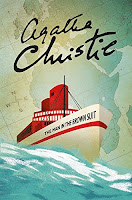
Setting Off For Adventure with Agatha Christie's The Man in the Brown Suit

Well, I’ve finally read my second Agatha Christie novel.

The Man in the Brown Suit (1924) was the January 2022 selection from the good folks over at AgathaChristie.com. It’s part of the Read Christie 2022 project. For the past two years, they’ve done something similar. This year, they’re focusing on Christie’ love of travel and selecting books with that theme.

I didn’t do the challenges the last two years, but opted to read this novel, Christie’s fourth book. Our lead heroine is Anne Beddingfeld, a young woman, on her own after her father passed away. With her whole life in front of her and with her mind swirling with the drive for adventure, young Anne finds all that and then some.

In a London subway station, Anne sees a man look at her in shock right before he plunges over the edge of the platform and dies. An odd-looking man swoops in to examine the body, claiming to be a doctor. But Anne questions the newcomer’s intentions. Couple that with a piece of paper dropped by the supposed doctor and Anne starts to see a mystery.

The mystery leads her to a ship bound for South Africa. On the ship, strange things occur and she’s introduced to a number of other characters. One is Sir Eustace Pedler, a member of Parliament, who brings with him a pair of secretaries, Guy Pagett and Harry Rayburn. Also of note is Colonel Race, supposedly of the British Secret Service, and Suzanne Blair, a married woman who befriends Anne on the voyage.

Lots of things happen on the boat and they continue when they get down to South Africa. It’s fascinating to read what was dubbed a thriller circa 1924 and compare it to what we think of as a thriller nowadays. Like many a mystery story set between the two world wars, there’s a quaintness to this novel. There’s the tendency of the bad guys to expostulate to the heroine, laying out the bad guy plan in detail. There’s the somewhat coincidental nature of some of the plot points, like what happens on the boat at night that just so happens to have Anne present.

Then there’s how the story itself is presented. A prologue shows us a few characters basically told from the author’s point of view. Then the novel switches to the narrative Anne writes herself. Spliced amid Anne’s reminiscences are those of Sir Eustace himself. It’s a clever trick because it enables Christie to show the reader certain things Anne and the others don’t know.

I’ll admit there was a time or two I’d have to think and remind myself which character Anne was referring to. I listened to a well-done narration by Emilia Fox and it wasn’t her fault. It was my own disjointed listening schedule. But by the time I was on the final homestretch, I was deeply into the story and barreled ahead until its conclusion.

And I rather enjoyed learning the identity of the mysterious antagonist nicknamed “The Colonel.” [No, it’s not Colonel Race. Christie obviously didn’t read all those how-to-write-a-mystery books in which you’re not supposed to name characters with similar names or titles.]

I enjoyed it, but it’s certainly not what I think of when I think of Agatha Christie. No Poirot, no Marple. But that’s likely the point of a reading adventure like the one planned for 2022. It looks like they’ll feature books that aren’t always on the top of people’s mind when they list favorites from the Queen of Mystery Fiction. Granted, the February book is Death on the Nile (to coincide with the new movie), a title I do know, but I’m looking forward to the rest of the selections throughout the year.

Wednesday, February 5, 2020

Orphan X Review - Not Your Typical Thriller Hero

For a few years now, the Orphan X series by Gregg Hurwitz, has been circling my radar. I'd download a sample onto my Kindle, but never get around to it. I'd see the second, third, and fourth books in the series be published, but still I didn't move off high center.

Until late last month.

In that timeless week between Christmas and New Year's Day, I was at the paperback racks at a Barnes and Noble in far west Houston and saw OUT OF THE DARK, the fourth volume in the series. My new standard for reading books is to read the book that captured my attention, no matter what number it is in the series. But when I realized it was an Orphan X novel, I was reminded that this series is one I should try.

From the beginning.

Evan Smoak - Not Your Typical Action Hero


If you read ten thrillers, how many of them open with the main character--or a side character--running? Seven? Eight? It's a perfectly acceptable trope for the genre, but I was happily surprised ORPHAN X didn't begin that way. True, Evan is bleeding from a knife wound and he's trying to get back to his apartment in Los Angeles, but there are no bad guys chasing him. Instead, we get a domestic scene with Evan trying not to show fellow tenants of his high-rise apartment he's bleeding. Not the nosy old lady nor the single mom who lives a few floors below. But her son suspects the truth. The entire tension of chapter one is whether or not Evan can make it up to his apartment without anyone noticing he's bleeding.

That is how ORPHAN X starts, and it makes all the difference.

It tells you that you're in for a different type of thriller, one I couldn't put my finger on until I saw Gregg Hurwitz at Houston's Murder by the Book on Monday.

A Normal Situation


Another thing Hurwitz does well is showing you what Evan's typical life is like. As an orphan, he was taken out of foster care and trained to be an off-the-books assassin. The kind with complete deniability. The only contact he has is his father-figure/trainer/teacher Jack Johns. For years, Jack trained Evan until--as we learn in the middle of the book--an even takes place that causes Evan to leave that life and disappear.

Now, he's the Nowhere Man, a man hiding in plain sight. Like the A-Team, if there's a person who needs help, all they have to do is call the special number: 1-855-2NOWHERE. Evan will help you. The only payment: pass his number--once--to another person who needs help.

Thus, the opening section of the book, we get an example of this "normal" life Evan has made for himself. You see him plan how he's going to help teenaged Morena, the terrible situation in which she and her younger sister find themselves, and how he goes about solving her problem. Intricate detail that reads fast and swift, never losing tension and anticipation.

It's when the next person calls--presumably Morena's pay-it-forward charge--that things really kick into a higher gear.

The Layers Unravel


Interspersed throughout the novel are flashbacks to Evan's training days and his early assignments. You get a deeper sense of what kind of man he is, what kind of person Jack Johns is, and how the two ultimately bring out nuances in each other both probably didn't expect.

I never saw the twists coming, which made for an even more entertaining read. It's no surprise--it's on the dust jacket--that some of the people after Evan are fellow Orphans, so he's not going up against run-of-the-mill thugs, but highly trained adversaries. Hurwitz, I learned on Monday night when I attended his author event, has done his research. But I already knew that. The details not only of the fighting but the weapons and accouterments are rich and descriptive.

Why is This Book So Good?


I knew going into the book the action would be good and thrilling. What surprised me, however, were the character moments. The time in the elevator I just mentioned. The times when he's having to worry about the bad guys and some busybody confronts him about not attending the HOA meeting. In addition, seeing Evan at home, in his apartment, what he did, what he drank, how he ate, all of that is there. I gravitated toward those moments just as much, if not more, than the action.

Why?

Well, on Monday night, Hurwitz commented that part of the genesis of Evan Smoak was the idea that you never saw James Bond go home.* You never saw Jason Bourne have an awkward conversation with regular folks.

That was the key to why I enjoyed ORPHAN X so much. That's why I'll keep reading the series.


*In the novel MOONRAKER (1954)--which is nothing like the 1979 movie--Ian Fleming writes a lot about Bond in the office, in his house, and playing cards. Not exactly pulse-pounding excitement, but wonderful to read. But the point Hurwitz is probably making is that none of the films show Bond in a normal setting. Not coincidentally, it is these scenes in MOONRAKER I remember well and hardly any of the larger plot. But hardly anyone remembers the original novel. You see? Hurwitz was onto something.


Click icon for more
book review blogs
@Barrie Summy

Tuesday, February 4, 2020

Gregg Hurwitz in Houston

Sometimes an author can deliver a sales pitch so good, you can't wait to see what he's talking about.

Gregg Hurwitz may be a new-to-me author, but I wasn't sure what to expect when he showed up at Houston's Murder by the Book on the first Monday in February. He was the author of twenty-one books--a fact on which he corrected me when I asked him  a pair of questions--so clearly many are reading.

Turned out the answer was a capacity crowd. By the time I walked in the door at 6:15 pm, there were no more seats. Didn't bother me. I have a standing desk at the day job, so I was perfectly fine with standing. I was even more excited to find stacks of the second Orphan X novel, THE NOWHERE MAN. You see, I'm new to Hurwitz's fiction and, as discussed in a prior post, was having the devil of a time securing a copy of the second book in the series. Leave it to Houston's best mystery bookstore to have my back.

The folks at Murder by the Book are nothing if not prompt, so a tad after 6:30, Hurwitz, dressed in black jeans, black shoes, and a black pullover took to the microphone. It's a never-ending trait of author events when you finally see these men and women in person, you realize they're just regular folks. You may be an engineer, a stay-at-home parent, a marketing writer, or an electrician, but these authors are just doing a job. Granted, their job is to make up stories for a living, but it still requires the nuts-and-bolts aspect of sitting down and hammering on a keyboard until they get to a 'the end.'

Hurwitz was the rare author who actually brought notes with him. It told me he was prepared for the evening and knew what he wanted to say. A professional, in short. Have to admire that.

His spiel centered on INTO THE FIRE, his newest novel and the fifth Orphan X novel to feature the character of Evan Smoak. He talked about where Evan finds himself at the novel opens, and the setup for the person who makes the fateful call to the Nowhere Man. Hurwitz discussed some of the returning characters, some I recognized having just read the first book in the series--ORPHAN X (my review)--and others I hadn't met yet.

I've only read the first book and it resonated with me. I knew why, but it was a phrase Hurwitz used that crystallized it: "We never see James Bond go home. We never see Jason Bourne have an awkward conversation." In short, we never see our famous professional killers in an everyday environment. It was that very aspect of ORPHAN X I loved the most. Sure, Evan was going to take out every bad guy he encounters no matter the personal cost, but his conversations with the old lady who lives in the apartment above him or the single mom a few floors below were some of my favorite parts.

After a short reading, Hurwitz took questions. It was cool to see a fellow Houstonian be recognized by the author by name. She was clearly a long-time fan. As an author myself, those are the best. She asked about the character Max (I think that's what she said) who is the one who calls on Evan for help in INTO THE FIRE. The new novel was released last Tuesday and clearly she'd already flown through it. She wasn't the only one. Hurwitz's answer focused on the difference between stories featuring a hero vs. a villain and a tale with a protagonist and an antagonist. There is a distinction. Remember: the best villains are the ones in which they think they're the hero of their own tale. There is room for nuance and character building. Conflict naturally comes from the clash of two protagonists who naturally become antagonists.

Late in the Q&A session, I got in two. The first was how he came to dream up and write ORPHAN X. At the time (2016), he had been writing professionally for over fifteen years. Did he always want to create a franchise character that would appeal to a broad audience? He answered by saying he dreamed up the concept of Evan Smoak years before the book was written and published, but he specifically wrote three other books in between. He needed Smoak to percolate in his mind. By the time he came to write the first book in the series, he and his talents were ready. The success of the series is proof that marinating with an idea can yield spectacular results.

Although I am new to Hurwitz's novels, it wasn't until I had finished ORPHAN X and did a little research that it finally clicked where I knew his name: he wrote Batman comics. I asked him how he got the Batman gig. His answer proved instructive to any creative, myself included.

After a brief stint at Marvel, DC Comics wooed Hurwitz with a tantalizing offer: you can write anything you want. Thinking of how THE KILLING JOKE is often referred to as the definitive Joker story, he wanted to write the definitive Penguin story. He got his chance, and, in 2011, PAIN AND PREJUDICE was released. The mini-series got good press and fan reaction that DC offered Hurwitz a writing gig for one of the monthly Batman books. By opting for a true passion project, new opportunities opened up.

I stayed in line, talking with some of the folks. A couple thanked me for asking the question about the comic books. They had no idea. Maybe they'll head to Bedrock City or Third Planet and track down Hurwitz's comics. One lady learned I was a writer as we discussed Hurwitz's material and I gave her my website address. Who knows? Maybe I gained a reader.

Hurtwitz certainly did. I've enjoyed witnessing my wife's reading habits. When she discovers and author with an extensive back catalog, she plows through them all. Now I've found one myself. Twenty more books to go.

I got Hurwitz's signature in THE NOWHERE MAN and am eager to read it. I really enjoy Evan Smoak as a character and Hurwitz's writing style. Then there's that one intriguing little thing Hurwitz mentioned about the end of INTO THE DARK that hooked me even more: "The last three words change everything."

How's that for a sales pitch?

Sunday, July 1, 2018

The President is Missing by Bill Clinton and James Patterson

Almost from the day it was announced, I knew I wanted to read THE PRESIDENT IS MISSING by Bill Clinton and James Patterson. On the one hand you have one of the all-time best-selling authors who has created his own fiction factory. On the other, you have a former president who served for eight years in the office and could provide vital details as only a man who sat in the Oval Office could. It was a match made in heaven.

But would the book be any good?

It’s an honest question, but let’s be honest: if it’s got Patterson’s name on it, the story will at least be serviceable.

And I’m here to tell you it’s more than serviceable. It’s pretty darn good.

The story opens as President Jonathan Lincoln Duncan, newly widowed, is facing the prospect of a compelled testimony in front of a Congressional committee. Impeachment is in the air because Duncan recently ordered a special forces raid seemingly to save notorious terrorist Suliman Cindoruk, leader of the Sons of Jihad group. The Speaker of the House—a member of the unnamed ‘other party’; Duncan’s party affiliation also remains unnamed making it more bipartisan—who has designs on the presidency smells blood.

But Duncan has an even greater problem. Somehow, Suliman’s cyber hackers have implanted a virus in the computer systems of the Pentagon. Codenamed “Dark Ages,” if released, the resulting damage would be catastrophic. It would literally plunge the US into a modern dark ages. And one of six members of Duncan’s inner circle—including the Vice President—is a traitor because a young girl from the Republic of Georgia is asking to meet with Duncan. Alone. And she utters “Dark Ages” to prove her point.

How could this young woman know that? Who is she? And, after Duncan goes incognito and meets at the baseball stadium, who is this other guy pointing a gun at the President of the United States?

THE PRESIDENT IS MISSING clocks in at over 500 pages, but they read extremely fast. Duncan’s prose is all in first person and the entire novel is written in the present tense, giving it an urgency. Having Duncan narrate his own scenes is great, especially with his asides when he gives details you know came from Bill Clinton’s memories. There are other characters and all those scenes are related in third person. It’s the first time I can remember reading a book like this. Granted, as a writer, I noticed the differences at first, but as the story went on and my reading speed increased, it faded away and I was solely in the action.

By now, Patterson is a master at crafting a story and, while I’ve read few, I could see how one of his stories is made. And I really loved how the tension was racketed up. Sure, there were lots of cliffhanger chapter endings, but this is a summer thriller. It’s supposed to have cliffhangers.

And there was one passage of about five chapters that completely fooled me. I thought one thing was happening and it was something else entirely. Much like watching “The Sixth Sense” a second time when you know the truth, I re-read those chapters just to see how Patterson did it. Brilliant. Also brilliant was the skillful way Patterson kept the truth behind the traitor and other characters, revealing their identity at precisely the right time. This guy can tell stories!

I purchased this book from my local grocery store and I pointed out something to some friends who noticed the book in my basket. I indicated all the other Patterson novels on display—eight?—and then at THE PRESIDENT IS MISSING. Patterson’s name was listed on top of all save the new one. It takes a president’s name to shift Patterson to second billing.

I very much enjoyed this book and would easily recommend it as a good beach read.

Saturday, April 7, 2018

A Writer Becomes a Hero: True Fiction by Lee Goldberg

Many times, we writers invent characters to project our greatest fantasies upon. Wish you were a World War II spy? Invent one. Wish you were a dashing hero in a romance? Invent one. So it came as a fun surprise when writer Lee Goldberg created a different kind of hero: a writer.

As a huge fan of the TV show “Castle,” I’m fine with lead characters being writers. Ditto for any number of Stephen King books. What makes Ian Ludlow different (albeit slightly) is that he doesn’t suddenly become a stud. Say what you will about Castle, but he became more adept at handling situations the longer the seasons went on, despite his constant man-child behavior. Ludlow doesn’t. Granted, this is his first adventure, so who knows what’s down the road for him.

Years before the opening scene of TRUE FICTION, Ludlow and a few other writers were recruited to dream up scenarios that terrorists might deploy to inflict huge amounts of damage to the US or US assets. Ludlow’s brainstorm was a plane crashing into buildings, not in a well-populated city like Houston or Denver or Los Angeles but Waikiki, Hawaii. The definition of paradise. Ludlow thought nothing of the experiment…until a plane is hijacked and crashes into a hotel in Waikiki.

Immediately, Ludlow knows he’d likely be a target. And when the other members of his secret writing group turn up dead, it is confirmed. Margo, the grad student assigned to drive Ludlow around Seattle on his book signing, quickly gets swept up in the action and the pair must escape the attempts by the secret agency who launched the attack.

Goldberg keeps the action moving along at quite a pace as befitting a thriller. But he manages to inject some humanity into Ludlow, who, more than once, wishes he was Clint Straker, the uber-hero of his own novels. Those moments are rather humorous, especially when Margo keeps reminding him of his inadequacies. And the humor sprinkled throughout the book made me chuckle more than once.

TRUE FICTION is a fun romp of a book that’ll keep you entertained from the first word to end.

Recommended.

Tuesday, November 14, 2017

Get ON With It

Twenty two chapters.

What does that mean for us this morning? That’s the number of chapters it took for the action to get started in Dan Brown’s latest novel, ORIGIN. Heck, I’m not even sure that’s the exact answer—it might have been twenty three or twenty one, but I just don’t care enough to toggle back in my Audible file to find the answer because it’s beside the point.

What happened for all that time up until Chapter Twenty Two? Talking. Lots and lots of talking. And even after the action gets started, there is more talking. Lots of talking. Mini lectures, actually. It’s almost like a Michael Crichton novel. I have a distinct memory of reading RISING SUN and, every now and then, I’d turn the page and there’s be wall-to-wall text and I knew I was in for a mini lecture. Heck, Crichton even had footnotes. At least Brown mostly put his lectures—but not all—in the form of dialogue.

I never disliked Dan Brown. I was one of those millions of readers who jumped on the THE DA VINCI CODE bandwagon. That was a thrilling book. Think about it. In that book, chapter one showed a murder and introduced the bad guy, chapter two introduced hero Robert Langdon, and we were off and running. I even diagrammed the first 100 pages of DA VINCI CODE to see how Brown made it work. It was an “aha” moment.

From there, I happily jumped back to ANGELS AND DEMONS and enjoyed it. In some ways, it was better than DA VINCI CODE. I read THE LOST SYMBOL (AKA, “Da Vinci Code in America”), but something must have happened because I completely bypassed INFERNO. For whatever reason, I felt the tug of ORIGIN and, with a new, long commute, I thought “why not?” With the audiobook clocking in at eighteen hours, it would certainly get me through a week or two.

I lasted for about twelve hours before I bumped up the speaking speed to 1.25.  At least then I’d be able to get through the novel in a shorter amount of time. I’m not even done (about three hours until the end) and I’m more or less still listening because I at least want to know the big reveal at the end.

But come on! If the book is supposed to be a thrill ride of a story, put some thrills in it. And speed up the pace. I’m not advocating Brown write a pulp fiction novel. He’s got something to say and has clearly done a lot of research—most likely, it all found its way into the text. But at least Crichton put lots of chases and escapes in his stories. They were exciting to read. Heck, DA VINCI CODE was an exciting and thrilling read. ORIGIN is simply dull.

Maybe the ending will be worth it. We’ll find out.

Coincidentally, in my science fiction book club, Frank Miller’s Dark Knight III: Master Race was selected. This is yet another sequel to his seminal 1986 work, The Dark Knight Returns, a fantastic graphic novel. I intentionally bypassed DKIII because I so loathed The Dark Knight Strikes Again (or whatever the second book was called). With that book, I got the distinct impression the good folks at DC Comics didn’t care what Miller produced as long as he gave them something they could sell. One might argue he didn’t really have an editor, because if he did, some of the stuff he threw in would have been chopped.

Same with Dan Brown, at least with ORIGIN. There’s a story here, but it is one that should have been tightened up, trimmed down, and streamlined. Maybe he’s of a particular stature now that he can pretty much write whatever he wants and it’ll get published. Maybe not, but if  you’re an author who writes a chase book, please start the action way before chapter twenty two.

*UPDATE*

I finished the book on Sunday. I'm not one to write a full review of a book I didn't like and I'm not gonna start now. But of the four Dan Brown books I've read, this is fourth on the list. I suppose there was a reason I skipped INFERNO. Now I know. 

Tuesday, June 14, 2016

Book Review: The Emperor's Revenge by Clive Cussler

053116_Emperors-Revenge-Oregon-Files-Clive-Cussler-Novels_199x300Sometimes it pays to read to the last sentence.

Clive Cussler has the type of literary output I aim to mimic. It started with the Dirk Pitt adventures and, over the years, Cussler has expanded his series to include the Oregon Files, the NUMA files, the Fargo Adventures and the Isaac Bell series. The first four all take place in contemporary times. The Isaac Bell series, my true introduction to Cussler’s works, is by far my favorite mainly because it is set in the early 20th Century.

Now comes THE EMPEROR’S REVENGE, the latest in the Oregon Files series. It’s the 11th book in the series, but my first. This series focuses on Juan Cabrillo, the captain of a fancy ship, the Oregon. On the outside, this ship looks like a hunk of junk, a trawler that wouldn’t normally catch the eye of any bad guy. Underneath, the Oregon is the top-of-the-line military ship equipped with all the latest technology and weapons. Cabrillo commands a group of folks who work as a team called the Corporation, a secret sub-group of the CIA.

I would have eventually gotten around to the Oregon Files series, but what jumpstarted my interest was reading my first NUMA book, THE PHARAOH’S CURSE earlier this spring. In that book, those main characters—Kurt Austin and company—got into a gunfight. In the middle of all that, Juan Cabrillo and one of his men show up. Each team tells the other team the Thing each need to know and then they went on their way. How cool is that! It was basically a little marketing ploy to get interested readers to buy THE EMPEROR’S REVENGE, which was publish three months after PHARAOH’S SECRET. It worked for me.

So what is EMPEROR’S REVENGE about? As in most of Cussler’s modern-day thrillers, the story opens in the past, namely 1821 and Napoleon Bonaparte. That’ll clue you in on whom the “emperor” is. Turns out, Napoleon escaped his exile at St. Helena taking with him secret messages from handwritten notes. Cut to the present day and Juan Cabillo and his team are on a mission. At the conclusion of the mission, he receives word of the events at the Monaco Grand Prix. It seems there was a huge accident that was used to cover-up something worse: a bank heist. Not something that might land on the Corporation’s radar until the truth is revealed: all the Corporation’s money was among the cash looted from the bank.

Now the story is personal.

What follows is Juan’s investigation into the bank heist. He and his team are assisted by Gretchen, a former partner of Juan’s and his “wife” on a previous mission. Needless to say, sparks fly, and not just from the bullets ricocheting off everything during gun fights.

To say that EMPEROR’S REVENGE follows standard thriller pacing sounds like a bad thing, but it isn’t. The pacing is nice and steady. The revelation of the bad guy, who makes up his team, and what he’s after is delivered piecemeal and in nice chunks. I enjoyed the story, the build-up, and the character moments. I suspect readers who have read the ten previous books will get more inside jokes, but as a newbie to this series, this book was just fine.

Long ago, if there was a new book (like EMPEROR’S REVENGE) that caught my eye and I learned it was a series, I’d always go back to book one and plow through the series. But I’d often get burned out and actually never get to the book with the cool cover that got my attention. I’ve chunked that reading style. Now, I read the current book. If I like it, I’ll go back. It seems that there’s a new Oregon File book every year so I have a decade’s worth of material to read.

I listened to the book by the brilliant narrator Scott Brick. He reads almost every series by Cussler, especially the Isaac Bell ones. Brick has a touch of whimsy to his voice and cadence that propels the stories, like EMPEROR’S REVENGE, along in a special way. Seriously, Brick could read the LA phonebook and I’d pay to listen. He’s that good.

Oh, and read until the last sentence…

What I Learned as a Reader:

Back in my original blog, I’d always end reviews with this and I thought I’d apply it here.

In Chapter 1, all the characters are introduced. For longtime readers, this is old hat. For newbies like me, it’s perfect. Each character gets a sentence or two of backstory and a trait. The prose makes each person on the team easily identifiable. From then on, through the rest of the book, I know what these characters look like and act like. I try to do that in my own writing, but it’s great to see how longtime professional like Cussler and Boyd Morrison do it.

Saturday, October 10, 2009

Book Review: The Lost Symbol by Dan Brown

How is Dan Brown like the rock musician Sting? Head on over to Do Some Damage and check out my review of The Lost Symbol for the answer.

Tuesday, August 4, 2009

Book Review Club: Trust Me by Jeff Abbott

(This is the August entry in Barrie Summy’s Book Review Club. For the complete list, click the icon at the end of this review.)

Sometimes, summer blockbusters don’t arrive in theaters. Sometimes, they show up at your bookstore. Jeff Abbott’s Trust Me is a summer blockbuster worthy of the name.

Like many a thriller, Trust Me starts with the bad guys. There are two men, one old and one dressed in a gray suit. They are in a park in London and they are discussing how many terrorists attacks they could unleash with the fifty million dollars the old man, a Middle Eastern prince, is giving to the man in the gray suit. Unbeknownst to them, a third party is there, a lady named Jane, listening in. Armed with this new knowledge, she telephones someone and says, “We start tonight. Rock and roll.”

Rock and roll is certainly one way of describing the intense action of the rest of the book. At the center of all this rocking and rolling is Luke Dantry, a twenty-four-year-old University of Texas graduate student. He’s a psychology major and has been helping his step-father—Henry Shawcross, his only living relative after his parents died in two separate accidents—conduct research into extremists groups on the Internet. Specifically, they want to find the radical folks online who may be the next Timothy McVeigh, people who will take their ranting to the next level. After a brief visit by Henry in which Luke delivers the latest reports on these online nut cases, Luke takes his step-father to the airport. On the way back to his car, Luke finds a gun in his ribs. Now, he’s kidnapped.

A desperate man, Eric, tells him to drive to Houston. Bit by bit, Luke learns that he is to be the ransom for Eric’s girlfriend. Chained to a bed in a cabin in the middle of the east Texas woods, Luke has to escape and stay out of the hands of the bad guys as well as the police who want him in connection with the murder of a homeless man, a man Eric shot and Luke witnessed.

The chase is on. From Houston to Chicago to New York to Paris, Luke has to stay one step ahead of the authorities and the members of the mysterious Night Road, the group of extremists whose sole desire is to inflict damage upon America. They’ve already started, too. An explosion near Houston is linked to other acts of terror across the country. Luke knows they are tied together and he must figure out a way to stop it while simultaneously clear his name.

As a writer, the structure of Abbott’s book was fantastic. In multiple POVs, we readers are privy to everything. We know the identity of the hired guns sent to the cabin to fetch Luke. We know what they’re thinking and what they don’t know. Later on in the novel, we know things Luke has to find out for himself. I usually write my stories with a limited POV, allowing the mysterious things to remain unknown until the main character learns about them at the same time as the reader. Abbott’s approach ups the intensity and tension. We know who is coming for Luke, even if he doesn’t. Armed with our omniscient viewpoint, we know the hired killers are bad, bad people and Luke best get out of whatever situation he’s in.

Luke is a regular guy. He’s not Jack Bauer or James Bond or Jason Bourne and he doesn’t have a name that starts with “J.” Abbott allows Luke’s logical brain to run through each scenario, putting together plans and contingencies, trying to find a way out of the nightmare in which he finds himself. It’s that normalness, that sense of This-Can’t-Be-Happening-To-Me, that grounds Trust Me. In the world of the fantastic, you get the sense that it could possible happen, even to you.

Luke’s progress throughout the book, from the young, innocent university student to what he becomes in the end, is evenly paced and believable. It’s not like, say, Catwoman in the 1992 movie “Batman Returns,” where one day she’s a secretary and the next she knows how to fight. Luke’s learns the hard way, usually with great pain and suffering. He’s put through the ringer and he’s damaged.

The pace of Trust Me is pretty relentless, an essential component in a thriller. The number one thing that propels the prose of the story is Abbott’s use of “Pulp Words.” You know what I’m talking about: one character “slithers” through mud; another has thoughts that “boom” in his head. Action words, words designed to punch the reader in the face at the same time describe non-stop action. I found myself smiling throughout the entire book as I would guess what sentence came next, the words I’d have chosen, and the better words Abbott chose.

A word about the audiobook. I listened to this story and the reader, Luke Daniels, did a great job of doing the different voices. The thing about audio books is that if the reader is good, the attributions (he said; she said) are not necessary. You can hear the difference. Part of the way through the book, a character says something. On the page, it’s just dialogue and you don’t know who said it. Abbott intended it this way. On the audio, however, the reader has to use the voice of the character. Thus, as an audio listener, when the identity of said character is revealed late in the novel, I already knew who it was. That’s my only con about audio books.

Trust Me is the first book I’ve read by Jeff Abbott. I’m a regular reader of his blog and have begun to put into place some of the writing habits he blogs about in his “Organized Writer” posts. Without a doubt, I’ll be reading more Abbott books. If you’ve got a hankering for a thrill-a-minute rush equal to or better than most things in the theaters this summer, Trust Me is it.


Click icon for more
book review blogs
@Barrie Summy