Showing posts with label Presidents. Show all posts

Wednesday, June 17, 2020

History Comes Alive With The Lincoln Conspiracy

There's a moment in The Lincoln Conspiracy: The Secret Plot to Killed America's 16th President - and Why It Failed where the President-elect hears dire warnings from two independent sources that his life is in danger and he takes action. He agrees to sneak out of a pre-Inauguration Day party in Harrisburg, Pennsylvania, don a disguise, and be whisked away by train, all in an effort to thwart the plot to kill him in Baltimore. That moment consists of me breathlessly wondering: Is he gonna make it?

It's been 155 years since his death. There's a giant statue of President Lincoln in Washington, He's on the penny. He's one of the most famous Americans of all time. He might be recognized in nearly every corner of the world here in 2020. Of course he makes it.

But that's the testament to the writing skill of Brad Meltzer and Josh Mensch: they weave the story and the details in such a way as to make history read like a thriller. And dang if this story won't thrill you.

We all know Lincoln's ultimate fate on Good Friday, 1865, but few know of the first plot to kill him before he even took office. I'll admit I learned about it back in grad school at the University of North Texas but it was only in passing. I knew it was foiled and that private detective Allan Pinkerton played a key role. But I never knew the details that fill over 350 pages in this remarkable book.

Much like they did with The First Conspiracy: The Secret Plot to Kill George Washington (2019), Meltzer and Mensch dig deep into the details of this 1861 plan hatched by a cabal of Southern loyalists. They didn't want the president-elect—who carried no slave-holding states in the recent election—to take his place in the White House. At the time, the Republican Party was against the institution of slavery even if Lincoln himself tried to steer a narrow line between free and slave.

Following a tradition dating back to America's first president, Lincoln traveled from his home in Springville, Illinois, to Washington, D.C., in the weeks leading up to his inauguration. Two things gave the Southerners fuel for their plot: Lincoln's itinerary was published in many papers and the rail-splitter from the west would have to change trains in Baltimore. What made this transfer problematic was not only was Maryland a slave state, but the transfer wasn't merely changing trains in a single station. No, this change from one rail line to another involved literally moving a train car about a mile from one station to the next. In that time, with the expected throngs of Southern sympathizers clogging the streets, the president-elect's life would be in jeopardy.

Hired by one of the railroad men to protect threats against the railroad, Pinkerton and one of his agents, Kate Warne, uncovered the real plot. It was then Pinkerton urged Lincoln to change his plans. The new president demurred until a fateful night when word of the plot arrived from his recent rival and future Secretary of State, William Seward. Convinced of the threat, Lincoln finally allowed himself to be disguised and sneak into the nation's capital under the cover of darkness.

Like they did with their Washington book, Meltzer and Mensch write their prose in the present tense. It gives the story an immediacy, a will-he or won't-he vibe that's pretty darn exciting. Often, they'll recount a scene and then cut to a contemporary scene in another part of the country. You really get a bird's eye view of the whole situation.

If you are a fan of audiobook, preeminent narrator, Scott Brick, reads the book. He could read the phonebook and I'd pay to hear it. He narrates everything he does so well, and I especially like the timbre of his voice as he reaches the end of the book and reads the last lines from Meltzer and Mensch.

History isn't just names and dates, laws and wars, pop culture and events. It is people, real people, living their lives and making decisions based on the best knowledge they have at any given time. Some decisions are momentous: the outcome of the 1861 election, the secession of the Southern states, the foiled assassination in 1861 and the successful one four years later. This book peels away some of the veneer Lincoln now lives with in the American imagination in the 155 years since his death, showing us a real guy, beset by personal and national tragedy, who is doing the best he can. Ditto for Pinkerton, Warne, and the Southerners.

Books like these breathe life into history, and as a historian, we need more books like this so folks in the 21st Century can be entertained and learn a little something along the way.

Highly recommended.

Friday, May 29, 2020

Grant the Mini-Series – A Popular Reassessment

As soon as I saw the commercials for History TV's mini-series, “Grant,” I knew I wanted to watch it. The big name attached to the project—Leonardo DiCaprio—wasn’t the draw. For me, it was the sight of actor Justin Salinger dressed as Ulysses S. Grant. From just the commercial, it felt like the 18th President was again alive.


The excellent casting was a harbinger of how good this documentary is. Based on Ron Chernow’s 2017 biography, Grant, the six-hour mini-series examines the life of the hardscrabble man from Ohio via a series of on-camera historians discussing various aspects of the man and reenactments featuring Salinger. The high production values are on full display for most of these reenactments, especially the one involving the Civil War. It makes you want more. I could have easily watched another six hours.

The vast majority of the six-hour running time naturally is devoted to the war. What I especially appreciated was the reassessment of Chernow’s biography on full display here in this mini-series—not surprising considering he wrote the screenplay. I’m a degreed historian who wrote a thesis about the Civil War, but even I didn’t remember all the modernity Grant brought to bear when he assumed command of the Army of the Potomac in 1864. As Chernow and the historians note, Grant was the first modern general, one who could see the entire battlefield (nearly encompassing half a continent) and act in concert. I’ve often thought that had some of the generals from World War I learned lessons from the American Civil War, fewer soldier would have died in The Great War.

Winston Churchill remarked once that Americans can be counted on to do the right thing after every other option failed. Chernow made the point that Grant, having been a failure in his early military life and his civilian life before 1861, was almost the perfect choice for Abraham Lincoln. Unlike other generals, Grant had the fortitude to try something. If it failed, he tried something else. But at least he tried. True, failures from a general meant death, but it was war after all. I found it a nice reminder that for all the talk of Grant being a butcher, his losses often were less than Robert E. Lee’s.

As interesting as his war years are, I would have enjoyed more from his presidential years. That’s the forgotten part of Grant’s history. So many of us—if we remember Grant’s two-term presidency at all—think of the scandals, but there was so much more to it than that. The historians touched on major points, but I wanted more. Which, naturally, led me back to Chernow’s book. If you are reading this on the day I post this (29 May 2020), the Kindle edition is only $1.99. That’s two bucks for a thousand page biography.

But as the show ended, a remarkable thing occurred: I grew sad and somber. Mixed with Grant’s heroic struggle to keep the cancer at bay while writing his memoirs, the historians discussed how Grant’s admirable personal reputation has been diminished—sometimes actively—in the century and a half since Appomattox. I’m not sure why and how Chernow selected Grant as his subject, but I’m very appreciative that a reassessment has started.

And this mini-series is broadening the audience. It’s very well done and highly recommended.

Thursday, August 1, 2019

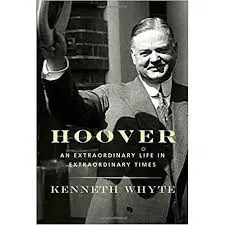
Hoover by Kenneth Whyte

Even to a historian, Herbert Hoover was a mystery.

Before reading Kenneth Whyte’s new biography of our 31st president, Hoover: An Extraordinary Life in Extraordinary Times, I knew three general things about Hoover. After World War I, he was instrumental in helping Europe feed itself and get back on its collective feet. As Secretary of Commerce from 1921 to 1929, he helped steer the American economy to high levels before the Stock Market Crash of 1929. And, as president, he was unable to stem the tide of Depression. On that last point, I had the general impression Hoover did little other than to say the Depression was just the way of business. It was only when Franklin Roosevelt came into office that the American government possessed a man willing to try anything to help.

But as I listened to the book and read about his energetic performance in just about everything he put himself into, a question began to form: what went wrong during his presidential administration? That is, didn’t Herbert Hoover try to help people?
When one reads a biography of a famous figure, generally you find things you like and can admire. Funny thing with Hoover: he was a peculiar man and, at least until his later life, an almost shy person who didn’t always enjoy the company of some people. In fact, during the early years of this biography, I got to thinking Hoover wouldn’t always be a guy with whom you’d want to just hang out. He was just peculiar. Even his marriage seemed rather perfunctory. The more the biography went on, the more it seemed, as the author noted, Hoover was a mere spectator of his own family.

Yet his engineering mind was fantastic. He worked all over the world which gave him a global perspective on things. In one of the more remarkable events I admired, it took Hoover, then living in London, barely a day to start setting up a group to help stranded American caught unawares at the outbreak of World War I. Many folks were stranded with no means to obtain money to buy a ticket back to America. Hoover started up a committee and did the thing he almost always insisted on: make him the one decision maker and leader. In this capacity, he was able to direct resources where needed and helped get over 100,000 Americans back home.

He repeated the feat during the war as he headed another committee to aid in relief of hungry Belgians. What I found fascinating was Hoover’s group, The American Relief Administration, was the only group recognized by both sides of the war. Each side allowed Hoover’s ships—flying its own flag—through enemy lines.

He was a data-driven man in an era just beginning to understand what data was and how it could be used. As Secretary of Commerce (and “under-secretary of everything else” as his detractors said), Hoover took an activist role in government. President Harding encouraged this and, when Coolidge assumed the office, kept Hoover on. He was in prime position to bring his expertise to American when the Mississippi River flooded in 1927. There Hoover was, on the ground, doing what he was most able to do: harness the goodwill of people and direct it to those in need.

He was a logical choice as the Republican nominee in 1928, and he won easily. His help to the poor in 1927 brought a large majority of Americans to his side in addition to the typical GOP voter. In an era of the Roaring Twenties, everyone seemed to like Hoover. Yet the man himself saw the warning signs looming on the horizon. He tried to thwart a potential downturn as Commerce Secretary, but others didn’t share his views. When the crash arrived, Herbert Hoover did what he had always done: gather a team with mounds of data and attack the problem.

It was here where I had my eyes opened. Rather than be the man who seemed to sit idly by waiting for the market to correct itself, Hoover actively pursued solutions. Sure, his personality wasn’t suited to leading the country in its most dire time before World War II, but he wasn’t a bystander. True, he preferred the government not to actively intervene if at all possible. He extolled the virtues of volunteerism, by individuals as well as businesses, seeing it as the best way for Americans to get back on their feet. But when businesses didn’t respond, he led the way. Not all his policies worked—the notorious Smoot-Hawley Tariff being the most famous example—but it is easy to see how Hoover paved the way for the direct government intervention of the Roosevelt years.

It is a rare figure where both sides of the political spectrum can claim a man as their own. The Progressives saw in Hoover a man willing to try things and have, as his ultimate aim, the betterment of his fellow Americans (and humans, as per his work prior to his government service). At the same time, the modern conservative movement can also claim Hoover as their own. After his defeat in 1932, he became a critic of what he saw as the overreach of FDR, and laid down a philosophy picked up by other conservatives in the 1950s and 1960s.

Herbert Hoover was a complicated man, yet there was more to him than meets the eye (or is contained in a Wikipedia article). He was certainly far from perfect and Americans needed a leader more personable than him during the Depression, but Hoover was a more-than-capable man who stands as a unique member of the American presidency. Whyte’s new biography is a fascinating exploration into a man hard to pin down, but is well worth the time.

Friday, July 19, 2019

American Moonshot: John F. Kennedy and the Great Space Race by Douglas Brinkley

I am a degreed historian with a knack for remembering dates of historical events. As 2019 dawned, I knew we'd hit the fiftieth anniversary of the moon landing this summer. Tomorrow. I also knew there'd be a slew of new historical accounts published to commemorate that momentous giant leap for mankind. Which one to read? When I saw noted historian Douglas Brinkley's name among the list, I made my decision.

American Moonshot: John F. Kennedy and the Great Space Race isn't necessarily a play-by-play of all the steps the United States took to land Neil Armstrong and Buzz Aldrin on the moon fifty years ago. Instead, it is more a political biography of two men--John Kennedy and German Wernher von Braun--as they both came of age in Depression and war. Most of us know the basics of Kennedy's life history, but Brinkely zeroes in on space and the filter through which he described Kennedy's life. What did he think about Sputnik? Where was he when Yuri Gagarin was the first man in space? What did Kennedy really think about space?

Which made for a fascinating way to examine Kennedy's experiences and how he came around to seeing the moonshot as a Cold War technique to use against the Soviet Union. Late in the book, Brinkley wrote one of Kennedy's defenses of the massive amount of money spent to land men on the moon was worth it considering the alternative--a shooting war against the Soviets, if not nuclear war itself--was too horrible to contemplate.

Von Braun, on the other hand, was more of a mystery to me. I first read about him in James Michener's novel, Space (1982), and again earlier this year when I read Apollo 8: The Thrilling Story of the First Mission to the Moon by Jeffrey Kluge. His story was a troubled one. With eyes on the skies and dreams of sending rockets and men to the moon, von Braun, in Brinkley's words, made the Faustian bargain in World War II, to build the V-2 rockets with slave labor, the end results of which were the deaths of civilians when those rockets were launched against England. Sure, von Braun was a crucial member of the NASA team in the 1960s to engineer the Saturn V rocket and an constant cheerleader for the importance of the moonshot, but at what cost? Did it even out his activities in the war? Should it? Still, it was interesting to learn more about him and the relationship he and Kennedy formed.

Speaking of relationships, what I most enjoyed was the descriptions of the camaraderie Kennedy formed with the Mercury 7 astronauts. I had always seen photos of him with them, but never knew how close some of them became with the president. Which made his assassination much more personal. Brinkley described where each of the astronauts were when they learned of Kennedy's death. For most of them, it was the radio.

As a native of Space City, USA, I have always been keenly aware of the role Houston played in the history of NASA and space exploration. Some of my favorite parts of Brinkley's book was the discussion of Houston and the surrounding areas during the 1960s. If Armstrong took the one giant leap for mankind, then the manned space program was Houston's leap forward.

Brinkley went on to write the great irony of Kennedy's death helped NASA get the funding it needed to land Armstrong and Aldrin on the moon in 1969. President Lyndon Johnson felt no problem with using Kennedy's vision, as set forth in a pair of 1961 speeches, to get the money. Was it worth it? Johnson himself, as vice president, delivered a report which laid out all the ancillary benefits humankind could reap as a result of doing what it took to put men on the moon.

Think about this: the device you're using to read this review is likely a cell phone. That computer-in-your-palm is exponentially more powerful than the computers used to shepherd Apollo 11 to the moon. The GPS system we all use to get us to where we want to go is a result of the space race. Might we have eventually got to the moon and invented all this technology without the great race? Most likely, but the pace would have been much slower.

There are lots of books that discuss the engineering feats needed to land the Eagle in the Sea of Tranquility fifty years ago tomorrow, including all the intricate details of all the various Mercury, Gemini and Apollo missions. But if you want the political version of that story centered on one man who saw the potential of a victorious moon landing for us here on Earth, then American Moonshot by Douglas Brinkley is a good recommendation.

Tuesday, August 14, 2018

Hoover by Kenneth Whyte

Even to a historian, Herbert Hoover was a mystery.

Before reading Kenneth Whyte’s new biography of our 31st president, Hoover: An Extraordinary Life in Extraordinary Times, I knew three general things about Hoover. After World War I, he was instrumental in helping Europe feed itself and get back on its collective feet. As Secretary of Commerce from 1921 to 1929, he helped steer the American economy to high levels before the Stock Market Crash of 1929. And, as president, he was unable to stem the tide of Depression. On that last point, I had the general impression Hoover did little other than to say the Depression was just the way of business. It was only when Franklin Roosevelt came into office that the American government possessed a man willing to try anything to help.

But as I listened to the book and read about his energetic performance in just about everything he put himself into, a question began to form: what went wrong during his presidential administration? That is, didn’t Herbert Hoover try to help people?
When one reads a biography of a famous figure, generally you find things you like and can admire. Funny thing with Hoover: he was a peculiar man and, at least until his later life, an almost shy person who didn’t always enjoy the company of some people. In fact, during the early years of this biography, I got to thinking Hoover wouldn’t always be a guy with whom you’d want to just hang out. He was just peculiar. Even his marriage seemed rather perfunctory. The more the biography went on, the more it seemed, as the author noted, Hoover was a mere spectator of his own family.

Yet his engineering mind was fantastic. He worked all over the world which gave him a global perspective on things. In one of the more remarkable events I admired, it took Hoover, then living in London, barely a day to start setting up a group to help stranded American caught unawares at the outbreak of World War I. Many folks were stranded with no means to obtain money to buy a ticket back to America. Hoover started up a committee and did the thing he almost always insisted on: make him the one decision maker and leader. In this capacity, he was able to direct resources where needed and helped get over 100,000 Americans back home.
He repeated the feat during the war as he headed another committee to aid in relief of hungry Belgians. What I found fascinating was Hoover’s group, The American Relief Administration, was the only group recognized by both sides of the war. Each side allowed Hoover’s ships—flying its own flag—through enemy lines.

He was a data-driven man in an era just beginning to understand what data was and how it could be used. As Secretary of Commerce (and “under-secretary of everything else” as his detractors said), Hoover took an activist role in government. President Harding encouraged this and, when Coolidge assumed the office, kept Hoover on. He was in prime position to bring his expertise to American when the Mississippi River flooded in 1927. There Hoover was, on the ground, doing what he was most able to do: harness the goodwill of people and direct it to those in need.

He was a logical choice as the Republican nominee in 1928, and he won easily. His help to the poor in 1927 brought a large majority of Americans to his side in addition to the typical GOP voter. In an era of the Roaring Twenties, everyone seemed to like Hoover. Yet the man himself saw the warning signs looming on the horizon. He tried to thwart a potential downturn as Commerce Secretary, but others didn’t share his views. When the crash arrived, Herbert Hoover did what he had always done: gather a team with mounds of data and attack the problem.

It was here where I had my eyes opened. Rather than be the man who seemed to sit idly by waiting for the market to correct itself, Hoover actively pursued solutions. Sure, his personality wasn’t suited to leading the country in its most dire time before World War II, but he wasn’t a bystander. True, he preferred the government not to actively intervene if at all possible. He extolled the virtues of volunteerism, by individuals as well as businesses, seeing it as the best way for Americans to get back on their feet. But when businesses didn’t respond, he led the way. Not all his policies worked—the notorious Smoot-Hawley Tariff being the most famous example—but it is easy to see how Hoover paved the way for the direct government intervention of the Roosevelt years.

It is a rare figure where both sides of the political spectrum can claim a man as their own. The Progressives saw in Hoover a man willing to try things and have, as his ultimate aim, the betterment of his fellow Americans (and humans, as per his work prior to his government service). At the same time, the modern conservative movement can also claim Hoover as their own. After his defeat in 1932, he became a critic of what he saw as the overreach of FDR, and laid down a philosophy picked up by other conservatives in the 1950s and 1960s.

Herbert Hoover was a complicated man, yet there was more to him than meets the eye (or is contained in a Wikipedia article). He was certainly far from perfect and Americans needed a leader more personable than him during the Depression, but Hoover was a more-than-capable man who stands as a unique member of the American presidency. Whyte’s new biography is a fascinating exploration into a man hard to pin down, but is well worth the time.