When did characters in stories become self-aware of all the story tropes they are in and comment on those tropes during the story? In short, when did characters become meta?
I’m not quite sure how to pose this question so let me tell you how I got there.
In my SF book club this month, we discussed John Scalzi’s the Kaiju Preservation Society. It is a wonderful B-movie concept: there is an alternate earth where kaiju (i.e., giant creatures like Godzilla) developed and humans did not. The humans from our earth can travel between worlds and said humans study the kaiju and, well, preserve them.
The story takes place in early 2020 and is populated by a bunch of characters, most of whom are nerds. As such, they say and understand a ton of SF in-jokes, jokes that most of Scalzi’s readers will also get. Not a problem. It’s like writing for the choir.
But one of the book club guys made a point: at no time in the book did any of the characters have a Wow Moment, a sense of wonder moment reminiscent of that scene in Jurassic Park when the characters (and viewers) first see the dinosaurs. He went on to posit that basically up to the 1990s, many characters in movies (and books) seemed to exist outside of the present pop culture moment. That is, many characters didn’t have a handy shorthand list of references to speak about.
For example, in the Scalzi book, when something odd came up, all the characters in the book had to do was reference an existing movie moment and everyone (readers included) would know. (I did the same thing when I name dropped Godzilla a few paragraphs ago.) You could make the argument that Scalzi was not bothering to expound or explain something, but I actually don’t mind the shorthand at all.
We started commenting that many movies in at least the last decade+ are populated by characters like this and we tossed around the idea of when it started. Naturally, we arrived at the first Scream movie (1996) where all the characters knew all the tropes of horror movies and actually riffed on them and tried to overcome the killer by using those tropes. The movies of Kevin Smith are full of references like this, and some of the Marvel films reference Star Wars and other properties.
That got me to thinking about the mystery genre. Were there films, books, or TV shows that fit this type of story? The first thing that came to mind was the TV series “Only Murders in the Building.” I’ve not seen any of season 2, but season 1 had the characters basically do what Scream did for horror: narrate, in a meta way, the story they were in, commenting that in a normal true crime podcast cast, this is where a twist would occur…right before a twist in their own story happened. “Castle” had some of that mainly because the main character was a writer.
So, fellow mystery fans, I challenge y’all to help me out: what are some mystery stories of any medium where the characters basically comment on the story their in using tropes of the mystery genre?
Monday, July 11, 2022
When Did Characters Become Meta?
Monday, June 27, 2022
All the Feels or All the Logic?
Why do you consume a story?
I use the word ‘consume’ because you could watch a movie or TV show, read a book, or listen to an audiobook or podcast.
My wife watches quite a bit of the true crime shows on TV and various streaming services. She likes to learn the intricate details of how the investigators discovered the culprit and, in most cases, land the perp in jail. She’s way more logical than I am and these shows give her a sense of order and justice. That drive for order is a large reason why she and I both enjoy BBC TV shows and other crime and mystery programs as well as books and movies.
But when it comes to established stories that have more than a twinge of nostalgia, I really enjoy the feels. How does the story make me feel?
I ran across this twice this week. The smaller version is my re-watch of the 1996 Mission: Impossible movie. My twenty-year-old son hadn’t seen it so we all watched it together. The way the movie is constructed—with its descriptions of how they’re going to break into various places and the spy stuff—is something I really dig. In fact, I found myself grinning like a goofball throughout the entire movie. Well, except for the vault sequence. Watching it again, I was in rapt silence.
By the end, I was buoyed by the story and ready to, I don’t know, hang by a wire from the ceiling. The story works, but the feels are fantastic.
The same is true for the Obi-Wan Kenobi finale this week. And spoilers are coming.
I’ve said it before but I think my favorite time of being a Star Wars fan is that initial era from 1977-1980. In those years, the galaxy was wide open and not some family drama. And I associate that feeling most with the first half of Star Wars, while the action centered on Tatooine. As such, I really enjoyed the Obi-Wan show.
From a logical point of view, the writers delicately threaded this series through established canon and I think they did a great job. It’s a testament to how much I enjoyed the show that even though I knew who lived, I found myself constantly on the edge of my seat. Will young Leia survive? Will Obi-Wan be killed by Vader?
But the finale proved to be one of my favorite Star Wars things. We got an epic lightsaber battle between Obi-Wan and Vader, complete with Hayden Christensen looking out from a seared-open Vader mask. We go a neat and tidy button on Obi-Wan’s infamous phrase to Luke: Vader betrayed and murdered your father.
And we got some fantastic character moments, a feat especially impressive considering the action. In fact, it was the character beats in the final ten minutes that really struck me and brought the tears. Oh, and the inclusion of Princess Leia’s theme from Star Wars? Icing on the cake. That piece of music ranks as one of my all-time favorite themes in the entire franchise and it was used so well.
That last shot? [won’t spoil this one] Perfection.
So, with Obi-Wan, in my mind, I got the logic of the storytelling but I also got the feels. That’s what often sends a story over the top for me. It’s why I enjoyed Jurassic World: Dominion so much. It’s why I dig La La Land, Toy Story 3, any random episode of New Amsterdam, and John Scalzi’s book, Redshirts.
I want the feels, and any story that delivers is a winner in my book.
How about you? Do you want the feels or is logic more your speed?
by
Scott D. Parker
Why do you consume a story?
I use the word ‘consume’ because you could watch a movie or TV show, read a book, or listen to an audiobook or podcast.
My
wife watches quite a bit of the true crime shows on TV and various
streaming services. She likes to learn the intricate details of how the
investigators discovered the culprit and, in most cases, land the perp
in jail. She’s way more logical than I am and these shows give her a
sense of order and justice. That drive for order is a large reason why
she and I both enjoy BBC TV shows and other crime and mystery programs
as well as books and movies.
But when it comes to established
stories that have more than a twinge of nostalgia, I really enjoy the
feels. How does the story make me feel?
I ran across this twice
this week. The smaller version is my re-watch of the 1996 Mission:
Impossible movie. My twenty-year-old son hadn’t seen it so we all
watched it together. The way the movie is constructed—with its
descriptions of how they’re going to break into various places and the
spy stuff—is something I really dig. In fact, I found myself grinning
like a goofball throughout the entire movie. Well, except for the vault
sequence. Watching it again, I was in rapt silence.
By the end, I
was buoyed by the story and ready to, I don’t know, hang by a wire from
the ceiling. The story works, but the feels are fantastic.
The same is true for the Obi-Wan Kenobi finale this week. And spoilers are coming.
I’ve
said it before but I think my favorite time of being a Star Wars fan is
that initial era from 1977-1980. In those years, the galaxy was wide
open and not some family drama. And I associate that feeling most with
the first half of Star Wars, while the action centered on Tatooine. As
such, I really enjoyed the Obi-Wan show.
From a logical point of
view, the writers delicately threaded this series through established
canon and I think they did a great job. It’s a testament to how much I
enjoyed the show that even though I knew who lived, I found myself
constantly on the edge of my seat. Will young Leia survive? Will Obi-Wan
be killed by Vader?
But the finale proved to be one of my
favorite Star Wars things. We got an epic lightsaber battle between
Obi-Wan and Vader, complete with Hayden Christensen looking out from a
seared-open Vader mask. We go a neat and tidy button on Obi-Wan’s
infamous phrase to Luke: Vader betrayed and murdered your father.
And
we got some fantastic character moments, a feat especially impressive
considering the action. In fact, it was the character beats in the final
ten minutes that really struck me and brought the tears. Oh, and the
inclusion of Princess Leia’s theme from Star Wars? Icing on the cake.
That piece of music ranks as one of my all-time favorite themes in the
entire franchise and it was used so well.
That last shot? [won’t spoil this one] Perfection.
So,
with Obi-Wan, in my mind, I got the logic of the storytelling but I
also got the feels. That’s what often sends a story over the top for me.
It’s why I enjoyed Jurassic World: Dominion so much. It’s why I dig La
La Land, Toy Story 3, any random episode of New Amsterdam, and John
Scalzi’s book, Redshirts.
I want the feels, and any story that delivers is a winner in my book.
How about you? Do you want the feels or is logic more your speed?
P.S. I wrote this piece late afternoon on Friday. Later that day, I watched the new Baz Luhrmann "Elvis" movie. Add one more to the feels list. Except this one was tragic. My wife and I just sat there for a few minutes while the main credits rolled. We both had teared up at the end. So we just sat and listened and thought about the creative spirit of Elvis Presley.
I don't know about you, but when I take in a story in
which a creative person is tamped down or abused or taken advantage of, I
feel my own creative spirit wanting to burst out and soar.
Tuesday, April 5, 2022
What are Some Book Examples of the AC/DC Rule?

Quick: What’s the most famous album by AC/DC?
If you, like me, instantly thought of the 1980 album Back in Black, you are not alone. It’s the band’s top-selling album and one of the best-selling albums of all time. But that seminal album never reached Number 1 on the Billboard charts. That was the next album, For Those About To Rock.
A year ago on the Hit Parade podcast, an episode dropped entitled “The AC/DC Rule.” This podcast discusses music history and quirky things about the chart performances of various songs and bands. It spent two episodes discussing what they dubbed The AC/DC Rule. Put simply, it’s this: there are famous albums by major musicians, ones we all know and love, with our favorite songs on them, but those albums are not always the ones that topped the album chart. It was the next album, the album that rode the coattails of the more-famous album to the top of the charts but may not be as fondly remembered or sold as many copies.
The episode details how Cat Stevens, Boston, Billy Joel, and others all experienced the AC/DC Rule. It happens for movies as well. The second Austin Powers movie, The Spy Who Shagged Me, scored more money in its opening weekend than the debut film did in its entire run.
The pattern exists for the second Pirates of the Caribbean movie, the second Hangover movie, and others. I can’t remember all the other albums the host, Chris Molanphy, discusses, but it’s a curious thing.
Which naturally got me to thinking about this rule for books. A few instantly jump to mind. The Da Vinci Code by Dan Brown was a massive success, but that was Brown’s fourth book. As well as Da Vinci Code sold, his follow-up, The Lost Symbol, sold a million copies on the first day. Yes, you read that correctly. Now, Lost Symbol ultimately didn’t outperform Da Vinci Code, but you can see the pattern.
I think it’s safe to say this kind of thing applies to debut authors as well. Be it music or books, it’s the dreaded sophomore slump. The debut album by Hootie and the Blowfish, Cracked Rear Window, sold more than 21 million copies. Their second album, Fairweather Johnson, sold only 3 million. Kinda funny to write "only" in that sentence. On the book side of the ledger, The Martian by Andy Weir and Ready Player One by Ernest Cline both took the world by storm but their next books did not meet with the same success.
I’ve been trying to determine if there are other books that fall into this category so that’s what I’ve been pondering this week. Can y’all help me?
Tuesday, February 22, 2022
What Are the Famous Books of the 1990s?
For the past couple of weeks, I’ve been listening to The Nineties by Chuck Klosterman. I’d never heard of him but the book’s cover caught my attention. Couple that with my son’s musical tastes currently residing in the 1990s and I thought why not take a chance with the new book.
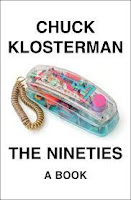
Klosterman focuses on pop culture, politics, TV, music, movies as a means to explain that last decade of the century. It was only by the end that I realized something: I don’t think he mentioned any books. Which got me to thinking about an obvious question:
What are the famous books of the 1990s?
Okay, do something with me. Think about that decade and see if you can recall any titles or authors but do not use the internet. Heck, don’t even look at your bookshelves. Just see if you can come up with any famous books strictly from your memory. I’ll wait.
Okay, so how many did you remember? Truth be told, as I’m writing this, I have not yet turned to Google. I’ve not even turned my eyes to my various bookshelves. In real time, I’ve been thinking about this question, off and on, for about a day, and only in the last few minutes did I remember an author and book that emerged in the 1990s: John Grisham’s The Firm.
I struggled to even remember many books. I went through my mental Stephen King list but could only remember Bag of Bones from 1998. Grisham’s status as the premier writer of the legal thriller instantly brought his other books to my mind. And I think Midnight in the Garden of Good and Evil was a 1990s book. But those were all I can remember.
So, if you’ll excuse me, I’m going to Google now. I suspect I’ll have more than a few “Oh, right! That book!” forehead slaps but such is my memory.
And I’m back, and I’ve slapped my forehead more than once in the category of “How could I have forgotten that book.” Among the titles that slipped my mind are Jurassic Park by Michael Crichton (1990), The Bourne Ultimatum by Robert Ludlum (1990), Truman by David McCullough (1992; my historian cred just went down the tubes), The Bridges of Madison County by Robert James Waller (1993), Men Are from Mars, Women are From Venus by John Gray (1993), Primary Colors by Anonymous [AKA Joe Klein] (1996), and many books by Danielle Steel and Mary Higgins Clark. I used this site to get the Top 10 books per year and not what someone thinks are the important books.
How many did you remember? More than me? That’s good. Heck, I couldn’t even remember all the Stephen King books of that decade. And how many mystery/thrillers did you recall? The presence of Clark and Ludlum tells me that our genres was at least at the table—as was Tom Clancy (more than once) and James Patterson.
Update: reader Jeremy sent me an email to remind me that Harry Potter was released in 1997 (UK) and 1999 (US) and publishers spent the next 15 years trying to chase the next big young adult craze. He also mentioned that the first Game of Thrones book was published in 1996. That brought Snow Crash (1992) to my memory although I didn't read it until the early 2000s. Ditto for the Potter books (I read them all in 2007).
Here’s a larger question: how many of those books were influential? How many changed things? I’ll come back to the Truman biography. I was in grad school and in 1992, many of my professors grumbled at McCullough’s book because it was too popular. Like the study of history had to be impenetrable to be good. I, for one, appreciate it when a historian writes a popular enough book that it becomes a bestseller (or a Broadway musical). I saw more history books written in McCullough’s style after 1992 than before.
What is the Nevermind of Books?
What about fiction? Is there a Nirvana moment (there was a Before Nevermind and then there was an After Nevermind) or a Matrix moment (same concept) for books? Historically, I’m guessing something like Agatha Christie or Dashiell Hammett (The Maltese Falcon) or Raymond Chandler’s work (The Big Sleep?) or Mickey Spillane (Mike Hammer’s first book) or Ian Fleming (was he the first huge spy writer?) or Tom Clancy (techno-thriller) or Grisham (legal thriller). I guess Grisham in the 1990s can count as the guy who put legal thrillers back on the map (Erle Stanley Gardner’s Perry Mason was king but I can’t think of any other ones other that Scott Turow’s Presumed Innocent in the interim).
Now, I also admit that I also did a more specific search for mysteries and thrillers in the 1990s. Here is that link. This is likely not an end-all, be-all list, but something is obviously apparent if you scan the list: the large majority of top mystery books in the 1990s involve series characters. I counted twelve out of 100 that were not series related. My guess is that a respective list for the 2000s, the 2010s, the 1980s, will reveal the same thing. Series sell. It’s a testament to a certain type of writer who can publish different stories within a genre and not do a series.
This essay is a thought exercise but also a real question. Were there any truly game-changing books published in the 1990s? Did they influence pop culture? If not, when was the last time a book sat in the middle of pop culture and dominated the national conversation or, at least added to the greater conversation? (I’m mainly talking about fiction because there are certainly non-fiction books that have made their mark on society.)
Saturday, February 27, 2021
What is the Tapestry of Books?

If you read about my regulated reading a few weeks ago, you’ll remember that I’m reading Never a Dull Moment by David Hepworth, his examination about rock music in 1971. As a fun project in 2021, I’m reading the book a chapter at a time, corresponding to a month of 1971. Thus, it’ll take me all year to read this book. Shrug. It’s fun.
Anyway, by reading Hepworth’s book, I have discovered Carole King’s 1971 album, Tapestry. It turns fifty this month, so it’s been fun to read all the retrospectives written about a new-to-me album. By the way, I ended up buying it last weekend after listening to it on YouTube for weeks.
One of those essays is by Bob Lefsetz, the man behind The Lefsetz Letter. He, too, is a new discovery from a few months back. I’ve quite enjoyed his deep dives in music and other things.
Lefsetz starts his post about Tapestry with this observation:
"It was an album for everybody.
That doesn’t happen too often, but when it does, the music business takes a giant leap forward, everybody pays attention, everybody listens, music is talked about, it drives the culture.
Last example? Adele. Her album “21” sold ten times, literally TEN TIMES as much as everything else in the marketplace. It worked for hipsters and as well as casual listeners. It was an alchemy of songs and singing, of passion and precision. “21” was a statement by an artist, not just product to support a system.
Same deal with the Beatles. At first it was a teen phenomenon. Then came “Michelle” and “Yesterday.” No one could deny them as songs.”
Lefsetz goes on to describe the phenomenon of an album for everybody. It is the album owned by the casual listeners, the hipsters, the soccer moms, the dads, the teenagers, the middle-aged, and so on.
After I finished reading Lefsetz’s piece—while listening to Tapestry for the I-don’t-know-how-many-th time, my thoughts turned to books.
What is the Tapestry of Books?
What is the book or books everybody owns? We can leave aside the question of whether or not the books are actually read. What is the book read by casual readers, soccer moms, dads, teenagers, the middle-aged, and so on?
Almost a decade ago, I wrote a short post about going to estate sales and seeing the novels of Louis L’amour on the bookshelves. But I specifically pointed out that those books were on the shelves of proto-man caves. If we were only talking about men’s novels, I’d suggest Clive Cussler or Lee Child or Michael Connolly.
But I’m going broader. I would think few teenagers or soccer moms might read the exploits of Jack Reacher. What are the books that appeal to a broad reading audience?
The Da Vinci Code by Dan Brown instantly jumps to mind. It was everywhere in 2003 and it seemed like everyone had read it. I think James Patterson books land in quite a few home libraries, but I cannot think of a single volume of his that fits this criteria. Stephen King is another author who probably has at least one book in many, many homes, but what’s that one book? Nora Roberts is very popular, but I can’t think many guys read her books.
Another candidate is John Grisham’s The Firm. Maybe To Kill a Mockingbird?
So I’m throwing out the question to everyone. What books are for everyone? What book is like Tapestry?
Oh, and yeah, I listened to Tapestry while writing this piece. Man, is that a great album. How in the world did I never hear it until February 2021?
Saturday, August 15, 2020
How Do You Find New Books?
by
Scott D. Parker
Earlier this week, a friend of mine at church posted an article about the mental benefits of listening to new music. In his post, he asked us how we discover new music.
I answered by saying nearly all of my nearly two dozens albums in 2020 stemmed from two sources: Frontiers Music (keeping melodic rock alive and kicking) and bands featured on the Texas Music Scene TV show.
When I stumbled on Frontiers Music in 2019, I ended up downloading a sampler CD and listening. That led directly to purchases. It also led me to subscribe to Frontiers’s newsletter. Every week, I get an email talking about the new releases of that week. I also Liked their page on Facebook. Now, whenever I get the weekly email or I scroll to the Frontiers Music Facebook page, I listen. Heck, this week I discovered a band called Pride of Lions and their kick-ass song “Carry Me Back.” I heard the first few bars of this tune and instantly marked the new album as a prerelease. Only later did I learn one of the lead singer (and lead guitarist) is Jim Peterik, a founder of Survivor and…The Ides of March! Yeah, the guy that sings “Vehicle” is still making music. Oh, and how cool is Peter’s guitar!
The Texas Music Scene is a syndicated TV show that comes on Saturdays at midnight, right after SNL. It used to be a casual show. Now it is appointment television. I take notes on the bands and the songs they perform. Then I go out and buy the albums. I’ve got quite a list and I’m slowly working my way through all the new-to-me music.
But for books, how does it work? How do I find new books?
Well, J. Kingston Pierce’s The Rap Sheet is top dog for me. Somehow, he finds the time to compile not only awesome lists of new books, but he pens fantastic articles about mystery and crime fiction. His Revue of Reviewers is a highlight as is his lists of awards. Plus, he has a knack for zeroing in on those fun old crime TV shows, complete with links. I often find new-to-me stuff there.
Turning my attention to the local scene, I subscribe to the Murder by the Book email list. All during the quarantine, they have continued their author events, only now, they’re online. They debut on Facebook and then show up on their YouTube page. Interviews with J. Todd Scott and Brad Thor have directly led me to book purchases.
Here’s the link to their events page.
But, to be brutally honest, other than a few other newsletters, that’s it for me.
So this post is actually a call to action: how do you find new books? I’d like to know so I can learn about even more books that are being published.
Tuesday, December 31, 2019
Favorite Music/Movies/Books/TV/Performances of the Decade
Songs
2010 - Hey Soul Suster - Train2011 - Rolling in the Deep - Adele
2012 - Hell or Hallelujah - KISS
2013 - (tie) The Stars are Out Tonight and Give Life Back to Music
2014 - Uptown Funk**
2015 - (tie) Seasons (Waiting on You) by Future Islands and Shut Up and Dance by Walk the Moon***
2016 - Put Your Money on Me*
2017 - Cumberland Gap - Jason Isbell
2018 - No Erasin' - Steve Perry
2019 - Hello Sunshine
*Song of the Decade - Up until I hear the opening chord of The Struts's "Put Your Money on Me," "Uptown Funk" was the song of the decade. Before that, it was "Give Life Back to Music" by Daft Punk. Unlike the album category, there's a whole lot more new music here. Put Your Money on Me--specifically the opening chord--sold The Struts for me. Joyful exuberance in song form.
**Uptown Funk is all but tied for first because it is everything I want in a song. Great vocals, funky bass, tight horns. I just HAVE to dance whenever I hear it.
***One man, one performance sold me the Future Islands album. Just listen to Letterman's reaction. Sounded like mine when I watched the performance live. See below.
Albums
2010 - Save Me San Francisco - Train2011 - Chicago XXXIII: O Christmas Three
2012 - KISS - Monster
2013 - Random Access Memories and The Next Day
2014 - Chicago XXXVI: Now
2015 - Burlap to Cashmere - Freedom Souls
2016 - Everybody Wants by The Struts*
2017 - Jason Isbell and The 400 Unit - The Nashville Sound
2018 - Sting and Shaggy - 44/876
2019 - Chicago XXXVII: Christmas
*Album of the Decade - A quick review of the albums on this list reveals one glaring thing: Most are good albums by older, legacy acts. When a band like The Struts shows up on our radar with unabashed enthusiasm for making rock music fun again and for making music multiple generations can love, well, that's a great album.
Movies
2010 - Toy Story 3 (Inception runner up)2011 - Harry Potter and the Deathly Hallows, Part 2 (Mission Impossible: Ghost Protocol)
2012 - The Avengers (John Carter)
2013 - Man of Steel (Iron Man 3)
2014 - Guardians of the Galaxy (Edge of Tomorrow)
2015 - Star Wars: The Force Awakens (Ant-Man)
2016 - Captain America: Civil War (Rogue One and The Nice Guys)
2017 - Star Wars: The Last Jedi (Wonder Woman)
2018 - Mission Impossible: Fallout (Avengers: Infinity War)
2019 - Avengers: Endgame* (Star Wars: The Rise of Skywalker)
*Movie of the decade - When a movie as big as Endgame actually sticks the landing, you can't not give it the award for best of the decade. Every feel, every cheer, every laugh, every tear was earned.
Books
2010 - Naked Heat by Richard Castle2011 - The House of Silk by Anthony Horowitz
2012 - Redshirts by John Scalzi*
2013 - Those Angry Days: Roosevelt, Lindbergh, and America's Fight Over World War II, 1939-1941 by Lynne Olsen
2014 - Face the Music by Paul Stanley
2015 - Destiny and Power: The American Odyssey of George Herbert Walker Bush by Jon Meacham
2016 - Longarm and the Bank Robber's Daughter by James Reasoner
2017 - Meddling Kids by Edgar Cantero
2018 - The Cutthroat by Clive Cussler
2019 - The First Conspiracy: The Secret Plot Against George Washington by Brad Meltzer and Josh Mensch
*Book of the decade - When you bawl your eyes out on hearing the final chapter of the audio and then break down trying to explain the ending to your wife and get emotional describing it to other people, well, that's an awesome book.
Television
2010 - Sherlock2011 - CSI: Miami
2012 - Elementary
2013 - Castle (5th season)*
2014 - The Flash
2015 - Castle (7th season)
2016 - Stranger Things
2017 - Broadchurch
2018 - The Haunting of Hill House
2019 - The Marvelous Mrs. Maisel
*Television show of the decade - I was hooked with the promos. Castle was the perfect show for me: writer who loves writing and pop culture teamed up with a beautiful detective to solve crimes. The mythology of the show blossomed into something larger than crime-of-the-week. The chemistry between Nathan Fillion and Stana Katic was palpable. The writers solved the "Moonlighting problem" [how long to keep the will-they-or-won't-they tension]. And then there were the actual books that became go-to fall reading. Great series (although that last season could have been scrapped; an odd thing to say for my favorite series of the decade).
Performances
I saw a lot of shows in this decade, and quite a few in 2018 and 2019. Here, off the top of my head, are my favorites.
KISS - Farewell Tour (2019) Full review
Halestrom (2019) Full review
The Struts (2019)
Ludovico Einaudi (2018) Full review
Tony Bennett (2018)
John Adams and "City Noir" with the Houston Symphony (2014)
Future Islands on David Letterman (2015)
Friday, July 29, 2016
Vacation Books
I just returned from a wonderful eight-day trip out to Texas’s Big Bend country. For those of y’all that don’t know where it it, visualize a map of Texas. Now, from the far left point, follow the Rio Grande (southern border) from El Paso to Brownsville. Big Bend is literally the point where the river makes a big bend. The family and I hiked, saw stars and satellites every night, and just enjoyed being away from the everyday.
Naturally, one of the things I love doing is visiting bookstores and antique stores. Interestingly, there were very few of each, although the antique stores outnumbered the bookstores. Two of the bookstores I visited were in Alpine, Texas, a great little town along Highway 90. Front Street Books is a block or two down from the Amtrak train station. They have new and used books. They had some old western pulp magazines, but I zeroed in on a couple of books.
I have only a few Longarm novels, but how could I pass up the adventure that takes place in the Big Bend region?

Ironically, there was a Star Western pulp magazine in the back, but I found this anthology instead. At $6.00, I was pretty much gonna buy it anyway, but the inclusion of a Day Keene story is what took it over the top.

The Alpine Public Library has a used book store and a nice western section. Lots of Louis L’Amour, but I selected this title based on the author and, especially, the cover painting.

Now, on the way back, we stopped in Uvalde, Texas, (also on Highway 90) at the Antiques on the Square store. I had traversed the entire store, not really finding anything that struck my fancy, until I was near the checkout counter. On a shelf, tucked almost unseen, was this book.
You are probably wondering why in the world I would buy this book from 1943. Because I write a series of books set in 1940 and will continue through World War II and beyond. This book is chock full of data, tables, photos, and details that the internet will likely just not have. In addition, many of the laws and executive orders are reprinted. To sum up, this is a perfect reference for future novels!
