I finally picked up a copy of Atomic Habits by James Clear this week. Well, my own copy, a hard back no less. I’ve been reading through it via my Kindle and my local library, but the book is in such a high demand, I only get 14 days to read it…and I’ve never finished. Now, I don’t have a countdown clock ticking and I’ll be able to finish the book.
Naturally for any new-to-me author, I check the website. JamesClear.com is laid out nicely, effortlessly guiding you through his introduction, the offer for his habit course, and a sampling of blogs and newsletters. You can sign up for his mailing list and get Chapter 1 for free. There’s a separate email list for a 30-day guide to building better habits.
In the footer, there is a link where you can see all the places you can buy the book and all the different formats and languages. What struck me was Step 2 of this process: Claim Your Free Bonuses. They don’t leave you in the dark as to your bonus content. You get a guide to how you can apply your atomic habits to business and parenting, a cheat sheet, a companion reading guide, and a habit tracker.
The only thing you had to do is buy the book and prove you bought the book. You do that via your purchase receipt.
I snapped a photo of the receipt on top of the book (to be doubly sure) and sent the photo to a unique email address. Within minutes, I received a confirmation email with links to the bonus content.
It was seamless and I felt I got more than I paid for when I bought the book at Target.
That got me to thinking about how to apply this concept of bonus material to fiction. I suspect there are a good number of authors who offer bonus content to readers, but up until now, I’ve only experienced it via Kickstarter.
The “How” of getting that bonus content is straightforward. I’ve done a version of it myself where I offered any reader on my mailing list a free copy of a book in exchange for an objective review. Done and done.
But what kind of content would a reader want from an author? Bookmarks? Shrug. Those are not always effective and you can’t spend $X.XX dollars to mail a bookmark to someone. Let me rephrase: what kind of digital content would a reader want from an author?
Some things jump to mind: A PDF of a particular chapter, an early draft all marked up with changes and edits. That would be interesting to see. Maybe a handful of chapters. What about research? Maybe a PDF of some research material an author used to write the book, especially if it’s an historical book. What about some peek into the internal process, like an early outline or a Beat Sheet a la Save the Cat.
As a reader, these would be interesting to see.
As a writer, would I want to divulge that kind of information? I don’t think I’d have an issue with it. The book’s done and published after all. But fellow writers, would you be willing to do something like that?
Monday, July 25, 2022
Extras for a Book?
Monday, July 11, 2022
When Did Characters Become Meta?
When did characters in stories become self-aware of all the story tropes they are in and comment on those tropes during the story? In short, when did characters become meta?
I’m not quite sure how to pose this question so let me tell you how I got there.
In my SF book club this month, we discussed John Scalzi’s the Kaiju Preservation Society. It is a wonderful B-movie concept: there is an alternate earth where kaiju (i.e., giant creatures like Godzilla) developed and humans did not. The humans from our earth can travel between worlds and said humans study the kaiju and, well, preserve them.
The story takes place in early 2020 and is populated by a bunch of characters, most of whom are nerds. As such, they say and understand a ton of SF in-jokes, jokes that most of Scalzi’s readers will also get. Not a problem. It’s like writing for the choir.
But one of the book club guys made a point: at no time in the book did any of the characters have a Wow Moment, a sense of wonder moment reminiscent of that scene in Jurassic Park when the characters (and viewers) first see the dinosaurs. He went on to posit that basically up to the 1990s, many characters in movies (and books) seemed to exist outside of the present pop culture moment. That is, many characters didn’t have a handy shorthand list of references to speak about.
For example, in the Scalzi book, when something odd came up, all the characters in the book had to do was reference an existing movie moment and everyone (readers included) would know. (I did the same thing when I name dropped Godzilla a few paragraphs ago.) You could make the argument that Scalzi was not bothering to expound or explain something, but I actually don’t mind the shorthand at all.
We started commenting that many movies in at least the last decade+ are populated by characters like this and we tossed around the idea of when it started. Naturally, we arrived at the first Scream movie (1996) where all the characters knew all the tropes of horror movies and actually riffed on them and tried to overcome the killer by using those tropes. The movies of Kevin Smith are full of references like this, and some of the Marvel films reference Star Wars and other properties.
That got me to thinking about the mystery genre. Were there films, books, or TV shows that fit this type of story? The first thing that came to mind was the TV series “Only Murders in the Building.” I’ve not seen any of season 2, but season 1 had the characters basically do what Scream did for horror: narrate, in a meta way, the story they were in, commenting that in a normal true crime podcast cast, this is where a twist would occur…right before a twist in their own story happened. “Castle” had some of that mainly because the main character was a writer.
So, fellow mystery fans, I challenge y’all to help me out: what are some mystery stories of any medium where the characters basically comment on the story their in using tropes of the mystery genre?
Tuesday, July 5, 2022
Release Order is Best…Or Is it?

Over here in America, PBS just dropped the eighth season of Endeavour, the prequel series to Inspector Morse and its spin-off, Lewis. My wife and I have enjoyed this series quite a bit, especially the interactions between the two lead actors. Shaun Evans plays a young Endeavour Morse while Roger Allam plays his superior officer, Fred Thursday. Their chemistry is fantastic, really serving as the backbone of the entire show and cast. That the show is a period piece—1971 in this current season—just adds to my love of the show.
But we’ve never seen either of the original shows.
Which is completely fine. For whatever reason, we only arrived at these characters via this prequel a couple of years ago. But it wasn’t until this week that we both agreed that we’d like to circle back and give the original show a look.
I was the one who voiced what we were both thinking: which characters, if any, appeared in the original Morse show? It was actually in relation to the Fred Thursday character. I wondered if any of the 33 original shows ever had the older Morse visiting with an even more elderly Fred Thursday. A brief glance at the Wikipedia page for Endeavour likely proves the answer. No, Fred Thursday does not appear in the original program.
That’s too bad, but it gives me hope that with the upcoming ninth and final season, the writers will tidy everything up and explain why Thursday isn’t in the original series. There’s the obvious answer. Maybe that’s the arc of Morse’s character. In this current season, he’s drinking more and becoming more aloof, telltale signs that is probably how the older Morse acts in the original.
This got me to thinking about someone in my situation, coming into an existing universe of stories during a prequel. Most of the time, the creators have to invent some new characters and not just have younger versions of the older/original ones. Star Wars did that—a lot—and many of those prequel characters get their own spin-offs.
Star Wars is a special case, of course, but if anyone ever came up to me and asked me where to start, I’d say follow the release order of the films. In that way, there are Easter eggs and shades of what’s to come sprinkled throughout the prequels. I suspect there are more than a few Easter eggs in Endeavour that longtime fans of Morse and Lewis pick up on that we don’t. That’s just good fan service. I wonder if a Morse fan from the jump—the first season aired in 1987—would have told us to start there just like I how I would introduce Star Wars to someone.
Be that as it may, my wife and I finally arrived in the Morse Universe—that’s a thing, right?—and we’re glad we’re here, no matter the route we took.
Monday, June 27, 2022
All the Feels or All the Logic?
Why do you consume a story?
I use the word ‘consume’ because you could watch a movie or TV show, read a book, or listen to an audiobook or podcast.
My wife watches quite a bit of the true crime shows on TV and various streaming services. She likes to learn the intricate details of how the investigators discovered the culprit and, in most cases, land the perp in jail. She’s way more logical than I am and these shows give her a sense of order and justice. That drive for order is a large reason why she and I both enjoy BBC TV shows and other crime and mystery programs as well as books and movies.
But when it comes to established stories that have more than a twinge of nostalgia, I really enjoy the feels. How does the story make me feel?
I ran across this twice this week. The smaller version is my re-watch of the 1996 Mission: Impossible movie. My twenty-year-old son hadn’t seen it so we all watched it together. The way the movie is constructed—with its descriptions of how they’re going to break into various places and the spy stuff—is something I really dig. In fact, I found myself grinning like a goofball throughout the entire movie. Well, except for the vault sequence. Watching it again, I was in rapt silence.
By the end, I was buoyed by the story and ready to, I don’t know, hang by a wire from the ceiling. The story works, but the feels are fantastic.
The same is true for the Obi-Wan Kenobi finale this week. And spoilers are coming.
I’ve said it before but I think my favorite time of being a Star Wars fan is that initial era from 1977-1980. In those years, the galaxy was wide open and not some family drama. And I associate that feeling most with the first half of Star Wars, while the action centered on Tatooine. As such, I really enjoyed the Obi-Wan show.
From a logical point of view, the writers delicately threaded this series through established canon and I think they did a great job. It’s a testament to how much I enjoyed the show that even though I knew who lived, I found myself constantly on the edge of my seat. Will young Leia survive? Will Obi-Wan be killed by Vader?
But the finale proved to be one of my favorite Star Wars things. We got an epic lightsaber battle between Obi-Wan and Vader, complete with Hayden Christensen looking out from a seared-open Vader mask. We go a neat and tidy button on Obi-Wan’s infamous phrase to Luke: Vader betrayed and murdered your father.
And we got some fantastic character moments, a feat especially impressive considering the action. In fact, it was the character beats in the final ten minutes that really struck me and brought the tears. Oh, and the inclusion of Princess Leia’s theme from Star Wars? Icing on the cake. That piece of music ranks as one of my all-time favorite themes in the entire franchise and it was used so well.
That last shot? [won’t spoil this one] Perfection.
So, with Obi-Wan, in my mind, I got the logic of the storytelling but I also got the feels. That’s what often sends a story over the top for me. It’s why I enjoyed Jurassic World: Dominion so much. It’s why I dig La La Land, Toy Story 3, any random episode of New Amsterdam, and John Scalzi’s book, Redshirts.
I want the feels, and any story that delivers is a winner in my book.
How about you? Do you want the feels or is logic more your speed?
by
Scott D. Parker
Why do you consume a story?
I use the word ‘consume’ because you could watch a movie or TV show, read a book, or listen to an audiobook or podcast.
My
wife watches quite a bit of the true crime shows on TV and various
streaming services. She likes to learn the intricate details of how the
investigators discovered the culprit and, in most cases, land the perp
in jail. She’s way more logical than I am and these shows give her a
sense of order and justice. That drive for order is a large reason why
she and I both enjoy BBC TV shows and other crime and mystery programs
as well as books and movies.
But when it comes to established
stories that have more than a twinge of nostalgia, I really enjoy the
feels. How does the story make me feel?
I ran across this twice
this week. The smaller version is my re-watch of the 1996 Mission:
Impossible movie. My twenty-year-old son hadn’t seen it so we all
watched it together. The way the movie is constructed—with its
descriptions of how they’re going to break into various places and the
spy stuff—is something I really dig. In fact, I found myself grinning
like a goofball throughout the entire movie. Well, except for the vault
sequence. Watching it again, I was in rapt silence.
By the end, I
was buoyed by the story and ready to, I don’t know, hang by a wire from
the ceiling. The story works, but the feels are fantastic.
The same is true for the Obi-Wan Kenobi finale this week. And spoilers are coming.
I’ve
said it before but I think my favorite time of being a Star Wars fan is
that initial era from 1977-1980. In those years, the galaxy was wide
open and not some family drama. And I associate that feeling most with
the first half of Star Wars, while the action centered on Tatooine. As
such, I really enjoyed the Obi-Wan show.
From a logical point of
view, the writers delicately threaded this series through established
canon and I think they did a great job. It’s a testament to how much I
enjoyed the show that even though I knew who lived, I found myself
constantly on the edge of my seat. Will young Leia survive? Will Obi-Wan
be killed by Vader?
But the finale proved to be one of my
favorite Star Wars things. We got an epic lightsaber battle between
Obi-Wan and Vader, complete with Hayden Christensen looking out from a
seared-open Vader mask. We go a neat and tidy button on Obi-Wan’s
infamous phrase to Luke: Vader betrayed and murdered your father.
And
we got some fantastic character moments, a feat especially impressive
considering the action. In fact, it was the character beats in the final
ten minutes that really struck me and brought the tears. Oh, and the
inclusion of Princess Leia’s theme from Star Wars? Icing on the cake.
That piece of music ranks as one of my all-time favorite themes in the
entire franchise and it was used so well.
That last shot? [won’t spoil this one] Perfection.
So,
with Obi-Wan, in my mind, I got the logic of the storytelling but I
also got the feels. That’s what often sends a story over the top for me.
It’s why I enjoyed Jurassic World: Dominion so much. It’s why I dig La
La Land, Toy Story 3, any random episode of New Amsterdam, and John
Scalzi’s book, Redshirts.
I want the feels, and any story that delivers is a winner in my book.
How about you? Do you want the feels or is logic more your speed?
P.S. I wrote this piece late afternoon on Friday. Later that day, I watched the new Baz Luhrmann "Elvis" movie. Add one more to the feels list. Except this one was tragic. My wife and I just sat there for a few minutes while the main credits rolled. We both had teared up at the end. So we just sat and listened and thought about the creative spirit of Elvis Presley.
I don't know about you, but when I take in a story in
which a creative person is tamped down or abused or taken advantage of, I
feel my own creative spirit wanting to burst out and soar.
Monday, June 20, 2022
Jurassic World: Dominion: A Wonderful Summer Blockbuster
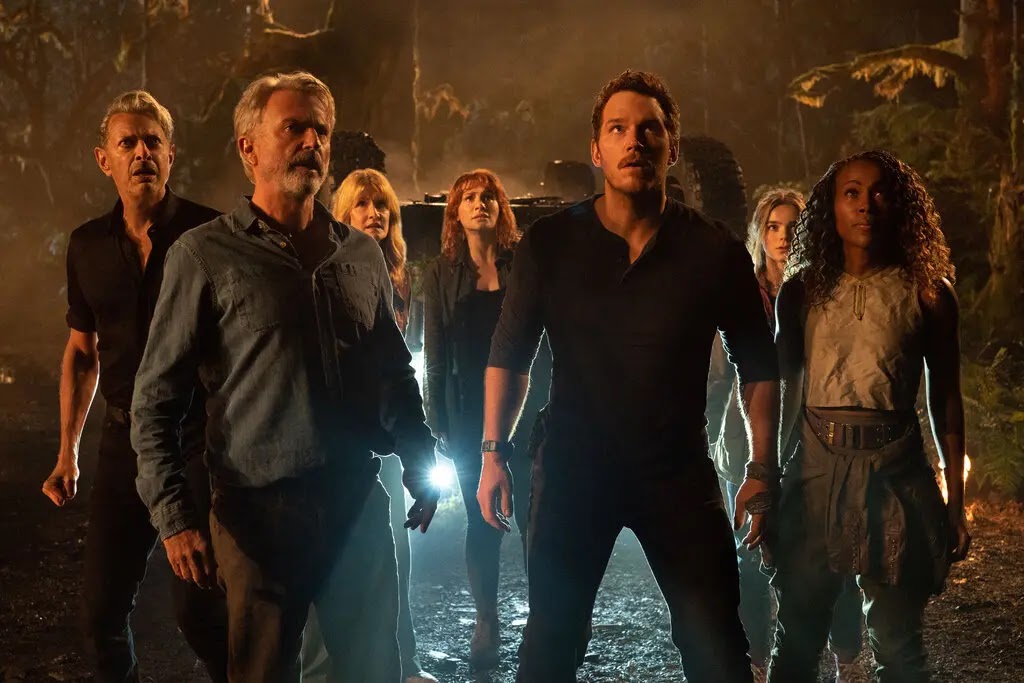
I’m not sure what movie some folks watched but it sure wasn’t the one I saw.
When it comes to movies, I make it point not to read any reviews ahead of seeing a movie I want to see. If the trailer hasn’t grabbed my attention and compelled me to watch—or the pedigree of the actors, writers, and director—then I don’t seek out the Rotten Tomato score to sway me. This is not the same with books in which I will happily read and take into consideration the opinions of dozens of fellow writers when they recommend books.
But once I’ve seen a movie, I am curious to know the general consensus and see if it lines up with my experience. When I saw the 2.5 hours of Jurassic World: Dominion (AKA Jurassic World 3 AKA Jurassic Park 6), I was enthralled, entertained, and emitted more than a few utterances of “Yeah!” and “Cool!” It ended the 6-movie franchise quite well, introducing the original Park actors with the new World actors in a way that felt organic. The music was nicely used throughout, including the elegant main theme from John Williams—both the orchestral as well as the softer piano version. There were dino-on-dino fights, a kick-ass motorcycle/dinosaur chase through a European city, and a dino/airplane chase. There were dinos in the water, dinos in caves, and dinos in snow. All things we’ve not seen before.
Well, I’m pretty sure we haven’t. I’ve pretty much got the first movie memorized. The Lost World and Jurassic Park III, a little. Jurassic World I remember decently and I all but forgot World 2: Fallen Kingdom.
But I remember the closing show of Fallen Kingdom well, accompanied by Jeff Goldblum’s voiceover. Dinosaurs now live among humans and we’re going to have to learn to co-exist as best as possible. And that’s how Dominion starts. It shows us a world like that. Granted, it’s not one I’d prefer to live in—don’t need the possibility of my plane flight being overtaken by a pterodactyl—but it is one original author Michael Crichton envisioned and that Goldblum’s Ian Malcolm keeps talking about in every movie he’s in. So in that respect, Dominion gets it correct.
So imagine my surprise when I hop on over to Rotten Tomatoes on Monday night—after eagerly relating all the fun and cool stuff in the movie to my wife who didn’t go—that the critical consensus was so poor. Again, what movie did these folks watch?
Okay, the plot. There are two threads. The World Plot has Owen and Claire trying to protect Maisie from the rest of the world because she’s a clone. Blue the velociraptor lives nearby and has unexpectedly produced a young raptor called Beta. (It shouldn’t be unexpected because “Life always finds a way.”) Bad guys kidnap both younglings and Owen and Claire follow.
The Park Plot involves our three original cast members and boils down to Laura Dern’s Ellie Sadler researching why formerly extinct massive locusts are eating some crops but not others. If they’re not stopped, there will be a global famine, yet the locusts don’t seem to be eating crops grown from seeds provided by Biosyn, the new bad-guy company a la InGen from the Park movies. She makes the assumption—with an assist from Malcolm—that Biosyn is behind both the seeds and the locusts. She enlists the help of Alan Grant (Sam Neill) and they set off in search of proof at Biosyn’s giant lab/breeding ground/dinosaur habitat in Europe.
Which is exactly where the kidnappers are taking Maisie and Beta. Naturally, the World characters and the Park characters will meet—the selling point of the film—and they’ll battle enemies both dino and human. Along the way, there are wonderful set pieces that are the definition of a summer blockbuster. In fact, as Owen is racing through the streets on his motorcycle, trained raptors on his tail, you see the aforementioned plane start to warm up. I leaned over to my son and said, “I bet he jumps into the open plane in midair.” Viola! That’s exactly what happened.
Yes, that entire sequence felt like an espionage film (Bond, Bourne, Mission Impossible) but who cares? It was thrilling. There were lots of other thrilling moments as our heroes fight to stay alive, but not without some humor along the way.
But there are also some great character moments. Goldblum is having a field day as Malcolm, just chewing scenery left and right and I loved every second of it. The quiet moments are also good, like when it’s just Ellie and Alan seeing each other for the first time in decades, subtly lamenting lost time. Yes, their story line got a little bumbly as they tried to escape from the locust lair but it was minor.
I also liked how certain scenes were set up so that you *think* you know what’s going to happen but then your expectations are subverted. Case in point: Goldblum’s Malcolm is stuck holding a flaming piece of a spear-like metal pole and there’s a dino looking at him. In Park 1, he doesn’t know to throw the light source and freeze. Well, I said to my son, I bet he’s learned now. Nope. Not what happens. But it’s way cooler.
Scott Campbell, as the bad guy, plays Lewis Dodgson oddly. He is all bad at one moment and then weirdly like an absent-minded professor the next. I liked that they used him as a character although in the movie, it isn’t explicitly stated that he was the character in the original Jurassic Park who pays Wayne Knight’s Dennis Nedry to steal embryos in the Barbasol shaving cream can. But said can is a trinket in Dodgson’s office as he tries to escape. And I won’t even tell you what happens to him, but if you’ve seen Park 1, you have an idea.
Speaking of that, I like the little subtle Easter eggs like when Ellie takes off her sunglasses in a manner almost identically to Alan from Park 1. Nice touch.
The nostalgic part of me would have liked one last shot of all the Park characters together. Sadly we don’t get that, but we do get some resolution for everyone. And character growth. And bad guys getting what’s coming to them. And dinosaurs. Lots of dinosaurs.
Again, I’m just not understanding why the dislike for the film. The audience score on Rotten Tomatoes is 79% so clearly it’s resonating with folks. It resonated with me quite well and I thoroughly enjoyed the film.
Monday, June 13, 2022
Is There Too Much?
Ever get the feeling you’ve jumped off the high dive, you splashed wonderfully in the deep end, but you can barely make it back to the surface?
There is a lot—A LOT—of stuff that comes our way in 2022, and it’s probably the internet’s fault. For every random piece of knowledge we can look up with the computer that fits in our pockets—stop and think about that for a moment—that same device and service blasts us with data and images and sounds and games and everything.
It can become overwhelming.
So I decided to see just how much stuff comes my way in a week. I didn’t count my emails (although I probably should have) and kept it to the articles via my Feedly app. It’s an aggregator where content comes to me rather that me having to visit a buncha sites to get the stuff I want.
I have maybe 75 sites that I have put in my Feedly. Some of those publish once a week (like Peter King’s football column). Others publish dozens of articles a day (Gizmodo and Slash Film). Have to keep up with the geek news. Ultimate Classic Rock posts about a dozen or so articles a day, too.
There are quite a few writers I follow. Some of them post daily (Dean Wesley Smith, John Scalzi) while others are also weekly (Kristine Kathryn Rusch) and still others are whenever.
Then there are the food blogs, Lifehacker, health and fitness blogs, the comic blogs, and the art and photography blogs. Yeah, it’s a lot.
But I don’t read them all. Far from it. I’ll scan the headlines and make an instant decision. If I’m reading on my iPad, I swipe and mark them as ‘read’ without even opening the article. Sometimes, I forward myself articles if I don’t have time right then and there to read them.
It’s a lot, but how much?
This is not an exact science. I tried to get through some and then note that I cleared, say, 38 on Monday morning. And the workday kept me off the app later in the week so the articles backed up.
But here are some numbers over a 5-day span from Monday until Friday.
By 1:30pm on Monday, I had received and cleared 135 articles.
By the time I went to be on Tuesday, I had received more or less 140 more. I didn’t log how many I cleared. My Wednesday number was approximately 363. Thursday morning I had 259 in the queue at 5:40 am. I cleared almost none. By Friday morning, the number was up to 468. I cleared some here and there so I don’t have a good number.
But you can see how it all adds up. So a rough guess is around 125 a day, making for approximately 625 individual articles in five days. This does not account for FaceBook or Twitter. That’s a whole other thing.
So is 625+ things to process per week worth it? I don’t really have FOMO at this stage of my life so I don’t care if I’m first. I just want to know. I could probably cull some of the articles and feeds I rarely read and ease up the deluge. But I do appreciate an app like Feedly where things come to me. And I like having it all in once place, even if it adds up to over 600 things to process per week.
How do you process news feeds? How do you get your news?
Monday, June 6, 2022
A Few Recommendations for Summer 2022
Every now and then when it comes time for me to write a Saturday post, a large, overarching one about a single topic, I realize I don’t have one. So I’m going to provide a few recommendations of things I’m listening to, watching, or reading.
Top Gun: Maverick

Now THIS is how to do a legacy sequel. Age up the characters in real time, address the passage of time, and provide a wonderful piece of closure with a legacy co-star. Oh, and incredible action sequences. Holy cow was this a great movie. I took my wife who didn’t necessarily want to see it but she emerged very entertained. Not as entertained as I was: now I want to see this film in IMAX.
And please tell me I’m not the only one who saw the movie and kept having to slow down the car while driving home.
Def Leppard: Diamond Star Halos

Taking a page from the legacy artist idea I wrote about a couple of weeks ago, Def Leppard released their newest album last Friday. Fifteen tracks (17 if you buy from Target) of classic rock goodness. Much like the modern band, The Struts, the Joe Elliott-led five piece band wear their influences on their sleeves, and it starts with the album title.
There’s a whimsical vibe to these songs from the opening chord progression of “Take What You Want” to open the album to the last few notes of “From Here to Eternity.” Allison Krauss lends her vocals to a pair of tunes but make no mistake: this is a rock/pop/metal album just like the band used to make in their heyday.
Lyrically, the guys know their age and acknowledge it throughout the entire record. This was an album I looked forward to ever since it was announced and boy did they deliver.
And yes, we listened to Def Leppard on the way to and from seeing Top Gun: Maverick.
Obi-Wan Kenobi
_logo.jpg)
The third thing released last Friday, this is a Star Wars series I’ve been eagerly anticipating since it was announced as well. In fact, I even held off reading the old Extended Universe novel.
We knew what we were going to get from the trailers: an older, wiser(?) Obi-Wan, living on Tatooine, watching over a ten-year-old Luke Skywalker. What I didn’t expect was his sister, Leia. In fact, it is her plight that propels the series.
I appreciate the slower roll, just like I did for the Mandalorian. I have zero issues with the actors on the show either (so a certain segment of the Star Wars fandom can just go home).
As big a Star Wars fan as I am, I didn’t watch the animated shows so everything in Obi-Wan Kenobi is new to me.
Oh, and so great to see Darth Vader back to being the feared force he is. But I’ll say something that might make a few of y’all look at me askance. I’m fine with James Earl Jones voicing Vader, but how about some more intense inflection, huh? I mean Vader/Anakin finally lays eyes on Kenobi after ten years and it’s like their talking over tea. The last thing Anakin yelled at Kenobi in Episode III was pure hatred. Where’s that emotion in Vader’s inflection?
No Time to Spy by Max Allan Collins and Matthew V. Clemens

If you like James Bond, might I point you in the direction of this trilogy of book by Collins and Clemens. The premise is pure fun: the main character is John Sand, a real spy who worked with Ian Fleming and the latter author based James Bond on John Sand. Sand, now outed as a spy, marries a rich Texas oil heiress. Despite his retirement, action and adventure follow Mr. and Mrs. Sand.
While I’ve not read all three books—Come Spy With Me; Live Fast, Spy Hard; To Live and Spy in Berlin—a compilation ebook is on sale *this weekend* for only $0.99. You read that correctly: for a dollar(!), you get three novels. Seriously, it’s an impulse buy at that point.
Here’s the Amazon link.
Roll With It by Jay Stringer

Jay Stringer broke the news that his latest novel is now available as an audiobook on Audible. As a person who primarily consumes books in that manner, this was great news.
But Jay went above and beyond and made available a few promo codes. These are US only—UK codes will be forthcoming—so if you haven’t had a chance to read his post from yesterday, head on over and see if any of those codes are still available.
Even if they’re not, the book is only 1 credit ($13.96 if you just want to buy it) so get on over to Audible and get a copy. Also, for you library folks out there, be sure to request your library to buy the book and help spread the word.
Monday, May 30, 2022
The Great Summer Writing Season
Here in the United States, summer officially begins today, Memorial Day. It ends 97 days later on Labor Day, 5 September. I know it is a great time to travel, watch summer blockbuster movies (by the time this is posted, I’ll have already seen Top Gun: Maverick), catch up on some TV, sit on the patio or beach or dock and sip something cold, and just enjoy the summer vibe.
But it can also be used to write.
Think of it: perfect bookends. There is a beginning and an end. There are 97 days of summer if you don’t include either holiday but do count weekends. If you were to write up to 1,000 words per day, more or less an hour, you’d have a novel.
Okay, you say, what about weekends? There are 28 Saturdays and Sundays this summer. Doing the math, that is 69 weekdays. At 1,000 words a day, that 69,000 words, still a novel.
But let’s say you don’t reach 1,000 words a day. What if you only spend 30 minutes a day and produce 500 words? That’s 48,500 words, a nice short novel. If you take out the weekends, that brings you down to 34,500 words, still very respectable.
And I’m only thinking novels here. Imagine if you wrote a short story per week. That’s 14 new short stories.
This is just to get you thinking about continuing your writing during what Dean Wesley Smith calls the Time of Great Forgetting, when your New Year’s Day resolutions to write more are ignored. You can do this. Just start on Monday and keep going.
I’ll be finishing up a novel rather than starting a new one. And I’ll also be preparing for the Great Departure: my son will be moving out and continuing his college coursework. Sigh. It is time. It is supposed to happen, but that doesn’t make it any easier.
The writing part is, however, pretty straightforward. Just sit and write. Keep at it long enough and you’ll reach those magical words: The End. And summer is a great time to keep that habit going.
Side Note: Namedropped
It’s not every day when a famous author reads a post and responds.
I always read Max Allan Collins’s blog so imagine my surprise when I saw my own name. It seems he read and responded to my post from last week regarding Legacy Authors and That Last Book. I nearly swallowed my coffee down the wrong pipe when I saw it. He provided some extra examples to address the question I posed. How cool is that?
Wednesday, May 25, 2022
Star Wars Through the Decades
Today marks 45 years since Star Wars debuted. While I didn’t see the movie opening day in 1977, by the time I did, I was hopelessly immersed in a galaxy far, far away. Not only that, but it opened up the broader world of science fiction for me, a world I’ve loved and appreciated these past decades.
I got to thinking about Star Wars and what it meant throughout the years so I did a fun little exercise: how did I perceive Star Wars every five years for the past forty-five years.
Star Wars at 5 Years (1982)
This was a year from Return of the Jedi—was the title already announced in 1982 as Revenge of the Jedi? This was the spring of my 7th grade year. I had many, many Star Wars toys, the bulk being from the Empire Strikes Back collection. Legos were still a thing as was other science fiction properties, especially Star Trek. I was gearing up for Star Trek II: The Wrath of Khan debuting in June 1982. Star Wars was always on the radar but with the last movie a year out, it was probably not front and center.
Still, I was and remain a charter member of the Star Wars Generation. It changed me and helped to shape the things I enjoy watching and reading and listening to.
Star Wars at 10 (1987)
I was a senior in high school thirty-five (!) years ago this month. I was heading up to The University of Texas at Austin in August. Music, including high school band, often took center stage of my life, so much so that I tried out for and joined the Longhorn Band.
I actually have no conscious memory of Star Wars from May 1987. The Marvel Comics run had been cancelled in 1986. I still own most of that run, but can’t barely remember any of the storylines. An interesting sidenote to 1983, the year Jedi was released. I was all in on seeing the movie—even paying extra to see it the day before its premiere—and saw it multiple times throughout the summer. But I never bought any Jedi toys. I was moving on from eighth grade to high school. Things were changing for me, just like they were in May 1987. Star Wars, for all intents and purposes, was done. It was wonderful and great and a vital part of my formative years, but that was in the past.
Star Wars at 15 (1992)
Star Wars was back…at least in print. May 1992 saw the publication of Dark Force Rising, the middle book of a new trilogy by Timothy Zahn. 1991’s Heir to the Empire reignited my love of Star Wars, bringing back wondering memories of the franchise and that time of my life. I started talking about Star Wars with college friends and reminiscing.
But, after I’d read Dark Force Rising, that was about it. Batman Returns was a month away and I was eagerly anticipating it. Interestingly, my other childhood favorite thing—KISS—had released their new album, Revenge, in May 1992 and I was spinning that CD constantly.
Star Wars at 20 (1997)
Star Wars was back…on the big screen. I owned the movies on VHS (still have them) but hadn’t seen them on a theater screen since the early 80s. Now, new special effects were being added to all three movies with the biggest expectation being the Han Solo-meets-Jabba scenes in Mos Eisley. This was awesome stuff. And I really wanted the Biggs/Luke scenes from early in the film to be in there as well. Alas, it wasn’t, and now Han shot second?
But here’s the thing: I loved seeing the old movies again, relishing in my past life, and shrugged off the weird nesses. I knew the movies backward and forward so instantly knew when changes had been made. And I realized during these viewings that this franchise, especially the first two movies, were time capsules. If I let myself just sit and watch, I could be transported back to my younger self. It was magical.
Star Wars at 25 (2002)
Yay, a new movie—Attack of the Clones—in the Prequel trilogy. Surely it was going to be better than The Phantom Menace, right? I mean, there’s Anakin as a teenager. Obi-Wan as a badass Jedi. Jango Fett. Samuel L. Jackson and his purple lightsaber. And Yoda as CGI?
Well, AOTC had its moments, but was it better than Phantom Menace? Not really. Looking back to 1999, it is difficult to overstate how excited I was about a new Star Wars movie. That first trailer was so good, but it didn’t live up to expectations. Could it have? Probably not, but at least we were getting new Star Wars movies, right?
I did not follow through and watch the animated series however. Not sure why. I had long since stopped trying to keep up with the novels as well. I read the big ones—especially the novelizations of the movies because they went into additional detail and made for a better story—but that was about it. Star Wars was still important, but it had become one of many things I loved.
Star Wars at 30 (2007)
Honestly, when I think of this year, no Star Wars thing pops into my mind. 2005’s Revenge of the Sith was the best of the Prequel movies. This movie’s novelization was itself the middle book of a little trilogy and I listened to all of them. A nice tidy little story, but then I didn’t read another Star Wars book until 2013’s Scoundrels.
I had finally started reading the Harry Potter books, and in May 2007, I was reading all six then-existing books leading up to the publication of the seventh book in July. Star Wars just wasn’t on my pop culture radar. It was Pixar movies (Ratatouille was in 2007) and things my young son enjoyed.
Star Wars at 35 (2012)
More of the same, to be honest. I’d pull out the soundtracks from time to time and give them a listen. The novels of the Extended Universe were still being published at a rapid rate and I was reading none of them.
I can’t remember exactly when I showed Star Wars to my son. Maybe it was in 2012. But in May 2012, The Avengers had been out a month and I was enjoying the new Marvel cinematic universe. And there was a new Batman movie coming out in July. Star Wars was just one of the things I enjoyed, and mostly not on a day-to-day basis.
Star Wars at 40 (2017)
In May 2017, we were seven months away from the next movie in the sequel series, The Last Jedi, a movie I enjoyed immensely. The trailer had dropped in April and Mark Hamill as Luke Skywalker was back (and speaking!). We were about six months after Rogue One, one of the four most original Star Wars movies made to date. Guardians of the Galaxy Vol. 2 was the brand-new Marvel movie and Wonder Woman would debut in June.
Had Star Wars been the only major franchise to vie for my attention, it would have earned more attention. But it was just one of many. Perhaps that was one of its lasting legacies.
Star Wars at 45 (2022)
Forty-five years ago today, it started. Ironically, just this past weekend, Colin Cantwell, the guy who designed the X-Wings, TIE Fighters, and the Death Star passed away. We’re getting a hotly anticipated new TV show, Obi-Wan Kenobi, something I’m really looking forward to, not the least of which being a new theme by John Williams.
Television seems to be the place where Star Wars shines nowadays. You have the chance to see new characters, allow them to grow, and not always show the vast galaxy only from the perspective of a single family. I’m happy to follow along with every new Star Wars TV show, watching all the live-action ones (still haven’t started any of the animated series). And I might pick up a book or two along the way. But, like in the heyday of the Extended Universe, I just can’t keep up. It’s a good thing (?) that there is so much because you can drop in here and there, picking up things that interest you and letting other things rest. I know that there are folks out there who memorize every little detail like I did back in the day, but it’s so much more difficult.
Conclusion
Star Wars is special. It’s one of the pop culture cornerstones of my life. It’s a joke in my family that I can’t remember to call a plumber but can still (!) remember random facts from the first movie (like the trash compactor number). Star Wars just is. And it always will be. My interest may ebb and flow, but it never disappears. It’s a part of me, just like it’s probably a part of you, too.
So let’s celebrate Star Wars for what it *is* and not necessarily what you want it to be. It is a multimedia franchise that started forty-five years ago today. It was and remains a story about a boy, a girl, a pair of robots, an old man, a scoundrel and his best friend, and an evil dark lord who welds a mysterious force and a laser sword. It is good vs. evil, the call to adventure, the hero’s journey with a sublimely wonderful soundtrack, and the willingness to stand up to the bad guys, even when all hope is lost. Because one person can make a difference, be it a pilot in an x-wing who can guide a proton torpedo through a 2-meter-wide exhaust port or a film director who has an idea about a movie he’d like to make to recapture the spirit of the movies he himself loved as a younger boy.
It’s that spirit that is at the essence of Star Wars. May that spirit always have a spark of creativity and keep the story going, yet always remembering where it started: in movie theaters forty-five years ago today.
Monday, May 23, 2022
Legacy Authors and That Last Book
One of my favorite sub-genres of music is when legacy artists create new music in the 21st Century. I’m not talking about bands like Bruce Springsteen, Bon Jovi, or Def Leppard who never stopped putting out new music. I’m referring to bands like The Beach Boys (That's Why God Made the Radio), Eagles (Long Road Out of Eden), or David Bowie (Blackstar) who go into the studio basically knowing that the soon-to-be-recorded album will be the swan song. The songs can sometimes acknowledge the passing of time, the artists’ ages, and their long careers.
Yesterday, one of my favorite bands joined the ranks of legacy artists creating new music that fits into this mold. Chicago released “If This Is Goodbye,” from their forthcoming album (not sure if they’ll use XXXVIII or a more streamlined 38). From the title alone, you get the vibe of the song. It is a wistful song with a typical surface meaning of two lovers looking back over their lives but we all know what it’s really saying: This band, through triumphs and tragedies and reinventions, has persevered but the end is nigh. Here’s the link.
It is a sobering thought to have yet another band that have been there my entire life reach the end of the road. KISS, my other favorite band, is literally on their End of the Road Tour. But those founding members of Chicago have been working musicians for nearly 60 years, 55 as Chicago. That’s a good, long run, and they deserve to do whatever they way to do, be it touring or just kicking up their heels and marveling at their accomplishments.
Authors, however, are different. At least I think they are.
I don’t presume to know if every single series character ages. I can’t say if Agatha Christie wrote her last Hercule Poirot novel knowing it would be the end or not.
I’ve only recently started reading the novels and blog posts of Max Allan Collins but in his posts, he talks about slowing down. Now, his output is still pretty prolific, but he acknowledges that some of the aspects of writing—namely the research he needs for his historical mysteries—is more challenging that it used to be. Again, I’m not as well versed with his bibliography as others are, but I wonder if he’s going to start writing that final Heller novel knowing it’s the last one.
Didn’t Michael Connelly age Harry Bosch along the way? Ian Fleming died while writing his final James Bond novel so I suspect that he didn’t approach The Man With the Golden Gun in that way. I don’t know about Sue Grafton’s Kinsey Millhone either.
What about authors who, say, haven’t written a book in twenty years and suddenly come out with a new one? I’m not talking about a found manuscript, a la Erle Stanley Gardner’s 2016 novel The Knife Slipped (written in 1939), that is then republished.
Maybe I’m zeroing in on series characters that actually age along with their creators. How many of them got their last book with an eye to the author knowing it was the last book?
Monday, May 16, 2022
Moderation Can Be a Good Thing
by
Scott D. Parker
I’ll admit something: it’s been harder than I expected to get back into the writing routine after it laid dormant for a couple of months. Which is odd considering I like this book (why else would I be up to chapter 31 of it) and want to get to the end—I’ve mapped out the scenes up through chapter 39 so it’s not like I don’t have a road map.
Part of the reason I’ll admit is health. I’m healthy, eat well, and walk about two miles every day per week except Fridays and Saturdays. But it’s the lack of sleep that’s actually started to get to me.
There are more things I want to do on any given day and there’s just not enough time to do them. That includes writing, living, working, being with the family, and doing my own thing (usually reading or watching a show). As a result, I recently found myself staying up later in the evenings (a little past 11pm) but still waking up at 5am. After starting off as an evening writer, I’ve become a morning writer.
Every time the alarm went off this past week, however, the body was having none of it. Usually I all but jump out of bed, but this week was a struggle. I actually felt myself dragging throughout the day, including when I’m in the office three days a week. I even resorted to a 15-minute power nap in my office, doors closed, reclined in my office chair, the legs up on one of those padded-top short filing cabinets. After those power naps, I’m good, but its necessity cut into my lunch hour writing time.
And that irritated me. I would have to do something about that.
Late last year as I was enduring some harsh times at the day job, I found myself drinking more. I never got drunk, but I’d have the five o’clock cocktail and then wine at nine almost every day. It wasn’t a good habit to keep, so when Lent rolled around, I gave up alcohol. First couple of days were not hard, but I certainly wanted to keep the muscle memory of drinking alive.
But on Easter, I didn’t rush to the liquor cabinet and make a cocktail. Instead, I reminded myself that it’s perfectly fine to have a glass of wine or a martini but I didn’t need to have both every day. Heck, I could have a day or two per week in which I don’t have any alcohol and let that become the new normal.
Couple the lack of enough sleep with the more limited alcohol intake since Easter and both things got me to thinking that a little bit of moderation can go a long way to a healthy lifestyle. The alcohol consumption is pretty easy: Just limit to one glass of wine on the days I drink and save the martini for Fridays and savor the heck out of it. That’s working well and it’s made the martini preparation something more special.
The sleep thing take more of a challenge. I literally have to cut out something I want to do in favor of making sure I get my six hours. That one’s tougher because there’s just so much I want to read and do and write and watch. But how much do I actually enjoy watching a show or reading a book when I'm nodding off?
What the heck does this have to do with writing? Well, moderation.
I’m fortunate to have a day job that takes care of all the bills and insurance and makes sure we have enough money and peace of mind to get us through the days. Granted, it also curtails my writing/watching/family/myself time, but that’s the trade off.
Where the writing part comes in is this: Moderation.
Right now in my writing career, I have no external deadlines. I have internal deadlines for writing and publishing stories well into 2023, but they are well enough in advance that I can write—wait for it—at a moderate pace and achieve my deadlines. The moderate pace will also enable me to do some moderate marketing and not interfere too much into the day-to-day life.
Because that’s the key, right? Sure, I could have kept drinking at last fall's pace, but sooner or later, I’d have hit the wall and the physical health would have suffered so much that the doctor would advise me to stop drinking. That’s no fun. Neither is constantly being tired during the days because I didn’t get enough sleep the night before.
And neither is writing when you’re under the gun. Yes, the old pulp guys using to do that to pay the rent, but guys like Walter Gibson and Lester Dent ultimately suffered physical ailments because of their constant demands.
I’d rather enjoy the writing process in the time I have rather than be sweating a deadline. I sweat deadlines at the day job and of course I’d sweat a fiction deadline if it ever presented itself.
But for now, I’m just enjoying the ride…moderately.