Saturday, September 29, 2018

The Importance of Awards and The Marvelous Mrs. Maisel

If it weren’t for the Emmy Awards, I would never have watched “The Marvelous Mrs. Maisel.”

I’ll admit: I barely watched the actual awards show. I stayed long enough to see Henry Winkler earn his first (!) primetime Emmy award (and his wonderful speech*) I also saw two actors from GODLESS win: Merritt Wever and Jeff Daniels. Loved that he thanked his horse.

The next day, I read through the rest of the winners. What struck me was this show on Amazon that won not only Outstanding Comedy Series and Outstanding Lead Actress in a Comedy Series. In fact, I think it won the most awards of the evening, taking home five trophies.

But what was this show about? My wife and I were intrigued, so we pulled up Amazon and gave it a look.

NOTE: The show is eight episode long. As of this writing, I have not seen the last episode, so I’ll be basing all my thoughts on the first 7 episodes. But that is enough.

Rachel Brosnahan stars as the titular character, Miriam “Midge” Maisel, a Jewish housewife who inadvertently discovers she has a talent for stand-up comedy. The show is set in 1950s New York, and Midge lives with her husband, Joel, and their two kids in an apartment a few floors below her parents’ apartment. Tony Shalhoub plays her father, Abraham, and in a bit of “Whoa, maybe I really am getting old”, her mother is played by Marin Hinkle. You might not know the name, but she starred as Jon Cryer’s ex-wife in “Two and a Half Men.” She’s a mere two years older than me...and she’s a grandmother!

As the show opens, it’s Joel who tries his hand at stand-up. He’s not good, but Midge dutifully takes notes during his performances, compiling a notebook full of ideas and lessons learned. After a particularly bad night in which he bombed, Joel informs Midge he’s leaving her for...his secretary. She gets drunk, wanders the streets, and ends up in The Gaslight Club, the very venue Joel just stank up. She gets up on stage, overcoat covering her nightgown, and proceeds to let it all out. Susie Myerson, playing a worker in the Gaslight, sees what Midge is capable of and convinces her to give stand-up comedy a serious go.

In what could have easily been a rote-type comedy, The Marvelous Mrs. Maisel vibrates with a joy not seen on the small screen in a long time. It’s a very New York show, complete with lots of Jewishness and talk about the town and society in the 1950s. This historian part of me loved it all. The clothes, the formal dinners, the evident ‘caste-like’ system is portrayed very well.

But what really sends this show over the top is the whip-smart dialogue. This TV show could easily have been adapted to a stage play, but the better comparison is the comedies of the 1930s movies. Think of the Thin Man movies or any of those films where the characters deliver their lines in a rat-a-tat fashion, always with the perfect comeback and precisely the best time. You will, um, marvel at how well these actors do their thing.

Brosnahan is a dream as Midge. Not only does she deliver the normal dialogue well, but when she gets behind the microphone to deliver her stand-up routines, she comes across as a natural. It makes me wonder if she’s ever had any desire or experience being a true stand-up comic. If not, she should definately try.

Tony Shalhoub is hilarious. I laughed out loud multiple times. And the chemistry he has with Hinkle is so palpable that you might wonder if they are not secretly married. Joel’s father is played in a wonderfully over-the-top fashion by Kevin Pollak. I know him best as the third person on Tom Cruise’s legal team in A FEW GOOD MEN, after Demi Moore. He all but steals every scene he’s in.

Every actor in this show is at the top of their game. I rarely binge, but there were a couple of nights when we’d finish one episode and, after a quick check of my watch, rolled right into the next one.

Awards are sometimes derided as things given within a group of people to bolster all those egos. I’ve never thought that. Awards, no matter the group, are intended to showcase good, quality things--in this case, TV shows--and let the world know some examples of good stuff.

I so enjoyed this show...and I never would have likely given it the chance were it not for all those Emmy wins. Well deserved, and highly recommended.


*Henry Winkler, upon winning his first primetime Emmy said, among other things, this fantastic line: “If you stay at the table long enough, the chips comes to you. Tonight, I got to clear the table.”

Let’s hear it for perseverance. And for continuing to show up.

Tuesday, September 25, 2018

Magnum PI (2018)


As a fan of the TV show CASTLE, I loved that the pilot episode of MAGNUM PI (2018) started with the characters reading the exploits of themselves in a book. It explained how it was we first saw Thomas Magnum in space, skydiving into North Korea.

And served as a teaser for what was a perfectly fine hour of television, especially on a Monday night.

Now, I’m of an age where I remember the original with Tom Selleck. However, I was not an avid watcher of the program. I knew the basics: Magnum was a veteran who lived in Hawaii, had a job as a private investigator, and lived in the home of Robin Masters, a mysterious figure we never saw and the only connection was Higgins, the caretaker of the estate. In the original version, HIggins was played by Texan John Hillerman, doing a great British accent. With Magnum were two pals from his time in Vietnam and they shared in Magnum’s adventures.

Magnum PI 2018 is pretty much the same thing except we get a real British person playing Higgins, Perdita Weeks (sister of Honeysuckle Weeks of Foyle’s War). The gender swap will likely lead to some romantic tension between the two characters. Yes, that will change the dynamic, but that isn’t a bad thing. While I pretty much envision Magnum and Higgins to pair up after awhile, they could always go the route of TV’s ELEMENTARY, where Sherlock Holmes and Joan Watson respected each other but never hooked up. It can happen.

The pilot episode showed what was updated and what wasn’t. The coolest thing that was kept was the theme song and the typical 80s-era credits sequence. I dug it. Now, Magnum and his three friends are veterans of Afghanistan. It was when one of their number is kidnapped and killed that Magnum--played by Jay Hernandez--Rick (Zachary Knighton) and TC (Stephen Hill) join forces and bring the bad guys to justice. In addition to the gender swap, Higgins is also former MI-6 (disavowed), so she called in favors to help locate a missing truck, and she kicked some bad guy butt along the way. Natch. The action was fun and over-the-top, but what were you expecting?

I expected a fun, light romp to replace the Monday night vacancy voided by ELEMENTARY last week. Magnum PI might not be everyone’s cup of tea, but as someone who doesn’t remember much of the material from the original, I’m good with the show.

Tuesday, September 18, 2018

Forty Years with KISS and the Solo Albums

It was forty years ago today…

The year 1978 was dominated by a few things: Star Wars. Comics. KISS. And more Star Wars. Yeah, Star Wars was like a pop cultural supernova that, in my distant memory, seemed all consuming. But KISS was right up there. I have no memory of what or how I first got interested in the band. I suspect it was the comic book--with real KISS blood! For a comic book geek like me, super hero rock stars were right up my alley.

But what was my musical alley? In case you didn’t know, I’m an only child, so I didn’t have any older sibling passing me LPs and telling me to listen. Up until 1978, my music consisted of the Star Wars soundtrack, my parents’ Roger Miller album...and little else. Maybe the Village People. Maybe the Bay City Rollers. So when I dropped the needle on Double Platinum, KISS’s first greatest hits collection, the drums of “Strutter ‘78” greeted my ears and likely shaped much of my musical tastes from that moment on.

The haziness of memory won’t let me remember what order I purchased subsequent albums. But the ones I had were the debut, Alive, Destroyer, and Alive II. Now, the big obstacle for my KISS fandom was the knights in satan’s service stuff. My parents were good, however. They reached what I suspect was some sort of compromise: I could keep listening to KISS, but my purchasing of new albums was limited.

So, by September of 1978, when the four solo albums were released, I suspect I had to pick only one. While my album consumption was limited, I consumed all information about the band I could find. That meant constant trips to U-Totem and 7-Eleven looking for magazines like Circus, Hit Parader, and such. I bought lots of trading cards, both comics, and even a few posters. I had one of those monster posters, measuring at 3 feet by 4 feet on my wall. The fall of 1978 was destined to bring four new albums (!) as well as a TV movie. It was, even looking back now, arguably the high point of KISS fandom...until 1996 when we did it all again.

Which album to get? Well, one was immediately off the table, likely by parental decree. Gene Simmons, the Demon himself, would not be found in my house. The little drip of blood on the cover pretty much secured that fact. Okay, what next? KISS was my first rock band so I had no preconceptions about drummers, but I don’t think I seriously considered Peter’s record. Paul or Ace? Well, being the science fiction fan I was, I think the choice was pretty obvious: I bought Space Ace’s album. Plus, I was a follower: “New York Groove” was on the radio and I wanted that song.

I was a music novice so all the songs were good to me. I had no clue about what Ace was singing about, but that didn’t matter. His album sounded like SF so I was good. Poster on the wall. Album spun over and over.

I have a distinct memory of a friend who lived down the street. He arrived home one day and, as he passed me in his dad’s car, simply put the Gene Simmons record up to the window for me to see. Lucky guy. I think he may have had all four. What never occurred to me at the time was to record the other three albums on cassette. If I had, my history with the solo albums would have been different.

The last new KISS album I was allowed to buy was Unmasked. I did--and still do--love that album. But, for whatever reason, KISS faded from my attention until 1983. Of course, I was fascinated by Lick It Up and the real unmasking, but didn’t purchase the album. It wasn’t until 1988 and the release of Smashes, Thrashes, and Hits reminded me of my first rock and roll love. The girls in my high school group of friends loved the sexiness of Paul, but I remembered fondly the make-up years. It wasn’t until Revenge was released that I picked up my first new KISS CD in over eleven years.

And I never looked back.

Cut to 1997 and the CD remasters. Those are the ones I own. Naturally, the albums that beckoned me most was Music from the Elder (never heard it) and the other three solo albums. By that time, I was nearing thirty, had decades of music listening under my belt, and knew music. What would those albums sound like?

Well, at the time, I immediately gravitated to Paul Stanley. His album was the most KISS-like. It became and has remained my favorite of the four. Gene Simmons was ...interesting, but nothing like I expected, even in 1997. Then there was Peter Criss. By 1997, my other favorite band--Chicago--had planted roots in my life, so I was actually cool with Peter’s record. It wasn’t KISS, but that was okay.

Over these last twenty years, I kept listening to the four solo albums. Paul’s remains my favorite. You can’t argue with the pure rock and roll swagger of this album. “Wouldn’t You LIke to Know Me” is all but perfection. “Tonight You Belong to Me” is the kind of song you’d end a concert with, while “It’s Alright” and “Goodbye” are so good. This might be the first record in which the vocal brilliance of Paul Stanley really shines. Peter’s is now my second favorite. I think Paul’s musical stylings line up perfectly with KISS, so his record sounding KISS-like was a natural. But so was Peter’s. His R&B vibe, complete with brass, was who he was. I have grown to appreciate this album more and more. “You Matter To Me” is a dang fine song. The album is admittedly filled with “Beth”-like songs, but “Easy Thing,” “I Can’t Stop the Rain,” and “Don’t You Let Me Down” are much better songs. And the vibe of “Hooked on Rock ‘n’ Roll” is just plain good old fashioned rock and roll. The same, however, cannot be said about Gene’s. Yes, “Radioactive” is a good song and I really enjoy “Mr. Make Believe” and “See You Tonite” but most of the other songs are just this side of good. He, like Peter, took chances. I applaud him for that, but the material is not to my liking.

Forty years is a long time to be a fan of anything, but I’m really happy to have discovered KISS when I did. Why? Because the solo albums were smack in the middle of it all. What a remarkable, bold feat. Were all the songs good? Nope, but much of the 40 (?) songs were pretty good to gold standards based on the vocalist.

What are some of my favorite songs? I’ve listed some. All of Paul’s, most of Peter’s and Ace’s, and a few from Gene. A few years ago, the PodKISSt folks did a “What if KISS made an album in 1978?” episode and used the solo album songs plus the five studio cuts from Alive II. It remains my favorite single episode. I was fascinated that the top 9 songs were all the same. It’s a great episode by the godfather of all KISS podcasts.

Forty years. Man, has it been that long? Yes and no. Yes because we can look at Paul, Ace, Peter, and Gene and see the years their faces. Heck, all we need to do is look in the mirror and we’ll know it’s been forty years. I was a nine year old boy when I bought Ace’s album. Now, I’m forty nine, and still loving this band.

A memorable moment in my KISS fandom was last year in which I took my son to see his first KISS concert. It all comes full circle.

It’s difficult to escape one’s first love. It gets embedded in our souls like few things rarely can. Star Wars. KISS. Those were the things I loved as a boy in 1978. They are still the things I love in 2018. And the KISS solo albums are a part of that legacy.

Happy anniversary, Paul, Peter, Ace, and Gene. Thanks for making those albums so long ago.

Saturday, September 15, 2018

Let Your Creativity Shine: The Inspiring Message of Brad Meltzer

Sometimes, a guy is exactly who he seems to be.

I’ve enjoyed Brad Meltzer’s work as a comic book writer and as the author of adult thrillers. His blend of history and exciting, page-turning books is right up my alley. His latest novel, THE ESCAPE ARTIST, is one of my favorite books of the year and has one of the best hooks I've ever read. Here’s my review. Meltzer is also a fantastic interviewee, especially when he deep dives into the stuff he loves. I wrote about one particular interview back in 2015.

This past Thursday, I finally got to meet Meltzer when came to Houston (at Katy’s Books-a-Million) to promote his latest book, I AM NEIL ARMSTRONG.

It is the latest entry in his series of children’s books featuring heroes from history from which we can learn. The genesis of the ongoing project was to remind his own children who were the real heroes. They were ordinary men and women who sought truth, justice, and to achieve something never before accomplished. Here’s one of the quotes from his website: ““These aren't the stories of famous people. This is what we're all capable of on our very best days.”

It is an admirable goal. It is also one that seems to be seeping through. There were something like eighteen kids there. Most held a copy of one of Meltzer’s books in their hands, and not just the Neil Armstrong book. A few had written him letters or drawn him pictures. All because of the stories he told in his books and were illustrated by Christopher Eliopoulos.

Speaking as a Houstonian, I’m very glad Eliopoulos captured the moment when President Kennedy declared the moon as the ultimate goal of the 1960s. You see the background? That’s Houston’s Rice Stadium.

In his his 30-minute talk, Meltzer talked about the genesis of selecting Neil Armstrong. I appreciated his history talk, especially the comment about heroes. In the Depression, when all looked bleak, Superman burst onto the scene. In the months after 9/11, the first Spider-Man movie arrived. I wore my Aquaman shirt (and stood next to a dad wearing a Flash t-shirt) so we had a little of the Justice League present and accounted for.

But heroes don’t always wear capes and tights. Heroes are like Armstrong who did something no other man had ever done. Heroes are Jackie Robinson and Lucille Ball, people who also accomplished things for the first time. And Meltzer—always cognizant of the children sitting on the floor right in front of him—kept reminding them that they could write their own story, be the heroes of their own stories, and make the world a better place. In fact, he uttered a sentence so inspiring I took out my notebook and wrote it down:

“You can use your creativity to put good in the world.”

Frankly, it made me want to get home as soon as possible and work on my stories.

After the talk, we all got back in line and waited for a chance to meet the author, get him to sign anything we brought, and snap a photo with him. The kids went first, of course, and Meltzer treated each one of them like they were the only kid in the store. Actually he did that for everyone, adult and child alike.

In the meantime, I struck up a conversation with some of the folks standing in line around me. All were women, and all were avid readers. We pointed at some of the books lining the shelves and talking about them. We talked about audiobooks. We talked about ereaders like the Kindle (I was the outlier). But there was a funny moment when one of the ladies asked the deadly serious question: do you bend down the corners of pages. Like a rousing chorus, all of them said no. It was so good to stand and chat about books with avid readers. I discussed my books, but like a dunce, I didn’t have any of my business cards with me. [Shakes head] But I got to meet Meltzer, let him know how much I enjoyed his thrillers, his comics, and how glad I am that Scott Brick—my favorite audiobook reader—is the narrator of his adult books.

Let me circle around back to the quote I captured: “You can use your creativity to put good in the world.” Think about that today. Then follow through.

Best News of the Week
Here at the Parker house, we got great news this week. My wife, Vanessa—jewelry artist extraordinaire!—is featured in HoustonVoyage Magazine. Here’s the link with her interview and some spectacular photos of her work. Need a hint at how good her work is? Here you go.

Monday, September 3, 2018

Batman Summer Spectacular 1978

To commemorate the end of summer 2018, let’s take a trip back forty years.

The summer of 1978 was smack dab in the middle of one of my favorite pockets of my life. You see, Star Wars had debuted the year before and it consume much of my imagination. It had awakened in me a love for all things science fiction and I sought out as much as I could, eventually discovering Edgar Rice Burroughs’s A PRINCESS OF MARS. I had discovered the rock and roll superheroes known as KISS through their albums, comics, and trading cards. And every issue of Circus or Hit Parader magazine I could find.

And, of course, there was the constant: comic books. I have memories of certain issues—where I bought them; what kind of day it was—but not all. Interestingly, as summer 2018 wound down, I was drawn to a forty-year-old comic of which I have no memory buying at the time. But I also have no memory of buying it in the years since, so it’s a logical conclusion that my ten-year-old self forked over a dollar bill for this unique issue.

Officially issue fifteen of the DC SPECIAL SERIES, the 1978 Batman Spectacular boasted of 68 pages of content and no ads. In reality, you get to 68 pages by using both interior covers. This issue is a true gem of my favorite era of Batman’s history: the Bronze Age. More or less, the Bronze Age of comics ran from 1970 to 1985. For Batman, the Bronze Age started with the pairing of writer Dennis O’Neil and artist Neal Adams in the early 70s to the publication of Frank Miller’s seminal THE DARK KNIGHT RETURNS. In the 1970s, Bruce Wayne moved out of Wayne Manor and the Batcave and took up residence in the Wayne Foundation building. He was a detective, a creature of the night, and, most importantly, still a man. He could be hurt, both emotionally and physically, and he was, including this book.

The Batman Spectacular features three tales. The first, “Hang the Batman,” was written by David V. Reed and pencilled by Mike Nasser. The story centers on the death, by suicide, of a famous author, Archer Beaumont. But Beaumont believed it was possible to communicate from beyond the grave, a belief given new relevance when various signs start popping up around Gotham City. A cryptic note admonishes the Dark Knight Detective to solve Beaumont’s murder or Batman himself will meet death. He investigates, gets into fisticuffs, and, no spoiler here, solves the case.

Reed’s writing is crisp, fast-paced, and typical of the type of story from the 1970s. He provides all the clues the reader needs to solve the crime along with Batman. But it is the visual way Nasser (now Netzer) drew the panels that really set this story apart. His Batman is lithe yet muscular. He rarely treats a single page with traditional panels and borders. He visualizes the entire page as a canvas, seeking out new ways to tell the story. And he gives you interesting angles. I read this tale twice in a row I was so enthralled by his art.

The second story is by Dennis O’Neil and drawn by Michael Golden. It features Batman’s (likely) best nemesis, Ra’s Al Ghul, and Batman’s unwitting and unwanted marriage to Talia, Ra’s’s daughter. O’Neil co-created Ra’s with Neal Adams and this is a perfectly serviceable story, but it seems rather small. Ra’s is best when he’s trying to take over the world or do something for which he sees as right. Here, he’s just trying to steal some diamonds—in a manner fitting a James Bond villain. Golden’s art is as realistic as you could get from art in the 1970s, and helps elevate this story.

O’Neil redeemed himself with the third tale of this issue. Advertised as “Something New..Something Bold!”, “Death Strikes at Midnight and Three” is a Batman story told in prose by O’Neil and illustrated by the great Marshall Rogers. All three artists are fantastic at creating interesting visual storytelling. Rogers drew a series with writer Steve Engelhart many consider to be among the best Batman stories every told. The scenes he draws for O’Neil’s story are, like Nasser’s very visually interesting and almost minimal despite the exquisite detail.

But that’s okay, because the real stars here are O’Neil’s words. Free from a traditional comic book story, O’Neil’s prose is lavish in detail and is spun like a magician. And the details provided give a glimpse of a Batman rarely seen on comic pages. In one scene, Batman confronts a brute who thinks he can best the Caped Crusader. “The Batman shrugged. ‘Take your best shot.’” I loved the noncommittal nature of Batman here, the hero who knows he’ll win, the hero who has confronted countless thugs who think they’ll be the one to take down Batman.

As a writer, I especially appreciated how O’Neil didn’t always conform to proper grammar to paint his pictures with words. “The footfalls stopped. Snick of lighter. Odor of tobacco.” That’s it. Sure, you could write a paragraph, but why when a short few words will do the trick. The way he describes Gotham City is also splendid.

It is a monster sprawled along 25 miles of eastern seaboard, stirring and seething and ever-restless. Eight million human beings live on streets that, if laid end-to-end, would stretch all the way to Tokyo, crammed into thousands of neighborhood from the fire-gutted tenements of Chancreville, where rats nestle in babies’ bedclothes and grandmothers forage in garbage cans,to the penthouses of Manor row, where the cost of a single meal served by liveried servants would support an immigrant family for a year. It is countless chambers and crannies and corners in bars, boats, houses, hotels, elevators, offices, theaters, shacks, tunnels, depots, junkyards, cemeteries, buses, cars, trains, terms, bridges, docks, sewers, parks, jails, mortuaries—the shelters of living and dead, millionaires and bums, fiends and saints.

Napoleon’s armies could search for a lifetime and leave places unseen.

An exceptionally energetic investigator could visit the likely ones in a month.

The Batman had less than sixty minutes.

Come on! You can see that as clear as any artist. O’Neil’s love of old pulp fiction, especially The Shadow, bleeds off the page. And how’s this description of Batman emerging to take on a couple of crooks in front of a movie screen: “The Batman, stark and implacable against the expanse of white, a grim figure congealing from the shadows.” So, so good.

I highly encourage you to seek out this issue. The entire thing has not been republished elsewhere. The Ra’s tale you can find in Tales of the Demon. The prose story is reprinted in The Greatest Batman Stories Ever Told, Legends of the Dark Knight: Marshall Rogers and in Batmam: The Greatest Stories Ever Told.

Saturday, September 1, 2018

The Movies of Summer 2018

 With the arrival of Labor Day, the season of summer movies is over.

Now, I don’t know about you, but I really love summer movies. It is an annual thing for me and (most) of my family to see nearly all the summer movies. The big ones. The tentpole movies. The loud films where you need giant speakers to fully get the experience. Thinking about it, many of my favorite all-time movies debuted in the summer: Star Wars (and Empire and Jedi), Raiders of the Lost Ark (and Temple of Doom and Last Crusade), The Dark Knight (and the entire Christopher Nolan trilogy), When Harry Met Sally, Guardians of the Galaxy (and many other Marvel films), Batman ’89, Die Hard, many Pixar films, and the list could go on. Yeah, that’s a bunch of a certain type of movie, but it’s the kind of movie I love.

Back in mid April 2018, the slate of films to come out in Summer 2018 was massive. Heck, “summer” started on 27 April when Avengers: Infinity War was released. So, to commemorate the end of Summer 2018, I’m going to chat a little about some of my favorite films. They are in chronological order with, ironically, the last one being my favorite. The only ones I haven’t yet seen are CHRISTOPHER ROBIN (likely on Labor Day itself), the Mr. Rogers documentary, and CRAZY RICH ASIANS.

AVENGERS: INFINITY WAR - Really, what’s not to love? It’s a giant team-up movie with nearly every Marvel hero on screen. And they broke out into various smaller teams, which I always a treat in the comics. Giant spectacle, great action, more humor than you’d expect, and some genuinely heartfelt moments (Spider-Man’s last scene). The audience was also fantastic, with gasps and shouts to the screen.

SOLO: A STAR WARS STORY - A perfectly fine film that would have done much better at the box office had it debuted December 2018 rather than a mere six months after last year’s THE LAST JEDI. It was a movie I didn’t particularly want or need, but it was enjoyable. An odd thing to say about a Star Wars movie, but if they keep churning them out, then the sense of “this is an event!” will fade and you’ll just have another Star Wars movie. The reveal at the end, though: great!

INCREDIBLES 2 - Wonderful film! Really, really enjoyed it. Laugh out loud moments and pure domestic emotions all usually within five minutes of each other. THE INCREDIBLES was, arguably, one of the best superhero movies of all time. The sequel doesn’t quite reach that level, but it is heads and shoulders above many, many other superhero films. And the Michael Giancchino soundtrack? Golden! He even leans harder into the James Bond-ian hooks. Funny note here: while driving back home after seeing this film, I commented we only had a week until the next blockbuster. My wife looked at me askance. Nevertheless, the following week, we saw…

JURASSIC WORLD: FALLEN KINGDOM - And, frankly, have forgotten most of it. The one image instilled in my memory was of the gentle brontosaurus lowing at the departing boat, doomed to die a fiery death. Oh, and Bryce Dallas Howard’s non-high heeled shoes. Other than that, not as exciting as the first Jurassic World movie, and nowhere near as good as the original Jurassic Park.

ANT-MAN AND THE WASP - Three years ago, the first ANT-MAN debuted and it was a breath of fresh air in the superhero genre. A funny one. Intentionally funny. And Paul Rudd was so not like every other chiseled hero out there. Now, with the sequel, it is still a darn good time at the movies. Rudd plays Ant-Man as a real human, with real emotions. The movie is really entertaining with some great laugh out loud moments.

Now, all of those movies are good and ones I really wanted to watch. But there was one movie that was so darn entertaining, thrilling, funny, and more that I actually saw it twice. Moreover, I spent over seven hours listening to director Christopher McQuarrie deep dive about the movie on the Empire podcast. Yes, I’m talking about my favorite movie of the summer…

MISSION IMPOSSIBLE: FALLOUT - I’ve already devoted an entire blog about it and another about the McQuarrie interviews. A phenomenal film. The first time, I grinned like a goofball, wholly entertained about what I was watching. The second time, having heard McQuarrie discuss this and that scene, I enjoyed it for the piece of film making it is. And it is still just as enjoyable the second time around. Even the audience for that second viewing—about a dozen or so folks—gasped in wonder at what was transpiring on screen. I’m now looking forward to the DVD where there will be even more behind-the-scenes material…and I’ll get to watch the film a third time.

So, those were my favorite summer movies of 2018. What were yours?

Monday, August 20, 2018

The Untamed West + "Gunmen Can't Hide" Excerpt

I can't tell you how excited I am to be listed among the great writers and stories in this new anthology from Western Fictioneers. This is a book I'd buy no matter what. Just read the names in the description.

A collection of twenty-nine tales of the Old West featuring previously unpublished stories by such classic Western writers as James Reasoner, Douglas Hirt, McKendree Long, and Michael R. Ritt. Edited by award winning author, L. J. Washburn. Western Fictioneers is the only writers’ organization devoted solely to traditional Western fiction, and this huge collection will take readers from the dusty plains of Texas to the sweeping vistas of Montana and beyond.

Western Fictioneers was founded in 2010 to promote the oldest genuine American art form, the Western story. Its worldwide membership includes best-selling, award-winning authors of Western fiction, as well as the brightest up-and-coming new stars in the Western field. The organization*s third anthology features original stories by Big Jim Williams, Easy Jackson, Jeffrey J. Mariotte, McKendree Long, Michael R. Ritt, S. D. Parker, James Reasoner, J. L. Guin, J.E.S. Hays, James J. Griffin, Jesse J Elliot, Ben Goheen, Barbara Shepherd, Nik Morton, S. L. Matthews, James Clay, Keith Souter, Tom Rizzo, Matthew P. Mayo, Dorothy A. Bell, L.J. Washburn, Angela Raines, Gordon L. Rottman, Charlie Steel, Douglas Hirt, Dennis Doty, and Cheryl Pierson.

You can purchase the ebook from Amazon, Kobo, or Barnes and Noble today. The paperback is also available from Amazon.

***

Now, I'm equally as thrilled with the story I submitted. "GUNMEN CAN'T HIDE" is probably my favorite story I've written this year. It features a new character that I enjoyed so much, I'm already working on a sequel or two.

Here's a brief description of my story and a short excerpt.

Uriah, Blake, and Orim Brink are outlaw brothers. They are cooling their heels in Laredo, Texas, after their most recent bank robbery. And murder. Uriah, after winning at poker and pocketing his money, goes upstairs to celebrate with a woman. But what he finds up there will make him wish he would have lost it all…

"Gunmen Can't Hide" Excerpt:

Not waiting another moment, Uriah reached out and slid all his winnings in front of him. His heart slammed in his chest with the thrill of the win. It wasn’t the same as robbing banks and shooting lawmen, but it was the next best thing. He arranged all the coins in stacks of five and evened the greenbacks. He tossed his cards to the ranch hand on his left and was ready for the next hand when he noticed Orim approaching.

The youngest of the three Brink boys, Uriah knew what Orim was going to do even before his brother put a gentle hand on his shoulder.

“Why don’t you take a break, little brother,” Orim said. “The bartender told me there’s someone special waiting.” He paused for emphasis. “Upstairs.”

Uriah was about to open his mouth in protest, to say he was back on a streak of luck, but caught the look in Orim’s eyes. It told him all he needed to know. Do what I say. Just like always.

To maintain some semblance of choice to the other members at the table, Uriah made a show. He inhaled deeply, drained the last of his warm beer, and collected his winnings.

“Wait a minute, señor,” Rodrigo said. His hands balled into fists on the table. “I want a chance to win back my money.”

Uriah stood and sneered. “It ain’t yer money anymore.” He nodded to the two ranch hands, scooted the chair back with his legs, and pocketed the coins. The jangling sound was music to his ears.

Orim put a hand on his brother’s shoulders. “Upstairs, third door on the left.”

The thought of what awaited him instantly got Uriah excited. He had just won back his money. What better way to celebrate than in the arms of a woman. A grin spread across his freshly shaven face, a touch Orim had insisted on. The better to hide in plain sight.

Uriah stepped away from the table and made his way across the crowded saloon. It didn’t matter he was going to pay for the woman’s services, he nevertheless tucked his shirt in and smoothed out the front. He looked around for the third Brink brother, Blake, yet saw no sign. No, there he was, leaning on the bar top, hand curled around a beer mug, talking to a man dressed in nice clothes. Uriah wondered if Blake was trying to get another job or just passing the time.

He ascended the stairs and reached the second floor. He opened the door at the end of the stairs, entered the hallway, and closed the door behind him. The general chatter from downstairs mixed with the piano player’s tunes were muted up here, but what wasn’t muted were the sounds coming from behind the closed doors. His heart quickened with the knowledge he’d soon join the chorus.

Uriah counted three doors and then softly knocked. He heard movement, the gentle sashing of flowing fabric.

“Uriah Brink?”

The woman’s voice was soft and sultry. Images flashed in Uriah’s mind as he imagined the type of woman who would possess such a sweet voice.

“Yeah,” he said. His voice cracked a little despite himself. He cleared his throat and repeated himself.

“Come on inside. I’m ready.”

Uriah reached out and gripped the door knob. He turned it and the door opened. He pushed it wide. The room was small. A brass bed was centered in the room. A bedside table held a lamp turned low. A mirror off to the left was next to a chest of drawers. Lavender permeated the room and he inhaled deeply. He detected perfume.

But he didn’t see the woman.

With slight concern, Uriah stepped inside the room and closed the door.

Something hard struck Uriah Brink on the back of his head. He saw stars. He blinked rapidly, trying to clear his vision. Whoever hit him was behind the door. Uriah tried to turn and confront his attacker, but something swiped at his ankles. He fell forward, feebly reaching out a hand to stop his fall. The wooden floor rushed up to his face. In another couple of seconds, he only saw black, but not before he noticed the deep red of a woman’s dress.

Tuesday, August 14, 2018

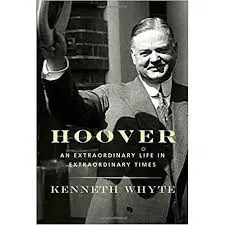
Hoover by Kenneth Whyte

Even to a historian, Herbert Hoover was a mystery.

Before reading Kenneth Whyte’s new biography of our 31st president, Hoover: An Extraordinary Life in Extraordinary Times, I knew three general things about Hoover. After World War I, he was instrumental in helping Europe feed itself and get back on its collective feet. As Secretary of Commerce from 1921 to 1929, he helped steer the American economy to high levels before the Stock Market Crash of 1929. And, as president, he was unable to stem the tide of Depression. On that last point, I had the general impression Hoover did little other than to say the Depression was just the way of business. It was only when Franklin Roosevelt came into office that the American government possessed a man willing to try anything to help.

But as I listened to the book and read about his energetic performance in just about everything he put himself into, a question began to form: what went wrong during his presidential administration? That is, didn’t Herbert Hoover try to help people?
When one reads a biography of a famous figure, generally you find things you like and can admire. Funny thing with Hoover: he was a peculiar man and, at least until his later life, an almost shy person who didn’t always enjoy the company of some people. In fact, during the early years of this biography, I got to thinking Hoover wouldn’t always be a guy with whom you’d want to just hang out. He was just peculiar. Even his marriage seemed rather perfunctory. The more the biography went on, the more it seemed, as the author noted, Hoover was a mere spectator of his own family.

Yet his engineering mind was fantastic. He worked all over the world which gave him a global perspective on things. In one of the more remarkable events I admired, it took Hoover, then living in London, barely a day to start setting up a group to help stranded American caught unawares at the outbreak of World War I. Many folks were stranded with no means to obtain money to buy a ticket back to America. Hoover started up a committee and did the thing he almost always insisted on: make him the one decision maker and leader. In this capacity, he was able to direct resources where needed and helped get over 100,000 Americans back home.
He repeated the feat during the war as he headed another committee to aid in relief of hungry Belgians. What I found fascinating was Hoover’s group, The American Relief Administration, was the only group recognized by both sides of the war. Each side allowed Hoover’s ships—flying its own flag—through enemy lines.

He was a data-driven man in an era just beginning to understand what data was and how it could be used. As Secretary of Commerce (and “under-secretary of everything else” as his detractors said), Hoover took an activist role in government. President Harding encouraged this and, when Coolidge assumed the office, kept Hoover on. He was in prime position to bring his expertise to American when the Mississippi River flooded in 1927. There Hoover was, on the ground, doing what he was most able to do: harness the goodwill of people and direct it to those in need.

He was a logical choice as the Republican nominee in 1928, and he won easily. His help to the poor in 1927 brought a large majority of Americans to his side in addition to the typical GOP voter. In an era of the Roaring Twenties, everyone seemed to like Hoover. Yet the man himself saw the warning signs looming on the horizon. He tried to thwart a potential downturn as Commerce Secretary, but others didn’t share his views. When the crash arrived, Herbert Hoover did what he had always done: gather a team with mounds of data and attack the problem.

It was here where I had my eyes opened. Rather than be the man who seemed to sit idly by waiting for the market to correct itself, Hoover actively pursued solutions. Sure, his personality wasn’t suited to leading the country in its most dire time before World War II, but he wasn’t a bystander. True, he preferred the government not to actively intervene if at all possible. He extolled the virtues of volunteerism, by individuals as well as businesses, seeing it as the best way for Americans to get back on their feet. But when businesses didn’t respond, he led the way. Not all his policies worked—the notorious Smoot-Hawley Tariff being the most famous example—but it is easy to see how Hoover paved the way for the direct government intervention of the Roosevelt years.

It is a rare figure where both sides of the political spectrum can claim a man as their own. The Progressives saw in Hoover a man willing to try things and have, as his ultimate aim, the betterment of his fellow Americans (and humans, as per his work prior to his government service). At the same time, the modern conservative movement can also claim Hoover as their own. After his defeat in 1932, he became a critic of what he saw as the overreach of FDR, and laid down a philosophy picked up by other conservatives in the 1950s and 1960s.

Herbert Hoover was a complicated man, yet there was more to him than meets the eye (or is contained in a Wikipedia article). He was certainly far from perfect and Americans needed a leader more personable than him during the Depression, but Hoover was a more-than-capable man who stands as a unique member of the American presidency. Whyte’s new biography is a fascinating exploration into a man hard to pin down, but is well worth the time.

Monday, August 13, 2018

Day Job Writer and Multiple Income Streams

 I am a day job writer. You know what I mean: fiction writing is not how I pay my bills. The day job as a technical writer does that. Fiction writing is the thing I do on the side. But recent events have me very aware that the revenue I derive from fiction writing could, one day, become a lifeline.

In the past couple of weeks, my day job suddenly became shaky. Yes, I’m still employed, but the project on which I worked was cancelled for the remainder of the year. I have a fallback project that I’ll begin on Monday, but the news of the cancellation was a shock to the system. It broke apart the great team with whom I’ve worked since last October. It also put my personal finances into peril.

It was then, surprisingly, that I realized my fiction writing must act as a bulwark against the ever-changing nature of the day job. In many, many places—podcasts, blog articles, and interviews—independent authors talk about the necessity of multiple streams of income. Typically, this talk circles around the choice between going exclusive to Amazon or making our books available widely in as many different bookstores as possible. Amazon exclusivity has its place, especially for short-term discoverability. But long term? Going wide is the optimal way to ensure any disruptions can be weathered.

Imagine you are exclusive to Amazon and they decide to change a feature without notice. What might you do if you find yourself the victim of Amazon’s crackdown like these folks? You have little to no recourse. Unless you have other sources of income. The concept is so strikingly obvious in the fiction world. Why had I never truly considered it for my day job?

Not sure.

But as I plan my publishing and writing schedule for the rest of 2018 and into 2019, I have an achievable goal: amp up the success of the fiction writing so it can act as a second source of income in the event my day job falters. It only makes economic sense.

How many sources of income do you have?

Saturday, August 4, 2018

Deep Diving Into the Mind of Christopher McQuarrie

This summer, I have seen every major film. But there is only one I want to see again. This time, in IMAX. Yeah, I’m talking about Mission Impossible: Fallout again.

Last week I wrote about sixth film in the Mission Impossible franchise. In the week since, I read every article I could find and watched every video featurette (discussions of the heists, that HALO jump, English slang, and the oh-so-charming one where Tom Cruise gets James Corden to jump out of a plane) but the crown jewel was the deep dive into the mind of director Christopher McQuarrie. Specifically I’m talking about his interview with the Empire Film Podcast. Host Chris Hewitt and McQuarrie talk. And talk. And talk. In fact, their interview is longer than MI: Fallout, which is the longest film of the entire series. But you will never be bored. You’ll want them to keep on going.

You might’ve already heard about some of the tidbits from this interview. Yeah, I’m talking about MustacheGate. Henry Cavill, deep into the filming of Fallout, was called back for reshoots on Justice League. But he had grown a mustache. Superman doesn’t have a mustache. What to do. McQuarrie relates the honest tale.

He also discusses the conspicuous absence of Jeremy Renner. His character, Brandt, starred in the two previous films, so why wasn’t he in Fallout? Again, the answer is as basic as it gets.

Those are likely the headline-grabbing pieces that might get someone to invest nearly three hours of listening. But that’s not the best. Not even close. The real gems of this interview is getting into the head of McQuarrie as he discusses, in intricate detail, aspects of the film. He talks about movie making in general, but most of his points can easily be applied to art of writing fiction. It was a master class in storytelling and making choices. More than once McQuarrie faced a deadline while shooting this film, and in nearly every time, he had to improvise. We writers talk about pantsing vs. plotting. The creation of Fallout is as close to pantsing as I’ve ever heard.

Best thing about the end of this episode? It’s only part 1. Part 2 arrives next week.

Do yourself a favor and listen to this interview. I bet you’ll come away not only with a greater appreciation of the film, but you’ll get a spark of creativity to boot. And sometimes, we all need a little spark.


You can find the interview here or via your favorite podcast app (I use and love Overcast).

Saturday, July 28, 2018

Mission Impossible: Fallout - The Best Pulp Movie This Year

First of all, Mission Impossible: Fallout is a phenomenal movie. I absolutely loved it. The action scenes are as you’d expect: awesome, over-the-top, and genuinely thrilling, especially when you know and see with your own eyes that Tom Cruise is doing practically all of them. Can you believe Cruise all but started doing these action movies around the age of forty, the age where many actors stop? The man knows how to craft a film.

I sat through most of the action scenes with a big goofy grin plastered on my face, loving practically every minute of film. I even jumped a few times, as did my wife who also thoroughly enjoyed the film. Heck, even my boy, seeing only his second Cruise movie and first MI film enjoyed it. Avengers: Infinity War was fantastic for what it did, The Incredibles 2 was gloriously fun, but MI: Fallout is hands down the best thrill ride of the summer.

One of my favorite hallmarks of these movies are the scenes where something appears to happen…only to learn later that another thing also happened that set everything into motion. It’s very much like a movie serial from the 1940s where you see Captain America appears to perish in a car explosion that caromed off a cliff…only to see that he jumped off at the last minute. Can’t get enough of that kind of thing.

Lester Dent’s plan for writing a pulp story also ran through my mind during certain scenes. Naturally, Cruise’s Ethan Hunt gets into trouble, and then more trouble, and yet more trouble. Then he must face choices that veer from bad to terrible. Just like Dent tells us writers. Oh, and that very end sequence, in Dent’s tales or MI films? Always there and always satisfying.

Speaking of satisfying, Henry Cavill is wonderful in this. He’s a big brute of a man, and those fighting scenes in the bathroom (they’re in the trailer) is brutal and vicious. Rebecca Ferguson returns and she is as bad ass as she was in the last movie. Simon Pegg is always a breath of levity in movies like this, especially this one which had much more humor than you’d expect.

Seriously, go now to a theater and buy your ticket to Mission Impossible: Fallout. It’s a living pulp story. You will enjoy it. Tom Cruise guarantees it and I wholeheartedly agree.