Monday, August 20, 2018

The Untamed West + "Gunmen Can't Hide" Excerpt

I can't tell you how excited I am to be listed among the great writers and stories in this new anthology from Western Fictioneers. This is a book I'd buy no matter what. Just read the names in the description.

A collection of twenty-nine tales of the Old West featuring previously unpublished stories by such classic Western writers as James Reasoner, Douglas Hirt, McKendree Long, and Michael R. Ritt. Edited by award winning author, L. J. Washburn. Western Fictioneers is the only writers’ organization devoted solely to traditional Western fiction, and this huge collection will take readers from the dusty plains of Texas to the sweeping vistas of Montana and beyond.

Western Fictioneers was founded in 2010 to promote the oldest genuine American art form, the Western story. Its worldwide membership includes best-selling, award-winning authors of Western fiction, as well as the brightest up-and-coming new stars in the Western field. The organization*s third anthology features original stories by Big Jim Williams, Easy Jackson, Jeffrey J. Mariotte, McKendree Long, Michael R. Ritt, S. D. Parker, James Reasoner, J. L. Guin, J.E.S. Hays, James J. Griffin, Jesse J Elliot, Ben Goheen, Barbara Shepherd, Nik Morton, S. L. Matthews, James Clay, Keith Souter, Tom Rizzo, Matthew P. Mayo, Dorothy A. Bell, L.J. Washburn, Angela Raines, Gordon L. Rottman, Charlie Steel, Douglas Hirt, Dennis Doty, and Cheryl Pierson.

You can purchase the ebook from Amazon, Kobo, or Barnes and Noble today. The paperback is also available from Amazon.

***

Now, I'm equally as thrilled with the story I submitted. "GUNMEN CAN'T HIDE" is probably my favorite story I've written this year. It features a new character that I enjoyed so much, I'm already working on a sequel or two.

Here's a brief description of my story and a short excerpt.

Uriah, Blake, and Orim Brink are outlaw brothers. They are cooling their heels in Laredo, Texas, after their most recent bank robbery. And murder. Uriah, after winning at poker and pocketing his money, goes upstairs to celebrate with a woman. But what he finds up there will make him wish he would have lost it all…

"Gunmen Can't Hide" Excerpt:

Not waiting another moment, Uriah reached out and slid all his winnings in front of him. His heart slammed in his chest with the thrill of the win. It wasn’t the same as robbing banks and shooting lawmen, but it was the next best thing. He arranged all the coins in stacks of five and evened the greenbacks. He tossed his cards to the ranch hand on his left and was ready for the next hand when he noticed Orim approaching.

The youngest of the three Brink boys, Uriah knew what Orim was going to do even before his brother put a gentle hand on his shoulder.

“Why don’t you take a break, little brother,” Orim said. “The bartender told me there’s someone special waiting.” He paused for emphasis. “Upstairs.”

Uriah was about to open his mouth in protest, to say he was back on a streak of luck, but caught the look in Orim’s eyes. It told him all he needed to know. Do what I say. Just like always.

To maintain some semblance of choice to the other members at the table, Uriah made a show. He inhaled deeply, drained the last of his warm beer, and collected his winnings.

“Wait a minute, seƱor,” Rodrigo said. His hands balled into fists on the table. “I want a chance to win back my money.”

Uriah stood and sneered. “It ain’t yer money anymore.” He nodded to the two ranch hands, scooted the chair back with his legs, and pocketed the coins. The jangling sound was music to his ears.

Orim put a hand on his brother’s shoulders. “Upstairs, third door on the left.”

The thought of what awaited him instantly got Uriah excited. He had just won back his money. What better way to celebrate than in the arms of a woman. A grin spread across his freshly shaven face, a touch Orim had insisted on. The better to hide in plain sight.

Uriah stepped away from the table and made his way across the crowded saloon. It didn’t matter he was going to pay for the woman’s services, he nevertheless tucked his shirt in and smoothed out the front. He looked around for the third Brink brother, Blake, yet saw no sign. No, there he was, leaning on the bar top, hand curled around a beer mug, talking to a man dressed in nice clothes. Uriah wondered if Blake was trying to get another job or just passing the time.

He ascended the stairs and reached the second floor. He opened the door at the end of the stairs, entered the hallway, and closed the door behind him. The general chatter from downstairs mixed with the piano player’s tunes were muted up here, but what wasn’t muted were the sounds coming from behind the closed doors. His heart quickened with the knowledge he’d soon join the chorus.

Uriah counted three doors and then softly knocked. He heard movement, the gentle sashing of flowing fabric.

“Uriah Brink?”

The woman’s voice was soft and sultry. Images flashed in Uriah’s mind as he imagined the type of woman who would possess such a sweet voice.

“Yeah,” he said. His voice cracked a little despite himself. He cleared his throat and repeated himself.

“Come on inside. I’m ready.”

Uriah reached out and gripped the door knob. He turned it and the door opened. He pushed it wide. The room was small. A brass bed was centered in the room. A bedside table held a lamp turned low. A mirror off to the left was next to a chest of drawers. Lavender permeated the room and he inhaled deeply. He detected perfume.

But he didn’t see the woman.

With slight concern, Uriah stepped inside the room and closed the door.

Something hard struck Uriah Brink on the back of his head. He saw stars. He blinked rapidly, trying to clear his vision. Whoever hit him was behind the door. Uriah tried to turn and confront his attacker, but something swiped at his ankles. He fell forward, feebly reaching out a hand to stop his fall. The wooden floor rushed up to his face. In another couple of seconds, he only saw black, but not before he noticed the deep red of a woman’s dress.
Tuesday, August 14, 2018

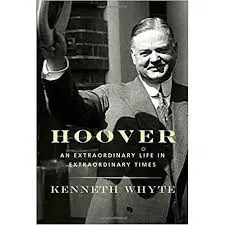
Hoover by Kenneth Whyte

Even to a historian, Herbert Hoover was a mystery.

Before reading Kenneth Whyte’s new biography of our 31st president, Hoover: An Extraordinary Life in Extraordinary Times, I knew three general things about Hoover. After World War I, he was instrumental in helping Europe feed itself and get back on its collective feet. As Secretary of Commerce from 1921 to 1929, he helped steer the American economy to high levels before the Stock Market Crash of 1929. And, as president, he was unable to stem the tide of Depression. On that last point, I had the general impression Hoover did little other than to say the Depression was just the way of business. It was only when Franklin Roosevelt came into office that the American government possessed a man willing to try anything to help.

But as I listened to the book and read about his energetic performance in just about everything he put himself into, a question began to form: what went wrong during his presidential administration? That is, didn’t Herbert Hoover try to help people?
When one reads a biography of a famous figure, generally you find things you like and can admire. Funny thing with Hoover: he was a peculiar man and, at least until his later life, an almost shy person who didn’t always enjoy the company of some people. In fact, during the early years of this biography, I got to thinking Hoover wouldn’t always be a guy with whom you’d want to just hang out. He was just peculiar. Even his marriage seemed rather perfunctory. The more the biography went on, the more it seemed, as the author noted, Hoover was a mere spectator of his own family.

Yet his engineering mind was fantastic. He worked all over the world which gave him a global perspective on things. In one of the more remarkable events I admired, it took Hoover, then living in London, barely a day to start setting up a group to help stranded American caught unawares at the outbreak of World War I. Many folks were stranded with no means to obtain money to buy a ticket back to America. Hoover started up a committee and did the thing he almost always insisted on: make him the one decision maker and leader. In this capacity, he was able to direct resources where needed and helped get over 100,000 Americans back home.
He repeated the feat during the war as he headed another committee to aid in relief of hungry Belgians. What I found fascinating was Hoover’s group, The American Relief Administration, was the only group recognized by both sides of the war. Each side allowed Hoover’s ships—flying its own flag—through enemy lines.

He was a data-driven man in an era just beginning to understand what data was and how it could be used. As Secretary of Commerce (and “under-secretary of everything else” as his detractors said), Hoover took an activist role in government. President Harding encouraged this and, when Coolidge assumed the office, kept Hoover on. He was in prime position to bring his expertise to American when the Mississippi River flooded in 1927. There Hoover was, on the ground, doing what he was most able to do: harness the goodwill of people and direct it to those in need.

He was a logical choice as the Republican nominee in 1928, and he won easily. His help to the poor in 1927 brought a large majority of Americans to his side in addition to the typical GOP voter. In an era of the Roaring Twenties, everyone seemed to like Hoover. Yet the man himself saw the warning signs looming on the horizon. He tried to thwart a potential downturn as Commerce Secretary, but others didn’t share his views. When the crash arrived, Herbert Hoover did what he had always done: gather a team with mounds of data and attack the problem.

It was here where I had my eyes opened. Rather than be the man who seemed to sit idly by waiting for the market to correct itself, Hoover actively pursued solutions. Sure, his personality wasn’t suited to leading the country in its most dire time before World War II, but he wasn’t a bystander. True, he preferred the government not to actively intervene if at all possible. He extolled the virtues of volunteerism, by individuals as well as businesses, seeing it as the best way for Americans to get back on their feet. But when businesses didn’t respond, he led the way. Not all his policies worked—the notorious Smoot-Hawley Tariff being the most famous example—but it is easy to see how Hoover paved the way for the direct government intervention of the Roosevelt years.

It is a rare figure where both sides of the political spectrum can claim a man as their own. The Progressives saw in Hoover a man willing to try things and have, as his ultimate aim, the betterment of his fellow Americans (and humans, as per his work prior to his government service). At the same time, the modern conservative movement can also claim Hoover as their own. After his defeat in 1932, he became a critic of what he saw as the overreach of FDR, and laid down a philosophy picked up by other conservatives in the 1950s and 1960s.

Herbert Hoover was a complicated man, yet there was more to him than meets the eye (or is contained in a Wikipedia article). He was certainly far from perfect and Americans needed a leader more personable than him during the Depression, but Hoover was a more-than-capable man who stands as a unique member of the American presidency. Whyte’s new biography is a fascinating exploration into a man hard to pin down, but is well worth the time.

Monday, August 13, 2018

Day Job Writer and Multiple Income Streams

 I am a day job writer. You know what I mean: fiction writing is not how I pay my bills. The day job as a technical writer does that. Fiction writing is the thing I do on the side. But recent events have me very aware that the revenue I derive from fiction writing could, one day, become a lifeline.

In the past couple of weeks, my day job suddenly became shaky. Yes, I’m still employed, but the project on which I worked was cancelled for the remainder of the year. I have a fallback project that I’ll begin on Monday, but the news of the cancellation was a shock to the system. It broke apart the great team with whom I’ve worked since last October. It also put my personal finances into peril.

It was then, surprisingly, that I realized my fiction writing must act as a bulwark against the ever-changing nature of the day job. In many, many places—podcasts, blog articles, and interviews—independent authors talk about the necessity of multiple streams of income. Typically, this talk circles around the choice between going exclusive to Amazon or making our books available widely in as many different bookstores as possible. Amazon exclusivity has its place, especially for short-term discoverability. But long term? Going wide is the optimal way to ensure any disruptions can be weathered.

Imagine you are exclusive to Amazon and they decide to change a feature without notice. What might you do if you find yourself the victim of Amazon’s crackdown like these folks? You have little to no recourse. Unless you have other sources of income. The concept is so strikingly obvious in the fiction world. Why had I never truly considered it for my day job?

Not sure.

But as I plan my publishing and writing schedule for the rest of 2018 and into 2019, I have an achievable goal: amp up the success of the fiction writing so it can act as a second source of income in the event my day job falters. It only makes economic sense.

How many sources of income do you have?

Saturday, August 4, 2018

Deep Diving Into the Mind of Christopher McQuarrie

This summer, I have seen every major film. But there is only one I want to see again. This time, in IMAX. Yeah, I’m talking about Mission Impossible: Fallout again.

Last week I wrote about sixth film in the Mission Impossible franchise. In the week since, I read every article I could find and watched every video featurette (discussions of the heists, that HALO jump, English slang, and the oh-so-charming one where Tom Cruise gets James Corden to jump out of a plane) but the crown jewel was the deep dive into the mind of director Christopher McQuarrie. Specifically I’m talking about his interview with the Empire Film Podcast. Host Chris Hewitt and McQuarrie talk. And talk. And talk. In fact, their interview is longer than MI: Fallout, which is the longest film of the entire series. But you will never be bored. You’ll want them to keep on going.

You might’ve already heard about some of the tidbits from this interview. Yeah, I’m talking about MustacheGate. Henry Cavill, deep into the filming of Fallout, was called back for reshoots on Justice League. But he had grown a mustache. Superman doesn’t have a mustache. What to do. McQuarrie relates the honest tale.

He also discusses the conspicuous absence of Jeremy Renner. His character, Brandt, starred in the two previous films, so why wasn’t he in Fallout? Again, the answer is as basic as it gets.

Those are likely the headline-grabbing pieces that might get someone to invest nearly three hours of listening. But that’s not the best. Not even close. The real gems of this interview is getting into the head of McQuarrie as he discusses, in intricate detail, aspects of the film. He talks about movie making in general, but most of his points can easily be applied to art of writing fiction. It was a master class in storytelling and making choices. More than once McQuarrie faced a deadline while shooting this film, and in nearly every time, he had to improvise. We writers talk about pantsing vs. plotting. The creation of Fallout is as close to pantsing as I’ve ever heard.

Best thing about the end of this episode? It’s only part 1. Part 2 arrives next week.

Do yourself a favor and listen to this interview. I bet you’ll come away not only with a greater appreciation of the film, but you’ll get a spark of creativity to boot. And sometimes, we all need a little spark.


You can find the interview here or via your favorite podcast app (I use and love Overcast).

Saturday, July 28, 2018

Mission Impossible: Fallout - The Best Pulp Movie This Year

First of all, Mission Impossible: Fallout is a phenomenal movie. I absolutely loved it. The action scenes are as you’d expect: awesome, over-the-top, and genuinely thrilling, especially when you know and see with your own eyes that Tom Cruise is doing practically all of them. Can you believe Cruise all but started doing these action movies around the age of forty, the age where many actors stop? The man knows how to craft a film.

I sat through most of the action scenes with a big goofy grin plastered on my face, loving practically every minute of film. I even jumped a few times, as did my wife who also thoroughly enjoyed the film. Heck, even my boy, seeing only his second Cruise movie and first MI film enjoyed it. Avengers: Infinity War was fantastic for what it did, The Incredibles 2 was gloriously fun, but MI: Fallout is hands down the best thrill ride of the summer.

One of my favorite hallmarks of these movies are the scenes where something appears to happen…only to learn later that another thing also happened that set everything into motion. It’s very much like a movie serial from the 1940s where you see Captain America appears to perish in a car explosion that caromed off a cliff…only to see that he jumped off at the last minute. Can’t get enough of that kind of thing.

Lester Dent’s plan for writing a pulp story also ran through my mind during certain scenes. Naturally, Cruise’s Ethan Hunt gets into trouble, and then more trouble, and yet more trouble. Then he must face choices that veer from bad to terrible. Just like Dent tells us writers. Oh, and that very end sequence, in Dent’s tales or MI films? Always there and always satisfying.

Speaking of satisfying, Henry Cavill is wonderful in this. He’s a big brute of a man, and those fighting scenes in the bathroom (they’re in the trailer) is brutal and vicious. Rebecca Ferguson returns and she is as bad ass as she was in the last movie. Simon Pegg is always a breath of levity in movies like this, especially this one which had much more humor than you’d expect.

Seriously, go now to a theater and buy your ticket to Mission Impossible: Fallout. It’s a living pulp story. You will enjoy it. Tom Cruise guarantees it and I wholeheartedly agree.

Monday, July 23, 2018

Chuck E. Cheese Con 2018: Where Everyone Can Be a Kid

There’s a con for that?

Those were the words I heard multiple times leading up to last weekend when I would tell folks I was taking my son up to Dallas for a Chuck E. Cheese convention. Sure there is. Why wouldn’t there be a con where fans of a particular property gather to exchange trivia, see classic memorabilia, and, most importantly, connect with other like-minded fans? Heck, there’s probably a con for anything you can think of that has a dedicated fan base, and certainly a property that is as old as Star Wars. And, in my discussions with some of the other fans and parents, I learned folks traveled from as far away as Delaware, New York, and Alabama to attend this event.

Chuck E Con 2018 is the brainchild of Matt Rivera, a lifelong Chuck E Cheese (CEC) fan since the age of two. Now, at thirty, he is known on YouTube as Matt the Franchize. His channel is dedicated to “the greatness of Chuck E. Cheese’s past, present, and future.” His love for CEC took him from being a kid who loved the brand to working for eleven years at various CEC locations all the way to the corporate office. From what I can gather, he is among the top, if not the primary channel, for CEC fandom on YouTube. And he has the stats to back it up. His channel has been viewed over 76 million times with over 52,000 subscribers. The last CEC convention (CheeseVention) occurred in 2013 and there hadn’t been a CEC con since, so Matt decided to fill the gap. With a dedicated group of friends and fellow fans and an effort of a year and a half, Matt the Franchize created Chuck E Con 2018.

After a gathering and a store tour of an Arlington, Texas, CEC location from the early 1980s, Chuck E Con 2018 moved to the multi-function room at American Legion Post 453 at Love Field. Along two walls were tables filled with CEC memorabilia, including a couple of animatronics, one of which Matt owns. At the front was a recreation of a CEC stage, complete with lights and props. Matt and his co-hosts (including Emily Sullivan and Brandon McMillan) made some introductory remarks and then the real stuff began.

You might be wondering what would be the main attraction at a CEC con. Well, if you’ve ever stepped foot into one of the restaurants, you know there are animatronic representations of Chuck E Cheese himself and his four friends. Every hour, Chuck E. himself (one of the store employees in costume) comes out to say hello to kids and wish that special someone a happy birthday. In addition, there are videos with the characters consisting of performers dressed up in costume and performing songs or skits. Some of these pieces are famous among the CEC fan community, and it is with this in mind where the real magic of Chuck E Con 2018 happened.

For nearly two whole days, Matt and the other performers donned costumes and performed what amounted to a set list of greatest hits and deep album cuts. Each song was pulled from the forty years of CEC history and was an original recording. What was really cool, even for a CEC layman like myself, was seeing the progression of Chuck E’s appearance from the bulkty, streetwise, New York-accented Chuck E from 1977 all the way up to the present, lithe and refined mouse. In a genius move, the actual songs being performed was not listed in the program, so with each run-up to the next song was met with anticipation by those of us in the room. After most every song, the characters would remain while fans lined up to have their pictures taken with the various incarnations. The finale was spectacular, but the song that nearly brought the house down was when Chuck E arrived in the costume he wore in an ultra-rare VHS movie. The roar was such that you might’ve thought Elvis had just walked into the room. If there was a holy grail of costumes, it was likely this one.

Speaking of costumes and performers, the folks running Chuck E Con carried on what fans of Sherlock Holmes call the ‘gentle fiction.’ We all know Sherlock Holmes is fictional, but most fans still consider him and Watson to have been real people, so much so that when new novels are released, they are purported to be found manuscripts from Watson’s personal files. So, too, it was on Friday and Saturday. At one point, one of the announcers commented that wasn’t it amazing that Matt was standing next to Chuck E. Loved it.

Chuck E Con 2018 was a labor of love for Matt, Emily, primary announcer Brandon, and all the other folks who put on this event. He picked up the torch of Chuck E Cheese conventions and moved it forward. With any good fortune, this will be the first of many Chuck E Cons to come. The CEC fan community is fantastic, and even the parents seemed to enjoy themselves. I know I did. It would be very difficult not to be engaged with you’ve got these characters dancing not five feet in front of you. Remarkably, the event was free, but if Chuck E Con 2018 was any indication, Matt can charge folks a registration fee for future events and fans will attend.

If the slogan of Chuck E. Cheese’s is “Where a kid can be a kid,” then the slogan of Chuck E Con 2018 and beyond should be “Where everyone can be a kid.”

Monday, July 16, 2018

Privy to a Secret: The Exquisite Playing of Ludovico Einaudi

“Privy to a secret.” Those were the words my wife said to me after we walked out of Houston’s Jones Hall last night and got in our car. We each took turns pointing out things we liked and enjoyed from “An Evening With Lucovico Einaudi,” but it was her words that summed it up best.

And we have Radio Paradise to thank.

Radio Paradise is an online streaming music service curated by husband-and-wife team Bill and Rebecca Goldsmith. Operated out of California, the music from Radio Paradise varies widely. You can easily go from “Lady Grinning Soul,” an album cut by David Bowie, to John Coltrane’s “Blue Train” with stopovers featuring Talking Heads, Tears for Fears, Cat Stevens, and The Black Keys. It is one of the few listening experiences nowadays where you truly have no idea what song is coming next.

We heard Einaudi’s music a few times on the station. My wife loved it enough to seek out his music. In the course of her online research, she discovered he was coming to Houston. With zero hesitation, we bought tickets. They were a pair of rear balcony seats, but it didn’t matter. We were in the hall. Ominously, when we walked up to the front doors yesterday, we read signs stating balcony seat ticket holders must go to the box office. The balcony, it seemed, was closed. The looks of worry were etched on more than one face, but I suggested it was likely because the orchestra level wasn’t sold out and they were consolidating everyone down there. Turns out, I spoke the truth. We ended up on row R, a definite upgrade.

Literally, I know Einaudi’s music by the three or four tracks I’ve heard on Radio Paradise. In each of those, it was solo piano, so that’s what I was expecting. The setup on stage was for six musicians with a grand piano in the middle. Interesting, the piano keys faced the audience. That meant we would get to see Eunaudi’s hands while he played but his back would be to us. I hadn’t seen that before, but it turned out perfectly fine because not only was Eunaudi the composer of the music we heard, he acted more as a conductor to his band.

Band. That’s not quite the correct word to use, but orchestra doesn’t fit, either. This collection of musicians consisted of a cellist (who played both acoustic and electric cello), bass (doubled as an extra synth player), percussionist (not a drummer), guitar (who also played some percussion), and a violinist (who picked up acoustic guitar, electric guitar, and played a small organ). Projected on a large screen behind the group were various images, hypnotic in their complexity and which worked so well with the music. Most of the time, the accompanying musicians were in shadow, so you’d only see them in silhouette against the screen.

It’s a little difficult to figure out words to describe the music of Einaudi, but exquisite is up there. Wikipedia lists “minimalist” first. No, this doesn’t mean fewer instruments. It is, according to Richard Rodda, “…the repetition of slowly changing common chords in steady rhythms, often overlaid with a lyrical melody in long, arching phrases…[It] utilizes repetitive melodic patterns, consonant harmonies, motoric rhythms, and a deliberate striving for aural beauty.” It’s the last phrase that is key. “Aural beauty.” What is remarkable about Einaudi’s music in all of its aural wonders is the personification of the music. When you listen to a symphony, a rock song, a jazz piece, or a Broadway tune, there is a common understanding of the music. Beethoven’s 5th Symphony or Dave Brubeck’s “Time Out” all have those familiar melodies we can sing on our own. With Einaudi’s music, you can’t. Instead, what you are treated to is a unique musical experience that won’t or can’t be repeated ever again. It’s like being in the presence of a great artist and his musician friends as they paint with sound. There is a meditative quality to Einaudi’s music that gets inside your mind as your ears take in these sounds and chords.

One fun thing was to take note of a couple of particular instruments. One was a sort of crystal piece, held by one hand while the other used a violin bow across the surface. The resulting sound was akin to rubbing your wet finger around the rim of a wine glass. The conical-shaped instrument—smaller at top and much wider on the bottom—changed pitch depending on the location of the bowing. The other unique thing was a metal rectangular sheet, suspended by a wire. The percussionist held it by the wire, lowered the sheet into a clear container of water, and used a mallet to strike the plate. He would raise and lower the sheet, creating different tonalities. Lastly, the electric cellist would rub his entire open palm up and down the strings. The aural effect was of a person breathing. Watching these performers last night was itself a work of art.

It’s a rare concert I attend where I know basically nothing about the music I’m there to hear. The experience was utterly mesmerizing. In other settings at other concerts, the performers do their thing for you. If you’re there to watch your favorite rock band, you jam with them and sing along. Einaudi’s concert is a personal journey, communal with all the other folks in the crowd. You all hear the same notes but you take away something entirely personal. The audience knew Eunaudi and his music, as evidenced by the cheers as he walked out, and the loud, boisterous, and prolonged exaltation at the end.

Like my wife said, it was like we got a peek into a man and his music unknown to a large part of the world. Or maybe it was just unknown to me. Don’t’ know. By all indications online, the Houston date was the last in North America after only a handful of dates across the continent. I’m again so happy to live in a city like Houston that can attract an artist such as Ludovico Einaudi, and I’m quite happy to be in on the secret of his exquisite music.

Saturday, July 7, 2018

The Gray Ghost by Clive Cussler and Robin Burcell

Clive Cussler is one of those authors I admire. He cut his teeth on his Dirk Pitt novels before expanding his universe to include the NUMA series (Kurt Austin) and Oregon Files (Juan Cabrillo). These three series have numerous crossovers (if my paltry reading of the entire run is any indication). But it’s his Isaac Bell series, set in the early days of the 20th Century, that I really enjoy. The fourth series is the Fargo adventures, featuring Sam and Remi Fargo. They’re a charming pair of millionaires (thanks to Sam’s invention) and they travel the world, searching for treasure and doing good. I had only read one novel of theirs to date (THE TOMBS) but the latest novel, THE GRAY GHOST, features not only them, but Isaac Bell.

How, might you ask, can a story set in the present also include Bell? Well, it’s a very clever conceit. In 2018, someone steals the Gray Ghost, a Rolls-Royce car from 1906. In the course of the story, Sam and Remi get involved in the search for the priceless car. You see, there has always been a legend that treasure exists in the car, but no one has found it for over a century. As soon as the Fargos get involved, they have bad guys trying to stop them, even while they try to help the actual present-day owners locate the vehicle.

Where Isaac Bell comes in is through a journal. Back in 1906, Bell helped an ancestor of the present owner thwart another attempt to steal the Gray Ghost. That ancestor kept a journal of the exploits, but that volume of the journal is missing in the present day. Stolen. Cussler and co-author Robin Burcell keep the action going not only with the Fargo adventures but the Bell investigation as well, interspersing passages of the journal with the current action.

As with all Cussler novels, I listened to the brilliant Scott Brick narrate the story. It was interesting to hear slight variations between how Cussler and Burcell treat Bell versus Cussler and Justin Scott, the team who writes the Bell novels. Brick brings so much to his narration that it enlivens the story above the mere prose.

If I have one criticism of this series, it’s in the back-and-forth dialogue of the two main characters. Often times, you don’t get the spark of passion between husband and wife. I’m not calling for a bunch of intimate scenes, and I’m completely fine with them walking to a hotel room with the knowledge of what they’re about to do, but I would like to see a little more fire to their relationship. In one of the dire moments in this book, I got the sense of it, but I’d like to see if when they’re not fighting for their lives. It’s a little thing, but noticeable.

For a good summer beach read, THE GRAY GHOST is a humdinger, and it’s propelled me to my next Fargo adventure, THE MAYAN SECRETS.

Tuesday, July 3, 2018

Project: Nemesis by Jeremy Robinson

When I asked my fellow science fiction book club friend how he came to select PROJECT: NEMESIS by Jeremy Robinson, he said he was looking for something that captured the 60s cartoon/monster movie vibe. Additionally, he heard a couple of folks saying this book was a genuine effort to do an American kaiju book. Well, that would have been enough for me, too. But a premise is only half of the equation. The book has to deliver.

Two words come to mind: Nailed it!

PROJECT: NEMESIS starts with a military operation in the far north and two soldiers stumble upon the remains of a giant monster. This story is set in a nebulous future/present where Japanese soldiers work with Americans and train together. When a high-ranking general arrives, he promptly asks the younger Japanese soldier to shoot his American partner.


The story cuts to our main hero, John Hudson, Department of Homeland Security-Paranormal Division. He’s in Maine mostly to investigate a series of reports of a Sasquatch sightings. He arrives at a cabin where he’s supposed to sleep only to find a mama bear and cubs have staked out their claim. So, in a novel about a kaiju, you first get a bear attack. And it’s pretty darn exciting. Hudson survives—but not his truck—and he throws back quite a few beers to decompress. Well, the next morning, the local law officer in the person of Sheriff Ashley Collins and, through his hangover, Hudson accompanies Collins to interview the old man who called in the complaints. What they find is unexpected: a seemingly abandoned military base from the Cold War days. But if it’s abandoned, then why is the razor wire new? And why is the wire coated with a substance meant to look like rust? And why is there a man and his hidden partners there pointing a shotgun at them?

PROJECT: NEMESIS definitely earns the name ‘thriller’ because the action rarely lets up. Robinson throws in a lot of sequences that are just flat-out fun. Plus, there’s a kaiju, the Japanese word used to describe giant monsters like Godzilla, Mothra, or King Kong. What makes this story interesting is how the kaiju was created and birthed. It may not be totally unique in the entire oeuvre of monster movies, but I liked it.

The bulk of the book is told from Hudson’s first person, present tense point of view. It gives the story a breathless immediacy.  When the POV switches, it’s all still present tense, including a few scenes featuring the kaiju itself. You actually get a ‘why’ to go with all the destruction. More importantly, you get a twist on a common story trope. Most of the time when an author introduces you to a character via their POV, you make the assumption you’ll be with that character the entire way through the book. Nope. He manages to make you care for a character and then have that character die. It was a shock, as in “Did [that character] just get killed?” Yup. It made the rest of the action higher pitched because you never knew if any of the main characters would get offed.

I listened to the audiobook and this is a perfect case for narrator giving that little extra something that comes across as greater than the whole. Hudson is basically your typical wise-cracking hero, and Jeffrey Kafer is pitch perfect. Robinson’s words and Kafer’s narration sucked me in almost immediately. Heck, I finished this nearly nine-hour book in five days. I started volunteering for household chores. Need the lawn watered? I’ll do it, just let me get my phone. Oh, we need to drive our empty glass bottles to get recycled? I’m your man.

PROJECT: NEMESIS is nothing less than a thrilling summer blockbuster in prose.

Sunday, July 1, 2018

The President is Missing by Bill Clinton and James Patterson

Almost from the day it was announced, I knew I wanted to read THE PRESIDENT IS MISSING by Bill Clinton and James Patterson. On the one hand you have one of the all-time best-selling authors who has created his own fiction factory. On the other, you have a former president who served for eight years in the office and could provide vital details as only a man who sat in the Oval Office could. It was a match made in heaven.

But would the book be any good?

It’s an honest question, but let’s be honest: if it’s got Patterson’s name on it, the story will at least be serviceable.

And I’m here to tell you it’s more than serviceable. It’s pretty darn good.

The story opens as President Jonathan Lincoln Duncan, newly widowed, is facing the prospect of a compelled testimony in front of a Congressional committee. Impeachment is in the air because Duncan recently ordered a special forces raid seemingly to save notorious terrorist Suliman Cindoruk, leader of the Sons of Jihad group. The Speaker of the House—a member of the unnamed ‘other party’; Duncan’s party affiliation also remains unnamed making it more bipartisan—who has designs on the presidency smells blood.

But Duncan has an even greater problem. Somehow, Suliman’s cyber hackers have implanted a virus in the computer systems of the Pentagon. Codenamed “Dark Ages,” if released, the resulting damage would be catastrophic. It would literally plunge the US into a modern dark ages. And one of six members of Duncan’s inner circle—including the Vice President—is a traitor because a young girl from the Republic of Georgia is asking to meet with Duncan. Alone. And she utters “Dark Ages” to prove her point.

How could this young woman know that? Who is she? And, after Duncan goes incognito and meets at the baseball stadium, who is this other guy pointing a gun at the President of the United States?

THE PRESIDENT IS MISSING clocks in at over 500 pages, but they read extremely fast. Duncan’s prose is all in first person and the entire novel is written in the present tense, giving it an urgency. Having Duncan narrate his own scenes is great, especially with his asides when he gives details you know came from Bill Clinton’s memories. There are other characters and all those scenes are related in third person. It’s the first time I can remember reading a book like this. Granted, as a writer, I noticed the differences at first, but as the story went on and my reading speed increased, it faded away and I was solely in the action.

By now, Patterson is a master at crafting a story and, while I’ve read few, I could see how one of his stories is made. And I really loved how the tension was racketed up. Sure, there were lots of cliffhanger chapter endings, but this is a summer thriller. It’s supposed to have cliffhangers.

And there was one passage of about five chapters that completely fooled me. I thought one thing was happening and it was something else entirely. Much like watching “The Sixth Sense” a second time when you know the truth, I re-read those chapters just to see how Patterson did it. Brilliant. Also brilliant was the skillful way Patterson kept the truth behind the traitor and other characters, revealing their identity at precisely the right time. This guy can tell stories!

I purchased this book from my local grocery store and I pointed out something to some friends who noticed the book in my basket. I indicated all the other Patterson novels on display—eight?—and then at THE PRESIDENT IS MISSING. Patterson’s name was listed on top of all save the new one. It takes a president’s name to shift Patterson to second billing.

I very much enjoyed this book and would easily recommend it as a good beach read.

Sunday, June 24, 2018

Congo by Michael Crichton

I'm a book dork. Are you?

I’ve read many, but not all, of Michael Crichton’s novels, but CONGO was one I had missed. I have the paperback, but it had remained on my shelf for years. Earlier this spring, a comment on the Doc Savage Facebook group said CONGO was a pretty good lost city novel. It landed back on my radar. I flipped it open and noticed one of the locations was Houston. How cool was that? Additionally, the action began on 13 June 1979. And I got to thinking: since I was already reading a book at the time, why not wait until 13 June to start the book?

So I did. Book dork? Guilty as charged. But at least I didn’t wait until 13 June 2019 to start it.

The story opens with a transmission from a team in the Congo back to their home base in Houston. The team is part of the Earth Resources Technology Services (ERTS), one of two companies searching for diamonds in the Congo rainforest. Just before the video feed is abruptly cut off, there appears to be what looks like a gorilla. Not just any ordinary ape, but something different.

Soon, a second team, led by Dr. Karen Ross, sets out to keep looking for the lost city and discover what happened to the original team. Coming along is zoologist Dr. Peter Elliot and Amy, a gorilla from the San Francisco Zoo that has learned American sign language. Along the way, Ross recruits the famed white hunter Captain Charles Munro to guide them.

I’ll admit it’s been awhile since I’ve read a Crichton novel solely written by him. (I read the posthumously published DRAGON TEETH last year.) I had forgotten just how much science the author crams into his books. What particularly interested me was some of the computer stuff the team had to do. In this age of cell phones and satellite phones and instant access, it was charming for Ross to have to wait six minutes for the satellites and her communication equipment to sync up. Then there is always the “As you Bob” moments that are liberally scattered throughout the book. With the zoologist being the outside member of the team, he gets to ask for clarification on things Ross and Munro know by heart. The science, however, was fascinating, especially regarding the attempts by scientist to teach apes communication skills. I found it ironic timing that I completed the novel a day before Koko the gorilla who learned American sign language died.

Unlike the JURASSIC PARK novel where, once the dinosaurs escape, you are in a series of chases and near misses, the action here is not as relentless. There are some political struggles that erupt in gunfire, and a few brushes with death, but CONGO is more a novel of discovery. In this, it’s a perfect book for Crichton’s talents. What makes the book even better is its seeming realness, almost as if Crichton is merely the author of a non-fiction book depicting events that really happened.

CONGO is a perfectly fine book, not in Crichton’s top tier novels, but well worth the time to read, especially if you enjoy lost city stories like I do. Now, I’m going to conduct a little search of my own and track down a copy of the 1994 movie.