(A decade is a long time, and, yet, one that can easily be remembered. Here, in 2013, we are marking the decade anniversaries of the Iraq War. One of the things that I always remember were the reporters embedded with our fighting forces, David Bloom in particular. Today, on the anniversary of his untimely passing on the battlefield, I am reposting the essay I wrote for and was published in the Houston Chronicle. Bloom died of a blood clot brought on by deep-vein thrombosis. It can be prevented, and you can learn more at PreventDVT.org. Mr. Bloom, we all still miss you.)
April 7, 2003, 8:18PM (Tuesday)
The war came home for me Sunday.
I
hesitate to write that sentence because the war in Iraq is almost
4-weeks-old now and there have been at least 108 coalition soldiers
killed. Each one of those families already has the war at home with
them. The war sits down to dinner in the empty seat of the missing
father. The war is in bed with the newly widowed wife, the empty space next to her now a hollow hole in her heart.
I
have no relatives fighting in Iraq. In this country of more than 280
million people and about 1.4 million people who serve in the
all-volunteer military, I am one of many in America whose freedom is
defended by someone nameless.
But those who cover the war aren't
nameless, and one of the best things to emerge from the war is the
reporting by embedded journalists in the field. With new technology and
24-hour news channels, the war --with its images of reporters in
military gear – is simply always on. Yet, while I admire the courage of
these reporters, some of them look out of place.
One reporter who
seemed exactly in his place was David Bloom, a journalist for NBC. Ever
since his unit -- the U.S. Army's 3rd Infantry Division -- moved out,
David was dirty. He was the first reporter to beam live images of the
moving convoy of tanks. I remember seeing these images and being
astounded that I was witnessing live war footage. He had a "boyish
enthusiasm" when he described military details, and he knew his role
exactly: Bring home the war to the American people.
But the war
details were not the entire story. He also knew that his greater
responsibility was to show America the lives these soldiers were
leading. He let us know that MREs were not all that bad. He let us know
how big a Bradley vehicle was and yet how cramped it could be when fully
occupied. He let us know how dusty it was by never cleaning up for the
camera. He let us -- the ones the soldiers were protecting --know what
it was like to be a U.S. soldier in Iraq.
David Bloom seemed to
always be on the air. Iraq is nine hours ahead of Houston, but no matter
the time of day here, there always seemed to be the word "Live" on the
screen. He was live during the middle of the night talking with Lester
Holt, live during the Today show and even live during the evening news,
giving Tom Brokaw the absolute latest. When I flicked channels between
the three major network news channels, if David Bloom was on, I stopped
and listened. He was, for me and for my wife, Vanessa, our favorite
reporter, a friendly voice from the front line.
He died Sunday of a pulmonary embolism.
Based on what I learned that day, he took power naps and would stay
awake for hours. Perhaps that is why he seemed to always be on, live, no
matter the program or time. The retrospectives told us that he was a
driven man, one who always had to be where the action was. He
volunteered for this assignment and, I think, broke the mold as a
front-line combat reporter.
I was feeding my son when the news
broke. I am used to nameless numbers when the media talk about
casualties, men and women who have laid down their lives for me. But
when the news anchor said David's name, my heart was pierced. Tears
seeped into my eyes for a man I never knew but, somehow, knew. My wife
cried, too.
The embolism was a noncombat death, but it really is a
combat death. David went to Iraq partly out of a duty to his
profession, but also partly out of a loyalty to this country. He is a
casualty of war, just as are the other fallen soldiers. They all are
heroes.
I have never been a soldier, but I am a writer and I know
what that is like. David Bloom and the more than 600 embedded reporters
are heroes to me. With them, the war is very close.
With the intimacy of television,
perfect strangers can seem like friends to us. We viewers think of Dave
or Jay, not Mr. Letterman or Mr. Leno. David Bloom's constant presence
on the television, his mannerisms, his wit, his focus on the ordinary
humanness of our soldiers made him seem like "David" to me, a person I
knew on a first-name basis. And he was, in a way. That is the nature of
television.
But on Sunday, upon learning that I'd never again
hear his voice, upon learning that he left his family to go and do
something bigger than himself, upon learning of his ultimate sacrifice
for his country and his profession, he was Mr. Bloom. That is the nature
of heroes.
The war came home for me that day.
Saturday, April 6, 2013
Wednesday, April 3, 2013
Book Review Club: Leviathan Wakes by James S. A. Corey
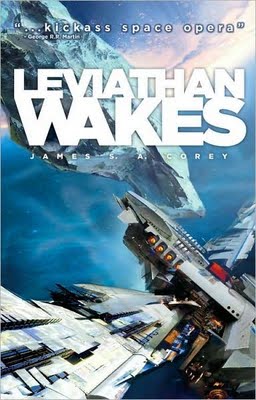
Let's get this out of the way at the start: Leviathan Wakes may be space opera, but it's not your grandfather's space opera.
Your granddad, if he were a mind, probably cut his teeth on Edgar Rice Burroughs, E. E. "Doc" Smith, Leigh Brackett, or any of the writers from the golden age of SF. Your dad probably cut his teeth on the likes of Michael Moorcock, Star Trek, Star Wars, or any of the things that have come in their wake. When you mention these authors or shows, certain things come to mind: spaceships, lasers, dreadful monsters, dashing heroes, and lots of derring do. Oh, and physics doesn't count because there's artificial gravity, warp drive, hyperspace, and all the usual stuff you associate with the genre.
Leviathan Wakes, then, is somewhat of a new animal. It's a space opera yarn for the 21st Century. It is not the only one, to be sure, but it is the first of its kind that I've read. Author James S. A. Corey (actually a pen name for the authors Daniel Abraham and Ty Franck) has set the first of a trilogy (aren't they all?) in the near distant future and entirely in our solar system. I say "near distant" because it's a few centuries away, but not far enough that all the parts of this universe isn't too far gone to be recognizable. By setting the entire story in our own solar system ensures the reader that the tale will be on the frontier, but a believable frontier complete with all the human problems that we early 21st Century citizens can understand.
The story follows two main characters. Jim Holden, Earth-born, is the executive officer on the ice hauler, Canterbury. The 'Cant' receives a distress call from the Scopuli and, under common practice, they answer it. Holden leads a crew of three on their smaller shuttle to investigate. They find evidence of piracy and attribute the origin to Mars. On their way back to the mothership, however, the Canterbury is attacked and destroyed. Distraught with emotion, Holden sends a message across the entire solar system that all but accuses Mars of being the perpetrators. Naturally, this stirs up some animosity between Earth, Mars, and the Belt (the asteroid belt between Mars and Jupiter).
The other main character is Miller, a police detective born and raised in the colonized asteroid Ceres. Granted, he's your typical noir-inflected character, but he's tasked with a new, off-the-books assignment: Find Julie Mao and bring her back, by any means necessary, to her parents.
Well, as it turns out, Julie was on the Scopuli, so, naturally, you pretty much have Miller and Holden angling on a collision course both between themselves and the entire system.
This book gets a lot of things right. This is space opera on the believable level. Yes, there are lasers, but not any photon torpedoes. There is no light speed and it really does take a long time to get from place to place. The characters experience G-force pressure when accelerating, nearly to a dangerously high level. Communication is not instantaneous. A "live" conversation has scores of minutes in lag time. The space combat is brutal and not without a comparison to old-style naval combat. All told, these characteristics of the story give this tale life, a vision of the future that you don't get from Star Trek.
Each chapter is told from the POV of either Miller or Holden. For the first third or so, they are separated, enabling the authors to comment on the events from a distance. Once the heroes meet up, the authors can show and tell of the events from the different POVs. Holden is an earnest man who believes that, if everyone knew all the facts, they would choose the right course of action. Miller is the cynic, the real world man who knows that is rarely the truth. Together, these two world views clash and strive towards the conclusion of the book.
Leviathan Wakes is satisfying on a host of levels, but none more than this: I've easily transitioned to the second novel of the trilogy (Caliban's War) and eagerly await the concluding volume later this summer. If you have a taste for blockbuster space opera in book form, Leviathan Wakes is your food. Devour it and enjoy.

Click icon for more
book review blogs
@Barrie Summy
book review blogs
@Barrie Summy
Saturday, March 9, 2013
Inspiration from Unlikely Sources
A common writerly thing we tell ourselves is that inspiration for a story can come from just about any place and at any time. You know what else can come from those same mysterious places? The desire, the push you might need to get one's butt in a chair and write.
I don't know if y'all ever experience this, but, at times, watching my current favorite TV programs (Castle, Elementary, Grimm, Body of Proof), at some point during the broadcast, two things usually happen. One, the realization that I should probably be writing. I let that one slide, typically, because we can't be a writer and/or writing all the time. Two, I get inspired to go write. I enjoy those shows for their creativity, their structure, and their characters that it can prompt me to take notes about my characters or stories or dash to the keyboard and fire out some pages of my own characters because I enjoy them coming to life as much as I enjoy watching Castle, Beckett, Holmes, or Nick Burkhardt come to life and do their thing.
That kind of inspiration is, I think, typical of all of us writers. What may not be typical is getting inspiration from as unlikely as source as a podcast about Batman. Kevin Smith has, since last year, created a podcast devoted to his love of the Dark Knight. Naming it "Fat Man on Batman," each week (more or less) is an episode devoted to one or another aspect of Batman's history. With this venture being an audio-only podcast, naturally, the only thing we have is the interview itself, the voices of Smith and his guests for that has been the way Smith talks about Batman. His guest list has run out pretty wide, even though it is probably more Batman: The Animated Series heavy.
For any Batman fan out there, I cannot recommend this show enough. It has been the weekly thing that I most look forward to. I download and put on my iPod as quickly as possible. The depth and breadth Smith and his guests take the adventures of Batman is inspiring. It will confirm things you already knew, reassess things you thought in a different way, and make the entire experience of watching and reading Batman fun again.
But that's not all. What comes across in your ears is passion. There is a passion for the material, certainly. How can you even think to have a podcast if you hated something, right? It's become something of a joke now, but many of Smith's interviewees bring the big man to tears. If it's not tears that are forming in Smith's eyes (and voice), then it's awe. All too often, the guests--who have ranged from Mark Hamill, Paul Dini, Bruce Timm, and Kevin Conroy (Batman: TAS) to Kyle Higgins, Geoff Johns, and Grant Morrison (comics)--convey their thought process behind a certain episode or issue or way of thinking about Bruce Wayne and his rather odd outlet for his childhood tragedy. Each time, Smith just sits in stunned amazement, comprehending something he thought he knew and seeing it in a new way. The same for us listeners, too.
Just like the old days when you were limited by the number of comics you could put in a box and take with you on vacation and you read those same issues over and over, these podcasts are like that. I've listened to most of them twice, so enjoyable are the conversation and the topics. But each time, I am prompted, nee I'm pushed by an uncompromising force to get to my Mac or pen/paper and *create*. It is the strangest thing. You'd think that I would start writing my own Batman story or jump back to an episode or an issue and re-read. I do that, but not initially. What I end up doing is want to create my own beings and put them through the motions of their lives. I want to bring the passion for my own material that others bring to Batman. I already have the passion for my projects--why else would I be writing them?--but sometimes, this podcast is like icing on the cake. It is a wonderfully unexpected consequence to listening to theses podcasts.
Is there something you do that brings unexpected creativity to your writing?
I don't know if y'all ever experience this, but, at times, watching my current favorite TV programs (Castle, Elementary, Grimm, Body of Proof), at some point during the broadcast, two things usually happen. One, the realization that I should probably be writing. I let that one slide, typically, because we can't be a writer and/or writing all the time. Two, I get inspired to go write. I enjoy those shows for their creativity, their structure, and their characters that it can prompt me to take notes about my characters or stories or dash to the keyboard and fire out some pages of my own characters because I enjoy them coming to life as much as I enjoy watching Castle, Beckett, Holmes, or Nick Burkhardt come to life and do their thing.
That kind of inspiration is, I think, typical of all of us writers. What may not be typical is getting inspiration from as unlikely as source as a podcast about Batman. Kevin Smith has, since last year, created a podcast devoted to his love of the Dark Knight. Naming it "Fat Man on Batman," each week (more or less) is an episode devoted to one or another aspect of Batman's history. With this venture being an audio-only podcast, naturally, the only thing we have is the interview itself, the voices of Smith and his guests for that has been the way Smith talks about Batman. His guest list has run out pretty wide, even though it is probably more Batman: The Animated Series heavy.
For any Batman fan out there, I cannot recommend this show enough. It has been the weekly thing that I most look forward to. I download and put on my iPod as quickly as possible. The depth and breadth Smith and his guests take the adventures of Batman is inspiring. It will confirm things you already knew, reassess things you thought in a different way, and make the entire experience of watching and reading Batman fun again.
But that's not all. What comes across in your ears is passion. There is a passion for the material, certainly. How can you even think to have a podcast if you hated something, right? It's become something of a joke now, but many of Smith's interviewees bring the big man to tears. If it's not tears that are forming in Smith's eyes (and voice), then it's awe. All too often, the guests--who have ranged from Mark Hamill, Paul Dini, Bruce Timm, and Kevin Conroy (Batman: TAS) to Kyle Higgins, Geoff Johns, and Grant Morrison (comics)--convey their thought process behind a certain episode or issue or way of thinking about Bruce Wayne and his rather odd outlet for his childhood tragedy. Each time, Smith just sits in stunned amazement, comprehending something he thought he knew and seeing it in a new way. The same for us listeners, too.
Just like the old days when you were limited by the number of comics you could put in a box and take with you on vacation and you read those same issues over and over, these podcasts are like that. I've listened to most of them twice, so enjoyable are the conversation and the topics. But each time, I am prompted, nee I'm pushed by an uncompromising force to get to my Mac or pen/paper and *create*. It is the strangest thing. You'd think that I would start writing my own Batman story or jump back to an episode or an issue and re-read. I do that, but not initially. What I end up doing is want to create my own beings and put them through the motions of their lives. I want to bring the passion for my own material that others bring to Batman. I already have the passion for my projects--why else would I be writing them?--but sometimes, this podcast is like icing on the cake. It is a wonderfully unexpected consequence to listening to theses podcasts.
Is there something you do that brings unexpected creativity to your writing?
Wednesday, March 6, 2013
Book Review Club: Bloodhype by Alan Dean Foster

Sometimes, you're mother is really correct.
Bloodhype is Alan Dean Foster's second published novel. Published in 1973, it is part of his Humanx Commonwealth, his version of the future where humans and Thranx (insectoid aliens) have created an alliance and spread their influence across this arm of the galaxy. The enemy of the Commonwealth are the Aann, spacefaring reptiles that are not unlike the Klingons. Well, to be honest, the Thranx are not unlike the Vulcans, but there is much more to the universe than the inspirations from Star Trek.
The titular substance, bloodhype, is a drug that, according to the dust jacket, is instantly addictive. Vanished from the galaxy for years, an improbable pair is assigned the task of tracking down its reappearance on the planet Repler: a young human woman (Kitten Kai-sung) and a furry raccoon-like thing (take a look at it up on the cover). Naturally, they meet up with a captain of a shipping freighter, the latter being the one who inadvertently discovered the presence of bloodhype.
Their investigation runs alongside the sub-plot of the Vom, a creature that is like a ebony blob. In my mind's eye, I kept imagining a sentient oil slick. The Vom is stranded (imprisoned, actually) on a dead planet, and yet the Aann remove it to Repler. It doesn't take a genius to imagine that the Vom, bloodhype, the trio, and the bad guys will all mix and mingle with various results.
Another pair of characters also make an appearance: Pip and Flinx. Foster's first book, The Tar-Aiym Krang, is the debut appearance for his most famous creations, Flinx and his flying snake, Pip. I bring up this fact because Foster had originally intended to make Bloodhype a stand-alone novel set in the universe, but the publisher prompted the author to include Pip and Flinx in the novel. Foster complied, but the Pip and Flinx don't really act like the versions you see in the first book. Turns out, after Foster wrote twelve more books featuring his famous duo (fourteen total), that the events of Bloodhype occur in the eleventh position. Rather odd, if you ask me.
Bloodhype is a decent book, especially if you can wrap your head around the fact that it really isn't a Pip and Flinx Adventure, but an adventure in which the pair make an appearance. The Tar-Aiym Krang is a much better book (and is part of a trilogy along with Orphan Star and The End of the Matter).
The reason I bring up my mom is this. Foster was my first favorite SF author when I discovered the genre back in the late 70s. At that time, there were only four Pip and Flinx books: the aforementioned trilogy and Bloodhype. One day (probably at the B. Dalton in Westwood Mall in Houston), I took Bloodhype to my mom. She had to review and clear books for me if they weren't YA. She read through it, cleared it for me, but told me that I probably wouldn't enjoy it. My young self certainly would not have enjoyed it--in fact, I never read it back then. My fortysomething self am glad I've read it--being the completist I am--but I doubt I'll ever re-read it (as I have the trilogy). Moms: they really know their children, huh?
Click icon for more
book review blogs
@Barrie Summy
book review blogs
@Barrie Summy
Wednesday, December 5, 2012
Book Review Club: The Man Who Invented Christmas by Les Standiford

One hundred and sixty-nine years ago this month, Charles Dickens published A Christmas Carol. A few years ago (2008), Les Standiford published The Man Who Invented Christmas: How Charles Dickens’s A Christmas Carol Rescued His Career and Revived Our Holiday Spirits. Standiford, a novelist and popular historian, fully acknowledges that much of what he has compiled in The Man Who Invented Christmas is available in other works and biographies. The beauty of this little book is the prism with which Standiford examines Dickens. It’s only about the Carol and how Dickens came to write it, the influences, where Dickens was in his life when the inspiration for Scrooge, Marley, and Tiny Tim struck his imagination, the immediate aftermath of the book’s publication, and its influence on western culture.
The book opens on 5 October 1843. Dickens, aged thirty-one, is on a Manchester stage, part of a fundraiser for the Manchester Athenaeum. He is to speak but he is distracted. His current novel, Martin Chuzzlewit, was not finding the dazzling sales figures of earlier novels like The Pickwick Papers or The Old Curiosity Shop. Not a Dickens scholar I, this fact surprised me. I just assumed Dickens’s stardom, once attained, didn’t wane during his lifetime. It was up and down for Dickens and in October 1843, Dickens was down. With sales figures dropping, his own debt rising—including his parents’ debt which he took pains to absolve—and a new child, his fifth, due early in 1844, Dickens needed to do something extraordinary in order to get back on the financial horse.
After he gave his part of the fundraiser, Dickens walked the dark streets of Manchester and the germ of an idea planted itself in his mind. With the memories of a recent trip to a “ragged school”—a school for poor kids—fresh in his mind, Dickens did something fascinating: he examined himself, as an artist, a man, a husband, and found that he could improve his position. According to Standiford, “Perhaps he [Dickens] had let his disappointment with America in particular and with human nature in general overwhelm his powers of storytelling and characterization in his recent work—perhaps he had simply taken it for granted that an adoring public would sit still for whatever he offered it.” The Chuzzlewit sales and themes proved this to be true. He tried to beat his readers over the head with his earnestness and the readers let him know they didn’t like it. He needed a different method to convey what he wanted to convey. And he needed it to be entertaining.
A Christmas Carol was the result. We all know the story so I don’t need to retell it here. But what is utterly compelling when you stop to think about it is that Dickens went through a transformation not unlike Scrooge, just without the ghosts. At a time when he could have moved to Europe, contented himself with travel writing, and cleared his debts, he chose to challenge himself. To do so, he needed to change. So he changed how he approached this book and its publication. I wonder how many of us have the courage to do that in our own lives to say nothing of something as public as a novel.
With numerous quotes from Dickens’ own writings and those of his contemporaries, Standiford shows us how excited Dickens became at his “little Carol,” how it cheered him, made his cry, and, presumably, warmed his heart as the book has done these past 169 years for the rest of us. The haggling, the negotiations, the business of writing, producing, securing the artwork, and all the other minutia needed to publish a book in 1843 is captivating. You realize that, in many ways, it’s the same then as it is now. The most paradoxical thing I learned was Dickens’ decision to publish A Christmas Carol on his own. You what that means, don’t you? A Christmas Carol was a vanity book. A self-published book.
As far as the claim that Dickens “invented” Christmas (Prince Albert also had a hand with his Christmas trees), Standiford goes into some good detail on how the celebration of Christmas had devolved to a holiday that was barely celebrated. He needs to do this and lay out for the reader where Christmas was in 1843 in order for the reader to understand the profound impact the Carol had on society. Christmas, for Dickens had the same enchanting power over him that his story has over us. That’s ironic considering the humiliation of his childhood—of having a father in debtors’ prison and being forced to leave school and work in a factory to help the family—made Christmas for Dickens not the overabundant thing it is today. The season of Christmas “accounts in large part for his development as an artist.” As Dickens himself wrote, “Any iron ring let into stone is the entrance to a cave which only waits for the magician, and the little fire, and the necromancy, that will make the earth shake.” There is a certain magic during this time of year and Dickens captured it between pages. It’s no wonder the story has thrived.
The Man Who Invented Christmas is a charming book, uncluttered with footnotes so it’s easy to read. (Standiford cites his sources at the back of the book.) The book contains just over 200 pages so it won’t take you many hours to read it. I recommend it for anyone with a little curiosity about how a great work of literature came about. It’ll remove the gauzy trappings that can sometimes surround a book—you know, the awe we writers and readers impose on great works of literature, how the author must’ve been touched by a literary god and the work just fell from the pen—and reveal a real man who experienced real worries but also created something special by means of his own imagination, sweat, determination, and perseverance. It’s a good lesson for all of us.
For all you writers out there, think about this. Where we you this year on 5 October? Imagine not having a word written in a new work. Imagine, now, getting that idea and you burn the midnight oil—you still have a day job, don’t forget—and finish a manuscript by the end of November and the book you just wrote is published today. Think you could do it?
Wednesday, November 7, 2012
Book Review Club: The Yiddish Policemen’s Union by Michael Chabon

(This is the November 2012 edition of Barrie Summy’s Book
Review Club. For a complete list of the other titles, click the icon following
this review.)
Generally, mystery writers don’t ask the historical question
“what if.” Science fiction writers are the ones who ponder the questions of
alternate history. What if the South won the Civil War? What if Rome never
fell? What if Hitler won World War II? One of the few examples of
“counterfactual history” in the mystery genre is Richard Harris’s Fatherland.
In that novel, he deposits his detective in 1964 Berlin, in the days leading up
to Hitler’s birthday. Aside from this major example, alternative history mysteries
rarely exist.*
So it took a writer not usually associated with the mystery
genre to ask another what if question. In The Yiddish Policemen’s Union,
Michael Chabon extrapolates an entire separate universe from a little-known
event in our actual history. In 1939, as Hitler was rounding up European Jews,
Harold Ickies, the Secretary of the Interior, floated an idea of allowing
Jewish refugees to settle in part of what was the Alaskan Territory, Sitka. An
influential Congressman killed the bill in committee and the resettle never
materialized. In Chabon’s book, however, it is the Congressman who is killed,
and the Federal Jewish District of Sikta, Alaska, is born. The looming shadow
throughout the entire book, however, is Reversion. That is, at the end of 2007,
the Sitka District, a federal district within the state of Alaska, reverts back
to ownership by the state. As the story starts, Reversion is merely two months
away.
For new writers—and not a few old ones—the directive has
always been to write what you know. For a place that never existed, Jewish
Alaska comes alive like a tourist brochure, complete with the cold, constant
rain, and the salty smell of the surf mingled with cabbage. One of the first
things a reader notices is the tense. Chabon used the present tense. That
little nuance is one of the major aspects that helps to bring all the
characters and this non-existent city to life. Had the author used the past
tense like so many others do, the idea that Jewish Alaska could actually exist
would be more difficult. Just like a reader who opens a book of ancient
history, the past tense would have relegated Sitka to the past. Maybe it
existing, maybe it could have existed, but not really. The present tense verbs
(and flashbacks in the past tense), reinforces in the reader’s mind, with each
passing sentence, the possibility that the Sitka District is real. Better go
check the atlas or the internet just to be sure.
Chabon sets this story in 2007, the present day (it was the
present day when I read this book the first time back in 2007). While echoing
Chandler and other great mystery writers from the Golden Age, Chabon puts his
characters in the 21st Century. Sure, the good folks of the District might
speak Yiddish, but they have the internet, cell phones, and 24/7 cable news.
They also have murder, conspiracy, terrorist, and a bureaucracy that can make
James Ellroy’s LAPD proud.
The reader experiences Sitka through the eyes of Meyer
Landsman, a down and out homicide detective (is there any other kind?) whose
only true friend seems to be the bottle. Chabon is a fan of the stories of both
Sherlock Holmes and Phillip Marlowe. The Holmes stories endure because of the
atmosphere. We want to return to the late Victorian era London time and time
again. Despite the protestations of my science fiction book club who said that
this story didn’t have as much Alaska-ness to it, I got the definite sense of
atmosphere to Jewish Sitka. From Marlowe, nearly a quintessential 20th Century
example of a hardboiled detective, Chabon fashioned Landsman, almost Marlowe’s
Jewish cousin. How both inspirations work together is fascinating to watch and
read and the pages go by.
Like any good hardboiled detective novel, a murder is what
sets this story going. One of the fellow residents in the down and out hotel
(is there any other kind?) Landsman lives in turns up dead. The superintendent,
knowing Landsman is a policeman, asks the shamus to have a look. Naturally,
Landsman gets himself on the official case and wants to investigate the
shooting. But, with Reversion on the horizon, his superior officer—who just
happens to be his ex-wife—wants to close out all outstanding cases and doesn’t
want to open a new one. Landsman objects, and begins conducting his own,
unauthorized investigation, and it is here where we get the tour of the world
of Jewish Alaska. We get glimpses of how the Jews interact with the Native
Americans in the area, how all the sub-groups within Sitka interact or have
power over each other, and how the Jews see themselves within the broader
world. Utterly fascinating stuff.
Now, the novel is not without its faults. Sometimes the plot
plods along in fits and starts, lurching in one direction while stopping in
other spots. But what carries it all along is Chabon’s prose. It is
magnificent, magical, lyrical, and, as one of my fellow book club members said
last night, remarkable how the author crafts interesting words into sentences
and paragraphs heretofore unknown in the English language. Having been the only
one of us four to have previously read Chabon (this counts as my third Chabon
book this year), all of them are looking forward to reading more, despite their
issues with The Yiddish Policemen’s Union. Having re-read this book, I can
again attest to the joy I always have when I read a Michael Chabon novel.
*If you know of other alternate history mysteries, please
let me know.
Click icon for more
book review blogs
@Barrie Summy
book review blogs
@Barrie Summy
Wednesday, October 3, 2012
Book Review Club: The Wrecker by Clive Cussler and Justin Scott

The adventures of Isaac Bell came to me in a rather serendipitous way. On the one hand, I was in a grocery store last year and I saw a book on the shelf and admired the cover. The cover of The Race showed two planes, clearly early 20th Century vintage, engaged in a dogfight over a city. The image got me for numerous reasons, but, since the To Be Read pile is so large, I basically forgot about it. Cut to New Year’s Day 2012 when my cousin, an avid railroad enthusiast, told me about "this series about a detective who operates on railroads." Cool, I said, seeing as how I had created my own railroad detective and didn’t want to copy anyone else, what’s the title? The Chase by Clive Cussler. Well, image my wonder when, upon looking up The Chase, I discovered That Cover I had forgotten about. And, thus, I found my way not only to Clive Cussler (and Justin Scott, his co-author) but also to Detective Isaac Bell.
I read The Chase earlier this year and was completely entertained. The Wrecker maintains the excitement, the intrigue, and the chess-like machinations of the hero and the villain. The hero is Isaac Bell, a detective of the Van Dorn Detective agency. A tall man with blond hair and mustache, he is the imperturbable, stoic hero of many a story you've read before. What sets him apart isn't his good looks, skill with a gun, nor his hand-to-hand ability. It's that Bell actually gets beat up, dirty, and flummoxed throughout both books I've read so far. He's a bit like John McClain from Die Hard. He may win, but it'll exact a price.
The title character of The Wrecker is the villain. That nickname is the moniker given to the man blowing up various railroads of the Southern Pacific railway in the Cascade Mountains, Oregon, all in an attempt to bankrupt the company. The president of the railway hires the Van Dorn Detective Agency to stop it. Set in 1907, what follows is a wonderful cat-and-mouse game between Bell and the Wrecker.
By giving his villain a nickname, Cussler is able to hide the true identity of the Wrecker for more than half the book. Interestingly, once the identity is revealed, Cussler actually fluctuates between the actual name and the nickname. I found that a little odd. What really sets this book apart from your general thriller is the timeframe. The year 1907 is just modern and technological enough where you have the beginnings of automobiles, phones, and planes. At the same time, it's old enough to where railroads and telegraph are the primary means of transportation and communication. What this mix does for a reader in 2012 is build in some interesting tension. If a hero in 2012 needs to travel across the country from Oregon to New York, it's a plane ride of a few hours. Need to contact some allies across the country? Use the cell phone. Detective Bell can't do that. A trip across the continent takes days. At one point, he needs to contact associates in Oregon while he's in Los Angeles. With the telegraph lines cut, there is only one way to communicate information: in person. That means, take the train. All of this builds tension and the excitement increases.
I've only read three Cussler books, two in the last few months. They are so well choreographed that they just sweep you along. The history is always fascinating and the detail is accurate. If you are tired of the modern techno-thriller, try a historical thriller featuring Isaac Bell. Very good read.
Click icon for more
book review blogs
@Barrie Summy
book review blogs
@Barrie Summy
Saturday, September 8, 2012
Twenty Five Years
Twenty five. I'm such a fan of the band Chicago that, when I hear that number, I automatically say "or six to four." But that's not on my mind this weekend. You see, I'm in Austin, Texas, participating in Longhorn Alumni Band. And, for me, it's been an even twenty-five years since I first stepped foot on the campus of The University of Texas at Austin as a freshman.
Of all the time on the 40 Acres, my time in band shines brightest. It was in this group that I made solid friends, worked together for a common goal, got to play my sax all the time, and, yes, attend football games for free. Well, I had to work the game, but I never had to buy a ticket.
It's been a dozen years since I last attended an alumni band weekend. The city has changed quite a bit in that span. For those of you who don't know what alumni band is, it's exactly like you think it sounds. We graduates from Longhorn Band return one home game a year to play our horns (or wave the flags), march up and down the field, and generally relive our college years in the span of a single day. It's fantastic and today, as I walked up to the band hall today, seeing those giant doors open, the sounds of conversation, laughter, and horns mingling together, the emotions swirling inside of me, I chided myself for not attending more.
What got me here this weekend was a combination of two things. One, the obvious: it's been twenty-five years since I started in band. The quarter century mark is a good time to take stock. Most people mark their 25th birthday as a milestone. It is important, but I contend that 25 years after you graduate from high school is a bigger milestone. At age 25, you will have only been our of your parents' house for, at most, seven years. Throw in college and, chances are, you've only been on your own by age 25 roughly three years.
Marking the anniversary of the 25th year since you left home is a more reasonable milestone. In this quarter century, I've had the opportunity to earn a bachelor's degree and then a master's degree. I've married a beautiful, intelligent woman, and we have a son. I've established a career for myself, and had a good time. Sure there were some ups and downs, but that's life. I regret none of the life experiences I've had, and I certainly don't regret the time I had with Longhorn Band. So it was that sentiment that pulled me here this weekend.
The other thing was the death of one of my fellow band members this past summer. Like me, this was his 25th summer since he graduated high school. Chris was one of the sax players with whom I joined band in the fall of 1987, and we experienced band life together. As can happen when folks move apart, it had been years since I spoke with Chris, but news of his passing struck me. As much as I claim that I've never grown up, that I'm an adult kid, the simple fact is that I *am* aging. I don't dwell on that fact because each day is a blessing of life, but those blessings add up. I live life with exuberance, relish, and a firm reality that each day that I wake up is a gift from God. Chris's death reminded me that I'm getting older and that I ought to do the things I want to do when I can because a day might arrive that I'm unable to do that which I want.
And, so, I'm marching tomorrow. It will commemorate my 25th anniversary of my first march to Memorial Stadium. I adore seeing all my fellow bandmates and sharing stories. I enjoy seeing the children of my friends as they stare at their parent(s) acting all goofy because, for one weekend a year, we can go back in time. And tomorrow, when we march on that field, with the stands full of Longhorn fans, I am going to cherish that particular joy I always got when I performed with the Longhorn Band. I will also say a prayer for Chris, as well, remembering how he looked as we marched together twenty five years ago. We miss you, and we'll never forget you.
Hook 'em Horns!
Wednesday, September 5, 2012
Book Review Club: Redshirts by John Scalzi

You need only know two things to sum up my thoughts on Redshirts by John Scalzi: while listening to the book, I laughed out loud and I cried. I don't often cry when reading books. The last time was the seventh Harry Potter book, but I expected to when I cracked that book. When I cued up the audiobook of Redshirts, I didn't even see it coming, which is, to be honest, better. So, if you want to stop reading this review right now, go ahead. If you want more details, read on.
Redshirts is John Scalzi's parody/love letter to Star Trek. After a funny yet unexpected prologue, the novel introduces Ensign Andrew Dahl, newly assigned to the starship Intrepid, the flagship of the Universal Union. (Think Enterprise) Dahl and his new group of friends start to get accustomed to their new duties and lives aboard the Intrepid but the seasoned crew members all act weird. It soon becomes apparent that the members of the Away Missions (off the ship for you non-Trekkies) always seem to face some heretofore alien presence. Said alien almost always inflicts bodily injury or death to a member of the away team, yet the senior command staff never suffer any harm. It's as if the lower staff members are jinxed to die if they go on the missions.
To put this in context of Star Trek, let me explain. In just about every single episode, Captain Kirk, First Officer Spock, Doctor McCoy, and some member of the the crew, nameless until the first commercial break, wearing a red shirt, perishes. For the rest of the episode, the lead characters emote over the death, emerge victorious by the end, and live to trek on another day. If you ever wondered what it was like to be a member of the Enterprise crew who didn't have a job on the bridge, this is your book.
Where Scalzi provides the bulk of his humor, early on, is in the myriad ways the crew employ to avoid going on an away mission. Naturally, Dahl gets himself assigned to one and, while he is injured quite badly, he survives. The other crew member does not. As a long-time fan of Trek, I was laughing at all the obvious references to actions done in a 1960s-era television show for dramatic purposes and what really might have happened were all this stuff real. Wil Wheaton, who played Wesley Crusher in Star Trek: The Next Generation, provides the narration with just enough snark to truly bring out the best in Scalzi's prose. He reads the boisterous captain's lines with gusto, the science officer's lines with calm precision, and the rest of Dahl's friends with skepticism that borders on incredulity.
Now, the story turns on a plot device that I loved. In fact, as a seasoned crew member gathers Dahl and his friends to explain his theory as to why all these occur on Away Missions, I had a thought: what if Scalzi did This Thing? Well, cool as it is, he did. I will not give it away here because I want you to be surprised.
The full title of the book is Redshirts: A Novel with Three Codas. In short, these are three epilogues that resolve some of the more human aspects of the story and, for me, these are what gave this book its emotional depth. In the final two codas, I was listening while doing something else which is one of the best reasons to listen to audiobooks. As the second coda wound down, I paused and felt the tears sting my eyes. You know, I thought, if that coda got me this way, I knew I was in for it as soon as I learned the subject of the final coda. I had to get up and walk away from everyone as I listened to the last coda. It got me, and it got me good. It got me so good, in fact, that, later that day, I could barely get through a retelling of the story to my wife without breaking down. Not sure she's ever seen me that way over a book.
You know what? I haven't seen myself that way, either. I loved this book, both for the laughter and the tears. It moved me, and isn't that what a great story is supposed to do?
Click icon for more
book review blogs
@Barrie Summy
Tuesday, September 4, 2012
Book Review: Brionne by Louis L'amour

Brionne is the story of Major James Brionne, a man who works for President Ulysses Grant. He's away the night the Allard brothers show up at his house with his wife and son alone. Brionne brought Dave Allard to trial and the guilty man swore that his kin would take vengeance on the lawman. That vengeance comes with a terrible price. Mat, the son, is told to hide by his mother, Anne. This stoic woman defends her home defiantly and, seeing as there's no escape for her, takes her own life. Cotton Allard, Dave's brother, seeing his vengeance taken from him is angry, but impressed. Nonetheless, Cotten sets fire the Brionne home. Mat escapes and evades capture and Brionne finds him the next day.
Seeking a new opportunity for his son and himself, Brionne turns down President Grant's offer of employment and set out west with his boy. Traveling by train, Brionne is always keeping his eye towards his back, always fearing that Cotton or some member of his gang is tracking him. Along the way, Brionne meets some folks on the train, and through the shared comradeship of fighting a grassfire, the group comes together, including Miranda, a young woman after a lost silver mine.
This 1968 novel is brisk at only 151 pages. As such, the narrative never lags, but neither does the tension. I found myself, over the course of a few nights, eager to return to this book. It's clear, early on, that Brionne and his boy are being followed. Not giving anything away here. What kind of western would you have without the big finale? And, naturally, all the characters end up in roughly the same place. Again, not rocket science here. But it is good, effective storytelling.
L'amour's style is clean, straightforward, and without flair. What comes across is his narrative voice. This book reads like an old cowboy is telling the story. For example:
There was something about such emergencies that lasted, Brionne thought. No matter what happened to them afterwards, the men on this train would never be strangers to each other again. They had something in common and there was now a warmth between them, a knowledge of readiness to rise to an emergency, and each one of them felt better within himself for this victory they had won together.
L'amour filters much of his narrative with the questions that Brionne--and, by extent, the reader--must answer. It's helpful, of course, but it's also an effective way to keep the momentum of the story going along. There are few chapters that end with cliffhangers, but more than a few that end on a question.
The best thing about reading and enjoying my first Louis L'amour western is the happy knowledge that there are over a hundred more novels to read. I'm looking forward to the journey.
Wednesday, August 29, 2012
The School Year as a New Beginning
A new school year, even if you are not in school, is an
opportunity for a new beginning. In some ways, it’s like a second New Year’s
Day. You can’t really escape its influence either. Walk into any store nowadays
and you will see sales on school supplies, clothes, and all the other stuff
kids need to attend school in 2012. As a person blessed with a school-aged
child, it’s truly an exciting time.
One of my passions in life is music, both listening and
playing. Last night was the first rehearsal for my church orchestra. We call it
an orchestra but, aside from the violins, it’s basically a band, so there’s a
particular “band-ness” associated with everyone. It’s a feeling and an attitude
that I’ve experienced since the fall of 1980 (!) when, in sixth grade, I first
picked up my saxophone to learn how to play it. You can watch the “American
Pie” movies and chuckle at the “band camp” references but, like every sub-group
in the world, there are certain attitudes and outlooks when you are a band
member. And you can call us band geeks, band nerds, or whatever, but we really
don’t care. The comradeship of bandmanship is a thing unto itself and I love
it.
While it was great seeing everyone again for the first time since
early June and asking about the summer activities and such, that rehearsal was
marked by an absence. One of the most funny, most friendly members of our group
passed away in June. Doug was a trombone player—and all band folk can fill in
the blanks on that—and he was one of the guys who always made rehearsals fun.
He was also in our big band, playing bass trombone and boy did he talk the
talk, that special jazz talk spoken only by folks who have been playing jazz
for a lifetime. He sat right behind me in the jazz band, his notes and playing
helping me keep the beat.
Many of us played at Doug’s funeral in June. Our director
was out of town and, through our small network, we were able to arrive on time,
rehearse, and then perform in Doug’s honor. It was a moving time, that morning
in June, and we’ve heard nothing but praise from Doug’s family and friends.
Life, like music, keeps going on and on. We all know that,
we all live our days with that intrinsic knowledge. But as rehearsal finished
last night and the director specifically addressed Doug’s absence, he opened up
the floor for anyone to speak. Sitting across the room from the trombones, I
had known that Doug wasn’t there the entire rehearsal. But, at that moment, the
memories hit me, moved me, helped me remember just what a precious thing life
is.
Every day is not a guarantee to be a good day, but it is a guaranteed
day. And this new school year, even if you are not involved in school at all,
is a great time to pull out that list of New Year’s resolutions and see where
you stand. If you’ve faltered a bit, make a renewed commitment to finish one by
31 December 2012. It can’t hurt, and it will likely make the rest of your year
rewarding.
Me? My resolution of one thing still stands. I’m not there
yet, but I’m aiming for it, and I’m letting this new school year act as a new
beginning for the home stretch of 2012.
Subscribe to:
Posts (Atom)