Saturday, May 27, 2017
Don't Tinker Too Long
Today, over at DoSomeDamage, I discuss how tinkering with things is essential for an indie author, but you have to know when to stop.
Friday, May 26, 2017
The Agony of Love: A Triple Action Western - An Excerpt
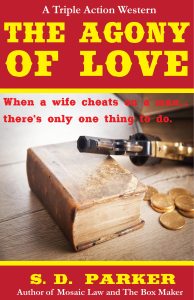
What would you do if your wife cheated on you with a dandy
of a gambler?
John Hardwick answered that question for himself. Now, he’s
about to act on it.
John Hardwick loves his wife like a Shakespeare sonnet:
full, complete, and without equal. Unfortunately, John now finds himself in the
crucible of infidelity. He knows the other man’s name: Alton Raines, a
professional gambler.
John is a good man, not prone to violence, but the images in
his mind’s eye—of his wife in Raines’s bed—puts murder in his heart and a gun
in his hand.
Available exclusively at Amazon.
Excerpt
Chapter 1
John Hardwick loved his wife Mary like a Shakespeare sonnet:
full and complete and without equal. He would memorize the Bard’s sonnets as
well as the poems of Byron, Blake, and Browning and recite them to her over
dinner or in front of the fire in their little home. Their life was hard—he a
farmer, she a farmer’s wife—but he loved it more and more each day. Even when
the hardships of farm life took their toll on him physically, he still loved
his beautiful Mary. When the farm life robbed her of her ability to bear
children, he still loved her.
But even the surest of love could be tested in the crucible
of infidelity. John Hardwick found himself in that crucible now as he stared
across the saloon at Alton Raines, his head full of things that normally never
entered his mind. Images of violence, hatred, and murder boiled his blood. He
wondered how loud the shot would be if he stuck his pistol up against Raines’s
body and pulled the trigger.
Still, he had to gather his courage. It had taken him over
an hour of waiting, drinking, and watching to figure out which patron of the
Oak Tree Saloon was Alton Raines . He had asked a couple of men if they knew
the. They did, and had easily pointed him out.
Raines turned out to be the dandy sitting at the poker
table. His dark hair, slicked back and coiffed perfectly. The mustache neatly
trimmed. His suit, gray and adorned with a shimmery purple vest. The black tie
formed a perfect knot over a pressed white shirt. Occasionally Raines would
check the time on his shiny gold pocket watch. He presented himself in a suave
manner, smiling at everyone in the room. Ladies would drape themselves across
his shoulders.
All in all, the sight made John Hardwick’s stomach turn. It
also brought a tear to his eye. He wasn’t much to look at. He knew that. Long
days of sun and wind and hard work had aged him. He looked ten years older than
his age of thirty. His eyes had developed permanent crow’s feet. His hands
looked like an old man’s. And his shoulders sagged a bit, even when he wasn’t
carrying heavy equipment or hay bales.
He caught a glimpse of himself in the mirror behind the bar
and felt an utter dislike for what he saw. Also in the reflection was Raines.
It appeared that the two of them were side-by-side. Any doubt as to the idea of
what he was about to do vanished in an instant.
John turned and sauntered over to the poker table. There was
an empty seat now since a skinny blonde man stormed off in a huff after losing
all his money. “Mind if I sit in?”
The remaining men seated at the table stared up at him.
Raines sat opposite the empty chair. On the left was a burly red-headed brute
of a man. When he held the cards, they looked like playthings in his oversized
fists. To the right was a man he knew: Christopher Allen, the owner of the
local tannery. The smell of the chemicals on his clothes wafted up and tickled
John’s nose.
“I don’t have a problem with it,” Allen said. “Paul?”
The red-headed man downed the last of his beer. He wiped his
mouth with the collar of his shirt and shook his head no. He raised the empty
mug and signaled for another.
“Alton?”
All eyes turned to Raines. The dandy took his time
answering. John felt like he was a prize hog being inspected for quality.
“Can you pay?”
John Hardwick nodded. “Yes, I can.”
Raines gestured to the empty chair. “Then by all means, have
a seat.”
John pulled the chair out and sat. It was a good thing, too,
since his legs had begun to shake. The closer he got to going through with what
he needed to do, the more nervous he became. The hard leather of his holster
thunked on the wooden chair and he had to adjust his posture to accommodate.
A barmaid brought Paul’s mug of beer and set it in front of
him. He leered lecherously at her exposed cleavage. He mumbled something John
found inappropriate and he felt it his duty to save her.
“Ma’am,” John said, “might I have a beer as well?” He turned
to Allen. “You want one?”
“Whiskey’s fine with me.”
John faced Raines. “How about you, Alton?”
“It’s Mr. Raines. I’m fine.” His voice was a smooth
baritone, the kind of voice that belonged in a choir or behind a pulpit, and
not in this den of sin.
The barmaid left and Raines began to shuffle the cards. “How
much you in for?”
John reached into his jacket pocket and withdrew a wad of
cash. Allen’s eyes widened in surprise. “Tarnation, John. That’s a lot of
money. Where in the world did ya get it all?”
Where indeed? John had discovered the love letter written by
another man tucked discretely into a book of poems he had given his wife on
their fourth anniversary. The letter was full of affectionate sentiments that
made John cry. At first, he felt the emotional punch in his gut. Then lost his
lunch. Mary Hardwick had been out of the house for the afternoon so she was
spared John’s immediate wrath. In the afternoon hours of that day, as he toiled
under the broiling sun, he thought about what to do. What to say.
In the end, he said and did nothing. He planned. He intended
to take his husbandly revenge out on the man who signed his name “Alton
Raines.”
Available exclusively at Amazon.
The Naked Con: A Triple Action Western - An Excerpt

What do you do when you see a naked man cowering behind a rock?
You’ll get the answer in an exciting new western from author S. D. Parker, inspired by the TV show Maverick and the movie Butch Cassidy and the Sundance Kid.
It’s not every day that the passengers of a stagecoach in the Old West see a naked man hiding behind a rock. But the motley group of people on a stage bound for Uvalde, Texas, stop and question Finnegan McCall, naked as the day of his birth. He says he is the new manager at the bank in town and a thief stole all his clothes.
But if Finnegan McCall is telling the truth, then who is the stranger at the bank claiming he is the new bank manager?
And why is this stranger asking the assistant manager to open the safe?
This exciting new Western from S. D. Parker will have you who is whom and what it all means.
Available exclusively at Amazon.
Excerpt
Chapter 1
Stagecoach driver Henry Price yanked the reigns of the horse team when he realized the man standing next to the road was stark naked. The man had hid himself behind a large rock and Price almost missed seeing him, but the paleness of the man’s body shone like a beacon in the midday sun.
Price called for a halt. The horses obeyed. The passengers in the stage began to grumble. Dust motes caught in the stage’s tailwind curled around everything.
There was a moment when Price thought about going for his weapon. The shotgun was shucked inside a leather holster on the ledge in front of him within easy reach if outlaws tried to hold up the stage. But this man was as naked as Adam. Both hands were visible. The man’s bare backend proved he wore no gun. Price relaxed.
“Tarnation, mister. Where are your clothes?”
That got the attention of the folks inside the stage. Winston Dennigan, the cattle baron, traveling back to Stonewall, Texas, peered out the window. Jim Stanley, a haberdasher, called up a question to Price. Lilly Bowman, stocky, blonde, and without a husband, opened the door and stepped out. “I want to see this.” She wobbled on legs too long in the stage and looked up at Price. “Where’s the naked man?”
Price pointed to the rock they had passed.
Lilly turned and tried to spy the man who had stopped the stage. She patted her sweaty face with a cloth. “I don’t see him.”
“I’m here,” a voice behind the rock said. “I’m just trying to spare whatever dignity I still have.”
“Why’re you out here in the nude?” Lilly said. She moved closer to the rock and chose a side. She waited for the man to begin speaking.
“I was taking a bath in the river,” the man began, “and I…hey!”
The naked man scurried around the rock to avoid the prying eyes of Lilly who had snuck to the back to catch a glimpse of naked man-flesh. He avoided her eyes but exposed himself to everyone else. He held a small branch of leaves over his privates but his pale rump glared in the sunlight.
“Where’d you go?” Lilly said from behind the rock. “Come back here. I ain’t seen a naked man in a long, long time.”
Dennigan leaned over to Stanley. “I don’t believe she’s ever seen a man as God made him. You?”
Stanley just shook his head.
“Ma’am,” the nude stranger said, “I beg of you. Have some decency.” One hand held the branch. The other, with fingers splayed, covered his butt. He backed away and leaned up against the rock. “I need help.”
“I can help,” Lilly said. She had come around the rock and stood next to the man. She leaned on an elbow and gave the stranger a long look up and down.
“Mister,” Price said. Ostensibly he was in charge, since he was the stage driver. His passengers were his responsibility, and the Pine Cove Stage Company prided itself on an excellent record of avoiding any hold-ups or Indian attacks. No record existed on meeting naked people in the wild. “How’d you come to be in your unique predicament?”
The man, tall, clean shaven, with tousled brown hair, bowed at the neck. “Thank you, sir.” He warily eyed Lilly out of the corner of his eye. He adjusted the angle of the branch to better hide himself.
“My name is Finnegan McCall.” He didn’t have a trace of an Irish accent. “I was traveling by horse to Uvalde. I was road dusty and weary so I thought it a good idea to clean myself up before I arrived in town. First impressions and all. I hitched up my horse, a beautiful gray beast I call Molly, and went down to the river. Which one is this?”
“The Frio,” Price said.
“Ah, yes, the Frio. Explains why it’s so cold. I wanted to get good and clean and, with no one coming around here, I thought it a good idea to, um, make all parts available for cleaning by bathing in the nude.”
Lilly whistled softly. She continued to mop her brow.
Stanley said, “Didn’ja figure someone might come along?”
McCall bowed again. “Quite right, sir. But no, I thought I’d have more than enough time to bath and redress before anyone saw me. I even had my undergarments in case someone did stumble upon me.”
“So what happened?” Dennigan asked. He lit a cigarette.
McCall gave a sheepish grin and a shrug. “The water felt so good, so refreshing that I kept swimming. I swam across the river and back. It so invigorated me that I did it three more times. It’s not far to the other side, maybe about fifty feet. By the time I done that, I felt great. I got out of the water, went to the branch that held my undergarments. They were nowhere to be found.”
He paused in his story. His hair, soft and billowy without any pomade in it, wafted in the fair breeze. He switched the branch to his other hand. Lilly craned her neck to get a better look.
“What business do you have in Uvalde?” Price asked.
McCall snapped his fingers. “My apologies gentlemen. And lady. I am the new bank manager at the Farmer’s Mercantile Bank. The home office down in San Antonio sent me up here to replace”—he thought a moment, trying to remember the name—“Elmer Curtis, I believe.”
Stanley looked to Dennigan. “How long’s it been since Elmer passed?”
“A week.” To McCall, Dennigan said, “I’m guessing your credentials are in your saddle bag.”
“Undoubtedly, assuming the bandit didn’t throw them away. I would be much obliged if I could get a ride into town and see if we can’t solve this little conundrum.”
“There’s another conundrum you haven’t accounted for,” Price said. “You’re nude.”
McCall cleared his throat and craned his neck to see where Lilly was. Somehow, she had inched herself closer to him. “Of course.” He took in the features of each man. Stanley was short, probably at least four inches under McCall’s six-foot frame. Dennigan was about the same height and build.
“Do you have any extra clothes I might wear into town?”
Dennigan shook no. “I woke up this morning in my own bed and I’ll be sleeping in it tonight. Didn’t need to carry extra clothes.”
Price still sat atop the stage. McCall couldn’t gauge his stature. “How about you?”
The driver slightly chuckled. “I’m in the same boat as Mr. Dennigan.”
From McCall’s left, Lilly edged closer another inch or two. “I’m returning from a week down in San Antonio to visit my sister.” She used her head to indicate the bag on top of the coach. “I’ve got something you could wear.”
McCall gulped. She was a tall woman, nearly as tall as he. “Please tell me you packed something other than dresses.”
The grin on her face widened, looking like a cat after eating a chicken. She merely shook her head.
The men started to laugh. Price stood and unfastened Lilly’s travel bag. “It beats arriving in the suit God gave you at birth.”
Lilly trotted over and retrieved her bag. She opened it, rummaged around, and pulled out a long dress. It was red and white striped. It more closely resembled a table cloth than a dress. She walked back over to McCall and extended her arm with the dress.
He reached for it but she pulled it back. “Since this is an exchange, I’d like a little something in return.”
McCall dreaded the answer. “Madam, I am hardly in a position to offer anything.”
She arched an eyebrow. “Not entirely true.”
“Once I get into town and hopefully recover my clothes and belongings, I will gladly pay you.”
“I don’t want money.”
“Well, what do you want?”
“A kiss.”
No one spoke for a moment. The silence was broken by Stanley spitting on the ground. “That’s a fair trade, mister. Hurry it up so we can get back home.”
McCall nodded. “But later. Only after I am fully restored in my own clothes.”
“Deal.” She held out the dress again.
McCall snatched it with his free hand. He edged along the rock, making sure his backside wasn’t exposed. “And you stay here,” he told her, “while I change.”
He vanished behind the rock. He dropped the branch and held out the dress to verify the front. He shimmied into the garment, straightened out the sleeves, and looked at himself. Thankfully, the dress extended to the ground. He sighed.
Walking around the rock, the three men guffawed heavily when they caught sight of him. He shrugged, resigned to his fate. Lilly caught his hand and escorted him to the stage. “You can sit next to me.”
McCall followed, gingerly walking on bare tiptoes. He tried to climb the steps into the stage but couldn’t manage.
“You’ll have to hike up the dress,” Dennigan said. That brought fresh peals of laughter from the men.
McCall stepped back and turned to Lilly. “Madam, if you please, show me how it’s done.”
Lilly stepped forward, grabbed handfuls of cloth and pulled up nearly to her knees. She stepped inside and sat. She patted the place next to her.
McCall, awkward movements and all, mimicked her actions. He climbed aboard the stage and joined her on the seat. She was uncomfortably close.
The other passengers returned to the stage and Price whistled to the team to start up again.
Available exclusively at Amazon.
Thursday, May 25, 2017
My Life with Star Wars

If Star Wars had never existed, I wouldn’t be the
man I am today.
A bold statement? Perhaps, but the more I think
about it, the more truth comes to light.
The first version of this essay had me starting from
before 1977 and moving forward with my life. I didn’t figure y’all’d want to
read that, so I abandoned it in favor of some higher level thoughts.
I still see the world with childlike eyes. Yeah, I’m
older than Star Wars with hair graying around the temples and adult
responsibilities, but I still possess a childlike wonder for the world. It
still amazes me that my iPhone is more powerful than the computer that landed a
man on the moon. When I ride my bike, I still channel my younger self who
inverted the handlebars of his ten-speed to better resemble the steering
mechanisms of Luke Skywalker’s X-Wing so that I could shoot imaginary T.I.E.
Fighters that took the real-world form of trash on the sidewalks. Every now and
then, when I’m at a new place—say, my trip to Big Bend last year and the rugged
land around the hotel—I still see areas where I could play with my action
figures. BTW, I still have them all, stored in my Darth Vader case. In short,
Star Wars gave my childhood imagination the power to roam across galaxies.
My love and appreciation for instrumental music is a
direct result of the soundtrack to Star Wars. I’m an only child so I had to
discover many things on my own. From the first time I saw the movie, the music
captivated me. I bought the soundtrack—and promptly learned to see the movie in
my head because of John Williams’s score. Little did I know I was learning about
classical music and jazz. I just let the aural blanket settle over me and
through me. I wore out my first copy of the soundtrack. Oh, and I had that John
Berkey poster on my wall as fast as I could open the original cellophane
wrapping. The music—specifically the main theme, Princess Leia’s theme, the
Force theme, the throne room theme—helped me replay the movie in my head. As a
kid, I don’t remember being irritated that the songs were somewhat out of
order. I just consumed them all. From Star Wars emerge a love for John Williams
music, more film scores, classical music, and jazz. Heck, in sixth grade, when
I chose to learn alto sax, I picked that instrument because it was one of the
horns used in the Cantina Band song.
My love for all things science fiction and fantasy
started with Star Wars. Sure, the fandom was already present—I enjoyed Space:
1999 and The Six Million Dollar Man and Fantastic Voyage—but Star Wars just
jumped the fandom to lightspeed. I discovered Star Trek because of Star Wars.
In reading the novelization, Splinter of the Mind’s Eye by Alan Dean Foster,
and the original Han Solo trilogy by Brian Daley led me to other SF books. It
didn’t hurt that Foster also wrote the Star Trek Logs. I discovered Edgar Rice
Burroughs’s John Carter in that magical time between Star Wars and The Empire
Strikes Back and I’ve never looked back.
Speaking of that magical time from 1977-1980, I
contend it was probably the greatest time to be a fan. We only got a small peek
into that galaxy far, far away. The possibilities were limitless. All that we
didn’t know intrigued us. The characters n the Star Wars universe were as broad
as our imaginations. Nothing against how it turned out—it’s one story about one
family which, in effect, shrank the galaxy—but up until Vader tells Luke about
his true parentage, the edges of the Star Wars universe couldn’t be seen. When
Marvel Comics published Star Wars #7, the first story not from the film, I was
over-the-moon. More Star Wars! Heck, I even remember watching the Holiday
Special on a black-and-white TV in a hospital and loving it. The lead-up to
Empire was wonderful as was the lead-up to Return of the Jedi. But it was
nothing like 1977-1980. The year 1991 was also good with the publication of
Timothy Zahn’s Heir to the Empire. The only time that comes close to what it
was like in 1977-80 was late 1998-1999 in the build-up to The Phantom Menace.
Never mind what you think about the movie, the fact that we were getting more
Star Wars for the first time since 1983 was beyond awesome. Seeing that first
trailer to The Phantom Menace opened wide the door of childhood—it never really
closed—and it hasn’t faltered much since then, despite adulthood, marriage, and
fatherhood.
Star Wars is my time capsule to childhood.
For that, I am eternally grateful. Star Wars taught
me in ways that might seem odd to some. With Empire, I learned that heroes don’t
always win even if they prevail. With Jedi, I learned there is good in most
people, even the most vile. I learned patience in having to wait three years
for the next movie. I learned to fill up my head with facts no one cared about
but seemed like the most important information to me.
I could go on and on about this movie and this
franchise, but I won’t, at least not here and not today. Suffice it to say Star
Wars is an integral part of what makes me the man I am today. If not for Star
Wars, undoubtedly something else would fill up that space. But I am so glad
that Star Wars arrived at the time it did, forty years ago today, at the age I
was. It helped me grow up, imagine, dream, soar, cry, cheer, love, learn,
mourn, and more. I am a proud member of the Star Wars Generation.
Tonight, I’ll be celebrating by pulling out a VHS
copy of the first movie and giving it a viewing. I haven’t seen it a bit. That first
movie is too special. When I start that film, more than just about any other, I’m
no longer an adult. I am an eight-year-old kid, wide-eyed with wonder, transported
to a galaxy far, far away.
Happy birthday, Star Wars. Your Force will be with
me. Always.
Monday, May 15, 2017
Favorite Songs by Year
Over at SamePageCast, co-hosts Craig and Megan took a look at the 1970s and selected one song per year to be on their desert island jukebox. I had so much much with that decade that I kept going, all the way up to last year. I threw in 1968 and 1969 so this list encompasses all the songs from each year I've been alive.
There were some years in which the favorite song leaped into my head (1969, 1999, 2015, 2016). Other years in which I had to select a song that I liked but don't love (2011). Then there were years (like 1975, 1977, 1984, 1989, 2004, 2016) in which there were so many good songs I ended up having to cast aside songs I truly love and listen to constantly.
In a comment, Craig mentioned they were picking from the Top 20 songs. I scrapped that and just selected my favorite songs.
When the original 1970s episode aired, six bands/things instantly jumped into my head: Chicago, KISS, Star Wars, Springsteen, Genesis, and Star Wars. The only real logjam is 1975 b/c that was when my favorite KISS album (Alive) was released but it’s also my favorite Springsteen song from the 70s. With the other years already accounted for, the KISS song I ended up choosing was slotted into 1976.
Moving up to the 1980s, 1985 was *the* year where everything for me was going wonderfully and just about all the music from that year is inexorably intertwined. So that pick was a difficult one.
1968 - All Along the Watchtower (Hendrix)
1969 - Introduction (Chicago)
1970 - 25 or 6 to 4 (Chicago)
1971 - One Fine Morning (Lighthouse)*
1972 - Supper’s Ready (Genesis)
1973 - Aladdin Sane (Bowie)
1974 - Maiysha (Miles Davis)**
1975 - Born to Run (Springsteen)
1976 - Take Me (KISS)
1977 - Star Wars, Extended Version (Meco)***
1978 - Summer Nights (Grease soundtrack)
1979 - Rainbow Connection (Muppets)
*Another fav horn rock band, I take a daily walk around my office building and this song is one of the ones I choose often.
**Miles’s Get Up With It LP was a hodge podge of cuts recorded over 5 years, but this song—and it’s groove!—is one I return to often. Plus jazz flute!
***I love the disco version of Star Wars, and this 15-minute song gets every major theme from the movie and I get disco on my list!
1980 - Imperial March
1981 - Raiders of the Lost Ark Main Theme
1982 - Hard to Say I'm Sorry/Get Away (Chicago)
1983 - Separate Ways (Journey)
1984 - Heaven (Bryan Adams)
1985 - The Power of Love (Huey Lewis)
1986 - Absolute Beginners (Bowie)
1987 - Brilliant Disguise (Springsteen)
1988 - Lead Me On (Amy Grant)
1989 - The End of the Innocence (Don Henley)
1990 - Silent Lucidity (Queensryche)
1991 - Enter Sandman (Metallica)
1992 - Living Proof (Springsteen)
1993 - I Almost Had a Weakness (Elvis Costello)
1994 - Singin' with the Big Bands (Barry Manilow)
1995 - Peace Prayer (Clarence Clemons)
1996 - Let Your Soul Be Your Pilot (Sting)
1997 - Dead Man Walking (Bowie)
1998 - Basic Instructions (Burlap to Cashmere)
1999 - Desert Rose (Sting)
2000 - Pavane (John Williams, guitar)
2001 - The Middle (Jimmy Eat World)
2002 - The Rising (Springsteen)
2003 - It's a Groove (Robert Lamm)
2004 - Black Crow (Diana Krall)
2005 - Mother India (Caedmon's Call)
2006 - Crazy (Gnarls Barkley)
2007 - Girls in Their Summer Clothes (Springsteen)
2008 - The Road (Tom Jones)
2009 - Haven't Met You Yet (Michael Buble)
2010 - City Noir (John Adams, composer)
2011 - Rolling in the Deep (Adele)
2012 - Hell or Hallelujah (KISS)
2013 - Give Life Back to Music (Daft Punk)
2014 - Seasons Change (Future Islands)
2015 - Uptown Funk (Bruno Mars, Mark Ronson)
2016 - Put Your Money on Me (The Struts)
Monday, May 1, 2017
Happy Writer’s New Year’s Day
Four years ago today, 1 May, I made the decision to start writing again. I had the germ of a story—a man wearing a fedora who was likely a private detective, knocking on a door and being answered by bullets. That idea became WADING INTO WAR: A BENJAMIN WADE MYSTERY, my first published novel.
Part of this idea was derived from a quote: A year from now, you will have wished you started today.
Every 1 May, I commemorate that first book and examine what I’ve done in the past year.
- I earned my first nomination for “The Box Maker: A Triple Action Western.” That would be the 2016 Peacemaker Award for Short Fiction from the Western Fictioneers, a group of which I’m a founding member. I was thrilled and very much had the realization that it truly is an honor to be nominated.
- I published ULTERIOR OBJECTIVES: A LILLIAN SAXTON THRILLER. I love all the books I’ve written but, to date, this is my favorite. Lillian is a kick-ass heroine and the story was so much fun to write.
- I now show my novels at the Sugar Land Arts Center and Gallery and it’s a blast to see things I’ve written on display.
- Recently, I made the decision to publish westerns under the “S. D. Parker” pen name. It’s not a secret by any stretch, but a way to differentiate my stories. Not coincidentally, I have republished all four western short stories today, complete with re-branded covers. I have also made the decision to put them in Kindle Unlimited, so if you want to read them, that’s where they are. And if you’re a Kindle Unlimited subscriber, they are all free to read.
Looking ahead for this fifth year since I started writing, I’m only into my second year as a published author, but there are big things on the horizon. Let me give you a preview.
- Two more Junction City Westerns are on the immediate horizon with publication dates between now and mid June.
- Railroad Detective Calvin Carter will have his big debut with three short stories also in the next couple of months. Later on, his novel-length adventures will begin.
- John Denton, the Rouge Gambler, will make his debut in ALWAYS BET ON RED this summer.
- The third Benjamin Wade novel, tentatively titled THE MISSING WIFE, will be published this year.
- The second Gordon Gardner novel will also be published this year.
And these are only the items I’ve completed. There will be many more coming your way.
Along with separating the author name, I’ve also separated the mailing lists. I now have one focusing on mysteries and a second, new one specifically focusing on westerns. Don’t worry: you can be on both, but I’ll also let everyone know what’s going on in the other mailing list. I also have two separate Facebook pages, one for mysteries, and a second for westerns.
The year 2017 should be an exciting one here at the offices of Quadrant Fiction Studio. I’d love to have y’all join in the fun.
Thursday, April 27, 2017
Thoughts on Pods and Sods Chicago SamePageCast Episode

I may know Craig Smith because of KISS, but today, it’s about Chicago.
Craig Smith is a music connoisseur. The podcast he runs with Eric Miller, Pods and Sods, talk music, often down to the granular level. When Craig teams up with his girlfriend, Megan Stemm-Wade, they produce SamePageCast, a podcast about music and films. Today, they spend 90 glorious minutes talking about Chicago: The Columbia Years.
https://podsodcast.com/2017/04/25/spc18/
Joining them today is Jimmy Pardo, from the Never Not Funny podcast and the Chicago documentary that aired on New Year’s Day.
Craig teased this episode last week and I already told him I was very, very excited about this episode. Nice guy that he is, Craig sent me the link on Tuesday and I’ve already listened to it. You are in for a treat. The episode is chock full of Chicago goodness, but it is tagged as Chicago For Beginners. If you are a deep fan like me, most—but not all—of this information is known. But this is a fantastic way to get a music history of one of my two favorite bands.
So, when I listened to the episode, I started sending comments and feedback to Craig. As the word count grew, I had the idea of compiling my comments into this post, a sort of a side commentary to the episode.
Had I more time, I would have dropped in time markers. I am listening to it now, so I can throw in the marker for the first line item (below). But most of the time, I kept my comments per album and you can easily follow along.
[Comment about relevancy 8:24 mark] Chicago really stopped being relevant when SOS was rejected. That was when they stopped being a rock band and became a nostalgia act. Big Band record is good. Christmas records are wonderful! But really...
Agree that 14 (Columbia) was the natural ending point. For me, the eras are the following:
- Originals - 1967-1977
- Dacus/14 - 1978-1980
- Warner - 1982-1992
- Nostalgia - 1995-present
Regarding the listenability of a podcast devoted to each album of Chicago…ABSOLUTELY it’s worth it. I’ve toyed with it myself. You never know. I still might. If the existence of Pod of Thunder—that examines every studio song by KISS; Every. Song.—is any indication, you can easily do it with Chicago.
CHICAGO TRANSIT AUTHORITY
[My full review here. [http://scottdennisparker.com/2017/04/27/music-review-chicago-transit-authority-1969/] It’s an older piece I republished on this blog last night, but it still is accurate.]
Free Form is noisy. I listen infrequently. It's not on my MP3 CD playlist I have in my car.
Someday is wonderful. Especially when the chant becomes the downbeat. And the bombs in the last chorus.
[They didn’t discuss Liberation, a song I put on and just let my mind go. Great song. Would have liked to have had a version of it on the remastered Carnegie Hall CD.]
[Time: 18:55] Agreed that last great tour was 1988 (19) but the 1995 tour (with the acoustic set including Look Away) was pretty darn good. The 1987 set was pretty wide spread in terms of songs, too. Oh, and in terms of "New-to-Me" songs, the 1998 Christmas tour had greater than 50% of never-heard material (Christmas + Back to You).
Chicago 18, and the 1986 version of "25 or 6 to 4" are special to me. It was the first album released after I discovered them and "25" was the first single. Also, in 1987, they opened concerts with the 1986 version and closed with the 1970 version. Thus, the 1986 version was literally the first ever live sound I heard from Chicago. I snuck in a tape recorder to that show (at the Houston Rodeo!) and you can hear my auralgasm. Thirty years ago last month.
CHICAGO II
Other than "25 or 6 to 4" - Likely the distillation of the band's definition of a "rock band with horns" - my fav track is Poem for the People. The complex horn arrangement is wonderful. It Better End Soon I have grown to really, really love, especially the flute solo. Also the sentiment of The Road, especially the lyrics and its Vietnam-era stylings.
CHICAGO III
My fav song from III has become Mother, but I prefer the Carnegie Hall version b/c all horn players play at the same time. Love the ending. Lowdown is another fav. Happy 'Cause I'm Going Home is a great tune. I play along with it. And I dig Approaching Storm mainly because all 5 solos are so distinctive of the players. Also, I've come to appreciate the sax/guitar solo from Sing a Mean Tune.
CARNEGIE HALL
A Song for Richard and His Friends - To me, this is the best way for a "Free Form Guitar" solo to work: as part of something else. I like how Lamm plays his keyboard to sound like machine guns. It took me a long time to come around to this song, but now I enjoy it.
Oh, and in 2003 when the Dixie Chicks got lambasted for criticizing Bush while playing in the UK, Chicago (on Live in Japan) did the same sort of thing. No pushback then...
CHICAGO V
Sat in the Park is pure pop perfection and, honestly, might be the turning point in Chicago's sound. Ironic that Lamm was the writer. Dialogue is also just a quintessential song. Other than those two, Now That You've Gone has become my go-to song. Thing to listen for: tambourine. I actually play air tamourine while driving in my car! Also, Serephine's drumming on this song I particularly appreciate. Goodbye and its trumpet solo is also a highlight.
Robert Lamm’s SKINNY BOY is a good "of its time" record. The vibe of "Love Song" is sooo 1972. And the electric organ I really dig. Whenever I want to mentally go back in time, this is one of the records I use.
DOCUMENTARY...
Yeah, I pretty much knew it all, too, but my wife--who watched with me--enjoyed it and learned. And, yeah, even she commented on Lamm's hair! :-)
CHICAGO VI
At this point in my fandom, I've heard Just You n Me probably too many times. But I still love it. For me, What's This World Coming To is my fav. And I really enjoy Something in This City Changes People. There's a 1973 live recording from Paris (?) where they do these songs and they sound really good. I think this is the tour ('73) when they also did "A Hit by Varese" from V. That's an interesting song live.
CHICAGO VII
Again, the hits I've heard a lot of time, but Call on Me I never tire of. Searchin' So Long as well. But my go-to songs are Aire, Italian from New York, Byblos, and especially Woman Don't Want to Love Me. That last song is one of my fav scripted Kath solos, especially how he interacts with the horns. [This sounds familiar. Did I already write this?] The pathos of Kath singing Byblos is heartbreaking.
Nice point on the Terry sound. I would agree with that. It probably started with Jenny, but with 7 and 8 it's put into stark contrast.
CHICAGO VIII
I had VIII with the iron-on transfer. I traded it in 1995 for a cassette copy of SOS. But I found another one and tried to iron it on. Didn't work.
Brand New Love Affair I love!
Harry Truman is always great. I asked Lamm once about this song and he commented that it was a Merle Miller book...which I went out an bought. I do not think Lamm was being sarcastic. He was being spot on. Granted, Truman died Dec 1972 so, in 1974 (when VIII was being recorded) Nixon resigned. Low point in America to that point. You look back and see Truman and he looks pretty darn good.
Then there's Oh Thank You Great Spirit. More proof of the Kath sound. Blistering is probably an overused adjective, but it fits here.
Old Days is always good.
All in all, VIII was a late discovery for me, so I've come to enjoy it.
CHICAGO in 1982.
There's a great show from Star Sessions. I think it's Champlin's debut. They're hungry again and you can hear it.
CETERA ON BASS:
Yes, Craig, CTA and II are a showcase for Cetera's bass playing. Heck, just Introduction is a good enough example. McCartney-esque. Ditto with Gene Simmons, BTW. And What's This World Coming To from VI is another good one.
CHICAGO X
Love how Once or Twice kicks this album off. You Are On My Mind is wonderful. I have heard IYLMN waaay too many times...but it's still a good tune. But I don't need to hear it again. ARDINYC I have always enjoyed, and the 2001 version (with Lamm singing). Mama Mama is cheesy fun. Scrapbook is a nice culmination of their history.
CHICAGO XI
Of all the Columbia records, for whatever reason, I came to this one last. Still not sure. Maybe I just had to mature for it. But likely it was because I opened my eyes to Kath. He's all over this LP. I LOVE MDCB. I remember being a youth and thinking "why the heck is he laughing?" Now, I know it's b/c Kath knows this tune is great. The guitar, the horns, the voice. "Big Surprise" is ... never listened to anymore. Between this and IYLMN, I'll take the former.
The more I think of this album, the more I get a sense that--although they clearly didn't know what was coming with Kath's death--they put their best on this record. Megan's idea of a distinct Kath sound is full on display here, especially with Uptown. Lamm's all over his politics here--last time until We Can Stop the Hurtin from 17?.
But it is the last two cuts (This Time and Little One) that just makes your heart soar and then crushes it. The scripted guitar solo in This Time is my favorite of Kath. And the bittersweet sentiment of Little One--even though Serephine wrote it--as sung by Kath, the last time we hear his voice on record, is heartbreaking. Like X, Kath opened and closed XI, but his stamp is over everything on this album. Top 10 for me.
ME: Hmmm, what are my top 10? CTA, II, SOS, V, 19, III, XI, 17, VII, and Hot Streets.
CRAIG: That's a very interesting Top 10.
ME: Yeah. It would have been much different 15, 20 years ago. But time has a way of changing what I prefer. Since 19 is the most un-80s record, I tend to like it. (Ironic since I'm a child of the 80s, graduating in 1987). Probably why I like the latter half of 30 so much (because it sounds like 19). It's the "Crazy Nights" of the Chicago catalogue. Ron Nevison producer, BTW. This was the record where Champlin took over. SOS was, like CTA and 16 and to some extent HS, the album Chicago made for themselves. They asked "Who are we in 1992?" and SOS was the result. It was fresh and unique, willing to try different things (rap; heavy rock), and light on ballads.
When the label said, "No," they stopped being a rock band with horns and became a nostalgia act. Dawayne Bailey left soon thereafter. You could probably say the same thing about KISS and Revenge (or COS)...because, as much as I enjoy Psycho Circus/Sonic Boom/Monster, they are all riffs on former sounds.
HOT STREETS
I just friggin' dig Alive Again. The bass falls, the brass. It's all there. And the joy. Perhaps the band's second mission statement song (after Introduction and post Kath's death). The title cut is fantastic. Maybe Top 10 Lamm song for me (I may have to give that some thought). Love that it features both flute and guitar. I put TGLOE as a semi trilogy with IYLMN and BWABS. I like this one the best. It's on that MP3 CD I mentioned earlier. They gave Dacus the keys to the band and, for a 1978 record, it's perfectly in the pocket. Love Was New I love. I is SO of its time. Odd that the 80s albums (16-18) are so of their time and I tend not to listen to them, but so is HS-14 for its time...and I listen to them. Perhaps that tells me I prefer the 70s sound...?
Again, find the live 1978 concert at the Greek. They play with an orchestra. The sentiment of being alive, playing together is palpable.
[I had to take a break from the episode to take a walk around my office building. Here is what I wrote upon getting back to my desk.] Okay, I just took my 10am walk around my office building and I listened to the live version of HS. Such a great song. Cetera's bass playing under the flute solo is just like he did back in 1969. And the Dacus solo is certainly something Kath would have played in 1978.
You know, I have an MP3 CD of my fav stuff from the entire catalogue, but I specifically have a Dacus Era MP3 CD that includes HS, 13, the live 1978 show. I enjoy this era of Chicago and it was good to hear Pardo extol its virtues as well.
CHICAGO 13
Easily my fav cover.
As a band kid in the 1980s, Street Player with Maynard Ferguson I enjoyed immensely. Mama Take is just good clean cheesy fun circa 1979 in the vein of REO Speedwagon's Keep On Lovin' You. The horn come in subtly. I dig it. And I dig that the brass is just all over the place (the brass/guitar interplay on Aloha Mama echoes VII's Woman Don't Want to Love Me). Sure, Cetera's "other" voice is odd (Window Dreamin'), but what the hey. Life is what it is = Love Was New, Cetera version. Plus a trombone solo. What's not to like? As much as I enjoy the Kath/Cetera/Lamm vocals, the Cetera/Lamm/Dacus blends well.
There's a TV special they aired around 13. Cheesy and goofy.
Oh, and Loser with a Broken Heart? Proto Hard to Say I'm Sorry.
CHICAGO XIV
Okay, so yeah, it's probably the nadir, but like I wrote elsewhere, you add in the unreleased cuts (from the reissue) and remove some of the cuts that made the album, it would certainly be better. Song for You is yet another run-up to the ballad-heavy 80s. Even for someone like me, Birthday Boy is just ugh. Side 2 of XIV is better. Doin' Business (from the box set) is a good tune. I enjoy it, but I prefer HS and 13 more.
Talking about Nadir, XIV is the one album that doesn't fit neatly. You have the eras 1967-1977, 1978-79, 1982-85, 86-etc. and all have multiple albums. XIV is the one that is its own era. The guitarist, Chris Pinnick, is pretty darn good, their first attempt to get a "Kath" sound (and that Keith Howland has done for 22 years now). He went on to tour for 16 and 17 but left after Cetera left to make way for DaWayne Bailey, the true 80s rock guitarist.
QUESTIONS
ANY DOUBLE LPS CONDENSED DOWN TO ONE?
Not for me. Even VII. I like the instrumental stuff. Not all the time and not always driving in the car with the windows down, but when I'm in the mood, it's good.
IS THERE A “ROCK AND ROLL ALL NITE” OF THE CHICAGO CATALOGUE?
Yup, 25 or 6 to 4.
NEVER WANT TO HEAR AGAIN?
If You Leave Me Now easily. More that than any of the 80s ballads. And yeah, the new live arrangements put the horns in. But even those ballads live starting around 1988 and especially 1992 were punchier and heavier. Of the 80s ballads, You’re the Inspiration is my least favorite. Hard to Say I’m Sorry/Get Away is Cetera's gold standard for Chicago ballads for me. Hard Habit To Break is good for the vocal interplay. Look Away I really enjoy. For Scheff, Will You Still Love Me is probably it although I'm pretty done with that song, too. Just heard it too much. He did it live, acoustically, with just him at piano for a while. That was nice. I now lean more to Scheff's material 19 and beyond because he stopped trying to sound like an obvious Cetera clone. What Kind of Man Would I Be? (remix) is pretty darn good. Twenty-1's Explain it to my Heart is HHTB part 2 but with Scheff. SOS's Better than Elvis is strong because of the history behind it. But even Scheff got too high and whiny. Some of the ballads from 30 are hard to hear...so I don't.
Oh, and Look Away acoustic with just Champlin and Keith on guitars was also great. And the live version is my preferred version. There's a 1993 Live at the Greek (?) that features probably the last time Chicago was a *rock* band with horns. You even get a SOS song thrown in.
DESERT ISLAND LP?
CTA (although I could cop out and say Carnegie so I also could get 25 or 6 to 4)
DESERT ISLAND SINGLE?
Introduction. My Favorite Chicago Song. Period. 25 or 6 to 4 is second.
BEST COMPILATION:
I've basically tuned them out, but Chicago IX - where it all started for me—might be it. You don't get Introduction, but you get basically all you need from Chicago sans the later material. The garden one Pardo mentioned is okay.
Oh, back in 1997/98, here in the states, Chicago put out their own version of a blue and red hits albums (like the Beatles). They threw on 2 new songs each so...I had to buy them. The red one (which came out first) is probably too ballad heavy, but one of the new songs, The Only One, was produced by Lenny Kravitz. He sings on it, too, and it’s pretty good. The blue one, a year later, has stronger uptempo songs, but put on "Love Me Tomorrow" versus...anything else. All Roads Leads to You is one of the two new cuts and features vocals by all three guys. Taken together, "The Heart of Chicago" might be the one I'd choose.
But...in Japan, they put out 4(!) "Heart of Chicago" albums. And they broke the catalogue down to 1967-1981 and 1982-1998. That was the red and blue from Japan but you also got a yellow and a green one. In those days, pre-SOS being officially released, that was the only way to get 3 of those tunes. They filled the rest of the albums with great rarities like pristine mixes of the dance version of Along Comes a Woman, the full HTSIS/GA together, Please Hold On (LP version), Someday, Street Player (dance mix), and more goodies. And, even though my memory can't recall if Introduction is on there, I'll take Heart of Chicago from 1997, 98 (Japanese versions) as my go-to compilations.
And there you have it. I really enjoyed this episode. Being a deep fan, naturally I'd want to dig deep into individual cuts, why I love them, etc. But this was so much fun!
Thanks to Craig, Megan, and Jimmy for the episode. I really dug it.
Now that you, Reader, have gotten this far, here’s the link to the podcast so you don’t have to go back to the top.
Tuesday, January 17, 2017
Catalyst: a Rogue One Novel by James Luceno
 There’s a reason why the original film was not titled Star Drama. Other than an odd combination of words, it just reeks of tedium. By its very nature, the word “wars” implies action, adventure, danger. It is those very qualities that are lacking in Catalyst, the prequel novel to the movie Rogue One.
Having said that, however, the novel is not without its good qualities. A healthy does of backstory is crammed into this 11-hour audiobook narrated by Jonathan Davis, the fantastic actor who voices many of the current crop of Star Wars novels. But the listener has to understand that much of what happens in this book is, by definition, mere prelude to the events in the movie. And there’s not a lot of action. It’s like an episode of House of Cards in the Star Wars universe.
I purposefully didn’t read this book ahead of seeing the movie. I wanted as clean an experience as possible with the film. Now, having seen it twice, I dove into this book. Going in, I expected to get the backstories of all the major players in Rogue One. That’s not the case. The focus of the novel is solely on Galen Erso (Mads Mikkelsen in the movie), his wife, Lyra (Valene Kane ), and their mutual friend, Orson Krennic (Ben Mendelsohn). Only late in the story does Forest Whitaker’s Saw Gerrera show up. Oh, Grand Moff Tarkin is present, but no one else. I was hoping for some background into the other characters, specifically Donnie Yen’s Chirrut Îmwe, the mystic who is blind and one with the Force. Perhaps future books.
Perhaps the neatest thing author James Luceno accomplishes is put these characters in the context of the prequel movies, specifically Attack of the Clones and Revenge of the Sith. You saw those events from their points of view, not always knowing what we viewers know about the Jedi, the Emperor, and Darth Vader. We get a nice scene with the Ersos—Felicity Jones’s Jyn is a mere babe through most of this novel—fleeing Republic droids when Order 66 is instituted. The droids fall dead. The humans don’t know why, but they also don’t care since they’re still alive.
As a huge fan of Ben Mendelsohn, I enjoyed the many scenes with Krennic and his machinations and politics behind the scenes. I’ve just started House of Cards and I can already see a partial parallel. Mendelsohn is a terrific actor who could have been used more in the movie, so it was nice to learn more about his efforts to maintain the production of the Death Star—a term never used in the book—while trying to woo Galen into the Empire’s folds.
Another great part of the book is the discussion of the Kyber crystals. These are the minerals Jedis use to power their lightsabers. Those are small. The ones needed for the Death Star need to be quite a bit larger. Luceno’s discussions of Galen’s attempt to understand the crystals is good. Moreover, his wife, Lyra, respects the Jedis and their ways even though she isn’t a part of their order. It’s a good dip into the greater Star Wars mythology that I, before reading this book, didn’t know.
In the end, however, and boy do I hate to say this, Catalyst reads like a well-written Wookieepedia entry. The material is nice, the drama is real, but none of it amounts to a decent story, at least one that stands on its own. I know it’s not supposed to, so I’m about to embark on the audio of Rogue One itself. I’m wondering how much the two novels will tie into each other. At the very least, however, there will be action.
Tuesday, January 10, 2017
A Year Without David Bowie
One year ago today, David Bowie left this world. Little did we know at the time that his death was merely the beginning of a deluge of death. From David Bowie to Carrie Fisher and everyone in between, the year 2016 witnessed what seemed like an unprecedented number of cultural icons passing away.
But David Bowie was the first. I remember a year and two days ago, I was flush with the music of Backstar, Bowie’s final album. In the days leading up to its release, saxophonist Donny McCaslin was interviewed on NPR about what it was like for him and his band to record with Bowie. The music I had heard in that interview was spellbinding. Hearing the entire album only more so. The CD was released on Friday, 8 January 2016, Bowie’s 69th birthday. By Sunday night, he was gone. The shock I felt was palpable, as it was for folks the world over. I wrote about my thoughts back then. You can read it here. Today, I’m talking about the year since.
I’ll freely admit that I went into a Bowie-only place a year ago this week. I played his songs constantly, not just Backstar, but his entire discography. Later in the spring, I contributed a review of the album. That’s here.
Then…nothing. For the longest time, I discovered I couldn’t listen to any of his music. The emotions I felt remained raw. That may sound maudlin, but the older I get, the more emotional I’ve become. In early summer, I was cleaning out my garage, the radio station tuned to the local classic rock station. “Changes” came on. I held it together until Bowie sang “Turn around and face the strange.” That was it. Waterworks flowed. I sat down on the floor and just listened. It had been months since I had heard his voice, and now it spoke to me from beyond the grave.
He was always just there. Even during his decade-long absence from recording music—or even the media—from 2004 to 2013, it didn’t really matter because somewhere, probably in New York, Bowie was alive. Now, he’s not. Now, he’s had his final say. And damn if Backstar isn’t just the perfect send-off.
When the fall rolls around each year, I tend to get in a Bowie mood, especially his later catalogue. I love his post 1995 oeuvre and I contend that some of those songs can stand head and shoulders with “Ziggy Stardust,” “Heroes,” and “Scary Monsters.” But I refrained. Not sure why. The David Bowie vacuum persisted.
Christmas was going to be sad, too. His version of Little Drummer Boy with Bing Crosby is one of my all-time favorite Christmas songs. Now, they’re both gone. One night, I watched the video before heading out to pick up some take-out food. Tears came to my eyes, but they weren’t deep. In retrospect, that moment was the turning point.
On the always excellent New Yorker Radio Hour, Donny McCaslin was interviewed. What was it like to be Bowie’s last band? What has this year been like for him and his band since? There’s this moment, about the 35-minute mark, when the interviewer asks McCaslin about the time Bowie came to hear the McCaslin band play. “So, one night, you were playing, and David Bowie walked in,” the interviewer says. Right then, both of them paused a second or two, just marveling at the gravity of her sentence. They both kinda laughed, sighed at what a moment that must have been for McCaslin. He goes on to tell the interviewer about the process of meeting Bowie and, ultimately, recording with him. You get the palpable sense that McCaslin is truly humbled to have worked with Bowie. Hearing him reminisce about the recording sessions, how Bowie was still pushing the boundaries of his music, helped me remember all the reasons I enjoy Bowie’s music.
And I had not listened in awhile.
Time to change.
That was just last week.
The more I considered McCaslin’s thoughts on the Backstar project, how Bowie was always looking forward, I looked back on 2016 and the music I discovered. I found a lot of music I loved, more than any year in recent memory. A few weeks after Blackstar, I found The Struts and their Everybody Wants album, my favorite of the year. Listened to those songs almost nonstop last year, and you could hear Bowie’s influence on their sound. I went on to enjoy albums by Reagan Browne, Wolfmother, The Heavy, Robert Ellis, The Eccentrics, Survive, Twenty One Pilots to say nothing of veteran performers who also released stellar albums last year: Sting, Ace Frehley, Santana, The Monkees, KISS, Michael Buble, and Lady Gaga. Come to think of it, I did what Bowie always did: find new things, move beyond the things to which I constantly listened.
In these past few days, it’s like a veil has lifted. Perhaps a moratorium, maybe even a mourning period. Not sure, but I’ve been spinning Bowie classics with great frequency. Just yesterday, on the way home from work, I cranked up “Hallo Spaceboy” and sang at the top of my lungs, giving way to the softer “Everyone Says Hi” and the 2000 live version of “Absolute Beginners,” perhaps my all-time favorite.
 So, yesterday, I listened to the four-song EP No Plan. These are the last songs Bowie ever recorded. I haven’t done a deep dive into the songs yet, but on this initial listen, one thing come to mind: this guy still had it. “No Plan” is an ethereal gem where Bowie got to throw his soaring voice one last time. His lyrics of “This is not quite yet” a poignant reminder of what this EP actually is. There's a nice video for it. “Killing a Little Time” is a crunchy rock song, visceral in its drum beat, the McCaslin band adding that special little extra spice to really propel this song forward. The pianist channels Mike Garson a la “Aladdin Sane” and it’s wonderful.
Then there is “When I Met You,” the last song, and the last new song we’ll ever hear from David Bowie. I’ll admit something: there was a part of me that didn’t want to listen to it. I wanted there always to be just one more song out there, still something new to help me imagine Bowie was still with us. Then I shook my head. The thought, no matter how genuine, was, in the end, silly. I pushed play and the song washed over me. Bowie’s voice was still strong, clear, and direct. A little over four minutes later, the song faded away. And that was it.
Yes, it’s a somber thought to realize that you’ll never again hear new music from an artist with whom you’ve grown from young teenager to middle aged man. But, damn, is his body of work simply stunning. All the countless hours listening to his songs, part of the soundtrack of my life. All those times seeing Bowie in concert, watching him perform and displaying his God-given gifts to the audience. All the memories. All the feelings. All of it. It’s breathtaking.
And there’s one last thing, too. His example. When it came to music and art, he acknowledged the past, but kept his eyes on the future. Where some rock stars settle into a comfortable existence making hardly any new music, David Bowie pushed forward. He always wanted to hear the next great thing, the new singer, the new band. By one definition, the new could also be characterized as the strange. That’s the kind of example we can all get behind. Yes, cherish and nourish our long-time favorites, but make room for the new. I certainly did that in 2016.
And I’ve continued into this new year. NPR Music has a Tiny Desk Concert with Donny McCaslin. It was my first time to hear his ensemble. In just these songs, I could easily hear what caught Bowie’s ear. As I wrote on Facebook, “Holy cow this is some incredible music. Donny McCaslin and his band backed David Bowie on his final album last year. Here, you get 2 originals plus their version of "Lazarus." McCaslin's tenor drips with emotion, both strident and somber, but it is keyboardist Jason Lindner and drummer Mark Giuliana that really make these pieces shine. I'll definitely be getting their new album....Today?”
Today marks a full year since David Bowie passed away. To commemorate his life, his music, and his example, I bought McCaslin’s latest CD, Beyond Now. It's fantastic. But of course it is. David Bowie knew good music when he heard it. He always made room for the new.
To put it simply, I’m following David Bowie’s example. I’ve turned and faced the strange.
Now, it's your turn.
Saturday, January 7, 2017
Albums of My Early Years
I've enjoyed seeing everyone's list of formative albums, so here's mine. For those who only want to know the list, they're at the top. The reasons are below.
KISS - Double Platinum
Star Wars Soundtrack
James Bond - Cassette of title songs (through "All Time High")
Amadeus - Official soundtrack
Queen - Greatest Hits
Chicago IX
Sting - The Dream of the Blue Turtles
Genesis - Invisible Touch
"We Are the World" - single
Paul Simon - Graceland
KISS - Double Platinum
I can't exactly recall how KISS landed on my radar. Perhaps it was because they were everywhere in 1977. Another possibility was the 1977 Marvel comic book (printed in real KISS blood!) Nevertheless, sometime after April 1978 when this two-LP, 20-song package of KISS Klassics was released, I bought it. That was all she wrote. I was enthralled, and, except for a few years in the 80s, have never looked back. KISS is my first, favorite rock band.
Star Wars - Official soundtrack
I'm an only child and much of the music I learned I discovered on my own. The music of Star Wars was a natural thing for me to get because it was Star Wars! I'd try and get anything related to the movie. Little did I know that the music of John Williams would lay the groundwork for much of the music that came after it. With this soundtrack, I was introduced to long-form instrumental music. I could "see" the movie in my head. I learned about themes and motifs (although I didn't know the terms yet). The Cantina Band song was arguably my introduction to jazz and the primary reason I selected the alto sax as my instrument in 6th grade band. Over the years, Williams has scored some of my favorite films and added numerous themes, but this original soundtrack with its original track listing remains foundational for my love of music.
James Bond - Cassette of title songs (through "All Time High")
Whenever I drove in a car with my dad, he'd almost always have the car radio tuned to KPRC-AM, talk radio. My mom's musical tastes while driving was KODA, i.e., elevator music. Most of the albums I had were actual albums and I had no means of transferring them to a cassette. Somewhere along the line, we got a compilation of James Bond theme songs from Dr. No's instrumental opener to "All Time High" from 1983's Octopussy. This was common ground for all three of us. My parents loved the movies--they also had the novels--and this was my introduction to singers beyond KISS. It was here my love of Tom Jones began. It was with these songs I heard how the same titular character could be conveyed in various musical styles. You had it all with these songs: 60s pop (Jones), early 70s rock (McCartney), mid-70s proto-disco (LuLu), and early 80s pop (Sheena Easton), all as filtered through the Bond sound.
Amadeus - Official soundtrack
If Star Wars was my introduction to instrumental music, then this soundtrack full of Mozart's music was my bridge into the world of classical music. This 2-LP soundtrack was a greatest hits collection of Mozart's music, starting off with the thrilling opening movement of the 25th Symphony. Moreover, Mozart himself, as played by Tom Hulce, educated me in how to listen to classical music. In the film, he describes the third movement of the Serenade for Winds in B flat major, K. 361. That scene in the film was eye opening.
Queen - Greatest Hits
Most folks my age can remember taping a penny to the card of a Columbia Music service postcard and getting 13 cassettes in the mail. This album was one of them. I had known who Queen was since 1978 and even had the Flash Gordon soundtrack, but this collection of songs did two things for me. One, it gave me a taste of a band competant enough to change style on almost every song. From rockabilly to theater to disco, this band could do anything. Secondly, and most importantly for me, was the inclusion of "Under Pressure" with this other guy named David Bowie. I liked Bowie's voice and sought out his records. Let's Dance was first, then two compilations--ChangesTwoBowie and Golden Years. After that, a radio broadcast on 101 KLOL-FM in Houston (which I taped) was enough to send me on a Bowie trajectory that I never left. And it all started with Queen.
Chicago IX
The summer of 1985 was THE summer for me. First car, first girlfriend, and glorious music on the radio. A fellow friend of mine in band loaned me a cassette of this band called Chicago. He said I'd probably know a few songs, but love them all. Chicago IX was the band's first hits collection. Not knowing a thing, I slipped the cassette into my Walkman, got the leash on the the dog, and starting walking. I pushed play. Track 1 was "25 or 6 to 4." In my headphones came the sound of Terry Kath's opening guitar riff, then the in-your-face horns, then Peter Cetera's clear vocals, then the incredible guitar solo, and finally the ending. To say I was blown away would be an understatement. Track 2 was "Does Anybody Really Know What Time It Is" and it delivered a completely different sound and voice in Robert Lamm. But those horns were still there! Third came "Colour My World," followed by "Just You n' Me" with its soprano sax solo. I literally ran home and called my friend. As low-key as every teenager is, I declared this music the best ever. Quickly, I started collecting all the other albums, never realizing I already owned--but never played--Chicago 17. I can't even remember how I got 17 but I was hooked. Still am.
Sting - The Dream of the Blue Turtles
I owned Synchronicity (who didn't?) but few of the other Police records. So when Sting left the band to make a record with jazz musicians, I was intrigued. Frankly, I expected Police-like songs with...I didn't know what. The first single was "If You Love Somebody, Set Them Free," a great tune of which I've never grown weary. But it was the rest of the album that helped introduce me to the then-contemporary world of jazz. Branford Marsalis's sax, Kenny Kirkland's piano were wonderful. All of that, filtered through Sting's songs really paved the way for my love of jazz.
Genesis - Invisible Touch
If you were a kid in the 80s, Phil Collins was EVERYwhere. If it wasn't a solo tune, it was a Genesis song or a one-off soundtrack song. Being a sheltered person, all of Genesis's music sailed under my radar until 1986 and this album. Here was Phil with this other band (?). What the heck? But this led me to learn more about this band that played, in "Domino," long songs. Little did I know at the time that this other guy (Peter Gabriel) who had a hit song called "Sledgehammer" used to be in Genesis. I can still remember my astonishment. I like the older material better now--"Supper's Ready," the 24-minute song, is my favorite--but it all started here with the bright sheen of 80s Genesis.
"We Are the World" - single
Not a record--although there was one--but a phenomenon, a cultural milestone. The song is a near-perfect snapshot of 1985 in music. All those artists singing together in a song that, for me, has held up. I distinctly remember that song playing on multiple radio stations at the same time, including KLEF, Houston's defunct classical station. It showed me that celebrities can do things besides sell records and tickets. As an interesting experiment, listen to the original then the 2010 version recorded for relief in Haiti. Note how in 1985, you had multiple voices that sounded different, then note in 2010 there was a homogeneaty to the sound.
Paul Simon - Graceland
I'm not alone in confessing that this 1986 album opened my ears and mind to the wonders of world music. Before this, I knew little if any world music. Afterwards, I fell in love with it and sought it out. The beats of the world still pulse in my ears.
Sunday, January 1, 2017
New Year's Day 2017 - Resolutions and Goals
Happy New Year’s Day 2017!
I suppose many of us make resolutions on the first of January every year. I know I do, and have for awhile. For many of us, resolutions often zero in on health. My weight management plan involves limiting my intake of sugar and weighing myself only on the first day of each month. That allows me to have splurge days and not go crazy with every half pound gained or lost. It’s worked for me for going on a year and a half now. So I’ll keep on doing that.
Cooking
Another thing about myself I want to improve on is my cooking. My wife is a fantastic cook. Just last night, we had chicken and sausage gumbo. Her Louisiana heritage always shines through when gumbo is made. But I’m not nearly as good as she is. We have a great system: she cooks and I wash the dishes! There are a few things that fall under my bailiwick—grilling is the primary one—but I’d like to develop a few things I can whip up with little notice. My wife can look in the pantry, assess what we have, and, in about an hour, has a great meal ready for us. Me? I can easily do a recipe, but I can’t do that. I’d like to beef up (as it were) my ability to cook on the fly and expand my current repertoire of recipes.
Reading
Put simply, I’d like to read more books in 2017 than I did in 2016. I can’t recall the exact number—and don’t feel like looking it up—but to read at least one physical book a month. For me, physical also equals my Kindle. Throw in another audiobook a month and I should safely be able to handle 24 books this year.
Professional
Those are resolutions. But on the professional side, I think of them as goals. What do I want to accomplish in my fiction writing life? The obvious: more sales. But, here’s the catch: I cannot control that aspect of the business. What I can control is productivity, output, and marketing. As far as marketing is concerned, I’ll be starting the third year of my professional fictioneer life come February. I would like to sell more. That means I need to market better. That’s my long-term goal for 2017.
But the main aspect of this fiction life is productivity and output. That is something that is 100% in my control. I plan to write more. A lot more. I’m hesitant to divulge the number I’m aiming for, but it’s a big one. And I’ll be tracking the numbers and speed rates and time taken to write.
Word count isn’t the only metric I’ll be using, although it will be my daily one. Products—books and short stories—will also be a metric by which I measure 2017.
The good news is that, as of today’s writing session, I’m 5217 words into the first brand-new western novel of 2017. Not a bad day’s mark by any stretch.
Happy New Year indeed.
So what are y’all’s resolutions and goals?
Subscribe to:
Posts (Atom)