Tuesday, March 15, 2022

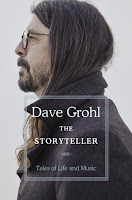
Thoughts and Inspiration from Dave Grohl’s The Storyteller

The urge came out of nowhere. Somehow, last year, I had the overwhelming desire to buy the new Foo Fighters album, Medicine at Midnight. That was odd considering I’d never purchased any of their albums up to that time. Heck, I knew only a handful of their songs and one main video, but buy the record I did and it became my favorite album of the year.

So when Dave Grohl, the founder and front man of the band, published his memoirs, The Storyteller: Tales of Life and Music, in the fall of 2021, I was primed and ready for it.

But I wasn’t ready for what it did to me.

A Parallel Life


With my newfound interest in all things Foo and Grohl, I learned Dave was only five weeks younger than I was. Back in 1991, when Nirvana released their seminal album “Nevermind” and set a dividing line in the history of rock music—there was a Before Nevermind and an After Nevermind—I probably knew that the trio were my age, but it didn’t register. Bands who made records I could buy were always older than me, right? Turns out, Dave was the youngest. He was like the younger brother of one of the two other guys in the band, brought along on account of his ferocious drumming style. I think we all know that Dave was at the right place at the right time, just before Nirvana blew away the general public with their sound.

But Dave was already a veteran of that scene. He had been intoxicated with the punk rock sound of Washington DC even though he was a suburban kid from Virginia. Even without a proper drum kit (he used pillows), the music flowed through him and he practiced and practiced the drums and well as strumming and picking out songs on his guitar.

Good fortune, luck, whatever you want to call it arrived one day when Dave, the seventeen-year-old struggling high school student, was given the chance to audition for the punk rock band Scream. He nailed the audition and, when invited to join the band, lead singer Peter Stahl finally thought to ask the young man his age. Naturally, Dave lied. “Twenty-one.” Peter and the other members of Virginia-based Scream accepted Dave’s word and Scream had a new drummer.

But Dave had one crucial thing to do, and even as I listened to Dave recount the story via the audiobook, fully knowing how it would turn out, it was a tense moment. Dave had to talk with his mother, a public school teacher, and convince her to let him drop out of school and tour with the band. Her words were surprising: “You’d better be good.”

As a listener to Dave’s journey, I found myself joining in his long days of traveling the country in a van, stretching out pennies per day on food, sleeping like sardines in said van, only to explode for an hour a day on stage. As a parent myself, however, I found Virginia Grohl’s faith in her son heart-warming yet also inspirational. The main job of a parent is to raise our children to be good, functioning, adults capable of holding down a job and making it on their own. She must have recognized that Dave was not going to be a typical nine-to-five kind of person and let him go. Even though my son is now twenty, I think back to when he was seventeen and ask myself if I could have let him go.

Turning it back on myself, however, I thought back to when I was seventeen. I was a junior in high school, just like Dave was. Could I have left the comfort of my suburban Houston home to tour with a rock band? Would my parents have let me? The answer to both is no.

That Guy From Nirvana


The four-year stretch when Dave toured America and Europe with Scream on less than a shoe-string budget helped forge his character into what he would become. His frugality he learned from his single mother, who raised Dave and his sister via her public school job and other jobs she took to make ends meet. He learned to make do with less and be happy about it. I found it telling that when he received his first check after joining Nirvana—an astounding-for-him $400—he blew it on a Nintendo and other assorted things he didn’t really need. Soon, he was back to scraping by, barely choking down the three-for-a-dollar corn dogs from a gas station. Still, he learned his lesson.

It’s common knowledge that Dave auditioned for Nirvana at a time when Scream was a slowly sinking ship. He joined the band with Kurt Cobain and Krist Novoselic and set to work on Nirvana’s sophomore album, Nevermind. It was great to hear Dave’s thoughts and memories about Kurt, especially how unprepared the trio was for the instant international fame they garnered with that fall 1991 album and, most importantly, the “Smells Like Teen Spirit” music video. Soon, the very people who poked fun of Dave in high school were now attending Nirvana shows. The alternative, punk rock mentality in which Dave and Kurt and Krist thrived was being co-opted by the mainstream. Dave struggled with it, but he managed to get through the deluge while Kurt did not.

I made the choice to listen to this book because Dave narrates his own story, and it is exactly the way to consume this book. You get Dave’s snide tonal shifts depending on if he’s talking about a funny memory, but you can also hear his somber voice as he talks about how Kurt’s death affected him. In interviews about this book, Dave mentioned he wrote the passages about Kurt last. I wonder if he recorded them last as well.

The Indie Spirit of Foo Fighters


In the immediate aftermath of Kurt’s death, Dave left music. He didn’t even listen to the radio. The very thing that pumped in his veins, that compelled him to become a high-school dropout was now the same thing he couldn’t endure. He wanted to distance himself from Nirvana, from Kurt, and, as he came to realize, from himself. After nearly picking up a hitchhiker in Ireland—the young man was wearing a Kurt Cobain t-shirt, the sight of which caused Dave to duck his head and pass by—Dave knew he must return to music.

As an indie author, I enjoy performing all aspects of writing and publishing myself. True, some tasks are more mundane than others, but that is the price I’m willing to pay. I knew about Foo Fighters back in 1995 but never bought the debut record. What I truly never understood, however, was that, save for a single guitar part in one song, Dave wrote and performed every bit of that twelve-song debut. And he did it all in six days in the studio. That astounded me, but what I really latched onto was how that creativity in the wake of Kurt Cobain’s suicide was Dave’s road out of his depression.

You see, I’ve been struggling with my own career as a writer, wondering if it is all worth it or if I should just hang it up. Why bother, I’d tell myself. No one cares if I write or don’t. In fact, those thoughts have so permeated my thinking that I actually have stopped. It’s been a month since I last wrote new words on anything other than blog posts.

But I have spent countless words on examining myself, and in this time of re-examining what kind of fiction writing career I want, I listened to Dave’s book. I hear him talk about his own struggles, his own doubts and fears, how he, even to this day, still struggles and wonders if he’s good enough.

Dave is a wonderful storyteller, weaving in and out of various tales from the road. All are remarkable and all had me questioning myself and my creative life choices. Late in the book, he described the feeling of being invited to perform—solo—at the Oscars. And it was the Beatles’ “Blackbird.” So, no pressure, right? He was scared, so scared that he nearly declined. But he and his daughter, Violet, had recently performed the song at her school talent show and she encouraged him to do the song. You see, she was scared to perform but she overcame her fears and knocked it out of the park. The child served as inspiration for the father.

In concluding this story, Dave wrote the following:

"Courage is the defining factor in the life of any artist. The courage to bare your innermost feelings, to reveal your true voice, or to stand in front of an audience and lay it all out there for the world to see. The emotional vulnerability that is often necessary to summon a great song can also work against you when you’re sharing your song for the world to hear. This is the paralyzing conflict of any sensitive artist, a feeling I’ve experienced with every lyric I’ve sung to someone other than myself. Will they like it? Am I good enough? It is the courage to be yourself that bridges those opposing emotions, and when it does, magic can happen."

Dave’s book arrived at the perfect time in my life and the inspirational journey he went on and continues to undertake hit me in the exact place I needed it: my creative spirit. It needed a jolt to get me out of the doldrums. My spirit needed to come around and be reminded that every single creative person—whether an indie writer, a rock star, or anyone in between—has moments of doubt. But if we just keep going and keep making our art, magic can happen.

It is remarkable to get an inside look at an established and famous rock star who is my age. The bass player, Nate Mendel, is four days older than me so I should have been a Foo Fighters fans from the jump. But I wasn’t. Instead, it took me twenty-seven years to come around.

Now, I’m there and not only am I on YouTube watching tons of videos but I’m rummaging through my wife’s CD collection and pulling every Foo Fighters album she has. The music is fantastic, but Dave Grohl’s message is even better.
Monday, March 7, 2022

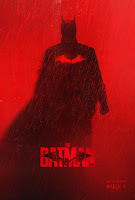
Impressions of The Batman

As I will do for every Batman movie ever made, I saw the new Batman movie on opening day. Lifelong fan of the character than I am, I have thoughts.

There will be spoilers.

Thirty-three years ago, we got a dark and brooding Batman in the form of Michael Keaton. Turns out, it wasn’t so dark, but holy cow was it at the time. Then after a more bright series in the 1990s, we got a darker, broodier Batman in Christian Bale. Then we got Ben Affleck who was dark and broody.

And now we have Robert Pattinson who is uber-broody. Like others have said, he's Emo Batman. And you know what? I'm fine with it. I actually enjoyed the film quite a bit, all three hours of it. And my middle-aged bladder was able to make it through the entire film without compelling me to run to the bathroom. Why? Because I didn't drink a lot of water. But mostly because the movie was rather compelling.

The Voice - Kevin Conroy is all but the definitive Batman for me when it comes to how he does the voice of Bruce Wayne and Batman. Bale's gruff growl became distracting and I particularly appreciated Affleck's voice modulator. Pattinson's low, non-gruff voice worked for me.

The Suit - A fully functional, bulletproof body armor bat suit. I loved the collar. The cowl was also well done, showing all the scrapes he's endured. And I liked that they acknowledged he wears black makeup around the eyes. I loved the gauntlets that could be deployed at a moment's notice. And the use of the taser. The bionic contact lens was a nice touch.

Jeffrey Wright - Can we just get a TV show with him as Gordon? Really, really liked how he stood up for Batman from the jump. We even got a few of the bewildered Gordon moments like when he looks back and Batman's gone.

The Police - Really liked how the cops go from disliking Batman to grudging acceptance. And that scene when Batman and Gordon walk Falcone out and they see all the good cops? Wonderful.

Colin Farrell/The Penguin - Completely could not see Farrell in the makeup. But I really liked his ferocity with the character. Sure, it's a little on the Deniro side of things but Oz is a crime lieutenant. It's was fun.

Zoe Kravitz/Selina Kyle - Her action scenes were fantastic with her multiple kicks per strike. I liked her one-track mind to help find then avenge her friend. And she had some of the few funny parts in the movie.

Paul Dano/The Riddler - Going into the theater, I could not have picked Dano out of a lineup. And I so liked that his visual style was basically a geek. A genius geek, but just a normal guy on whom the world had shat on for years. His monologue in the jail cell was pretty darn fun.

The Riddler's Big Plan - I so love movies when the villain is 25 steps ahead of the hero, and this movie had that in spades.

Batman as Detective - Very, very nice to have a movie like this. Yeah, we've had the big explosion version of the character so why not basically have a PI solving riddles and crimes who just happens to wear a bat-suit rather than a trench coat and fedora. T'was nifty that Alfred helped out with that.

The Fight in the Dark - Maybe 30 seconds, but holy cow, was that sequence awesome. One of the best in all of Bat-movie history. I'd bet money that director/writer Matt Reeves was inspired by the hallway sequence with Darth Vader in Rogue One.

The Finale/Mist Scene - As soon as Batman exploded that fire extinguisher and created a cloud of mist, I knew he was going to jump out of it. Fantastic visual.

And a child shall lead - When Batman, with red flare in hand, goes to help the mayor-elect and others get out of the flooded arena, I so loved that it was the young boy who was the first to take Batman's offer of help. The boy recognized the hero that Batman was and showed the way.

The Ending Speech - I appreciated the mirror version of Gordon's closing speech in 2008's The Dark Knight. This Batman, for all his mopiness, recognizes the need for hope in Gotham. That is an intriguing plot thread to open.

The Mood - I'll admit I was a tad leery of yet another brooding Batman movie, but I was sucked in almost instantly. It was a slow burn movie, punctuated with intense fighting sequences, but I really liked it.

The Music - John Williams's theme to Superman is arguably the greatest super-hero theme every written. Well, not arguably to me. But Danny Elfman's Batman theme is definitely second. When I saw that Michael Giacchino as the composer, I was excited. But a theme like from Williams or Elfman would not have worked in a movie like this. The slow, downbeat score, with the new Batman theme scattered throughout the movie, worked really well. Of particular note was the harp-and-cello piece when Bruce Wayne went into his parents' room.

The Verdict


Up until 2022, there has only been one live-action Batman at a time. That changes this year. Later, when we get The Flash movie, veteran Batman Michael Keaton returns and we'll a second live-action Batman, even if it is a return of an old favorite. That's a good thing, because if you don't like the mopey Batman, just wait. Or watch other versions.

Here's the thing: in the summer of 2008, we got one of the best Batman movies ever in The Dark Knight. Later that fall, we got the equally fun and light-hearted animated series Batman: The Brave and the Bold. Boy did I love that series. And I also liked that year's epic Batman movie. I can appreciate both of them because there is room for Batman to be interpreted in different ways.

This is Matt Reeves's interpretation of 80 years of Bat-stories and the character and situations. As much as I love the brightness of the Marvel movies, Batman works well in this kind of story. Like I mentioned at the top of this post, I was a little leery/weary of broody Batman.

But Reeves's story, direction, and cinematography as well as Pattinson's performance won me over. It did for my wife as well. (Note: she is not a super-hero film fan but loved Bale's Batman, especially The Dark Knight, perhaps the only super-hero movie that she'll start to watch if she runs across it on TV.)

I thoroughly enjoyed this movie and look forward to seeing it again.

Tuesday, March 1, 2022

Writer, Know Thyself AKA Don’t Fight Who You Are

The year 2022 has been rather productive even if that productivity hasn’t always generated new words. It has, apparently, yielded greater clarity as to the type of writer I am. It also meant I had to struggle through some thoughts that really got me down.

On New Year’s Day, I had the idea that I wanted to write every single day in 2022. That lasted 41 days, longer than some folks do with their resolutions but it still stopped. Part of the reason was that I was a bit haphazard in what I was writing, but I think I learned something about myself in the process.

I thought it would be fun to write some short stories. I also thought I could write 1,000 words per day. I busted out the first one in only three days. Then I jumped on a second one, knocking it out in about seven or so days. Then a third. I then shifted to writing chapter 29 of my current WIP and finished up that chapter. But I wasn’t sure where to go next with the story. With the 1,000-word-per-day goal hanging over my head—when I really wanted to stop, re-read the WIP, and determine where to take chapter 30–I left the WIP and started a fourth short story. The thing was it wasn’t as good as I thought it could be. I was literally stringing words along just to get to 1,000, and I wasn’t writing what I truly wanted to write (the novel).

Dissatisfied with my output, I ended the 1,000-word streak. Then I ended the writing streak. And, to date, haven’t started it back up. Why?

Well, because of burnout, I'm guessing. I looked back on my 2017 writing calendar. I wrote three Calvin Carter novels in three months. Each time, I finished the books with days in the month to spare and I took a break. In January, I had about 5 days. In February, it was only two. I finished the March book on 28 March, giving me a three-day break. As you can see, I built in breaks. They were my rewards for a completed novel.

Then, in April 2017, I quit Calvin Carter Book 4 on Day 15. Back in 2019, when I was using NaNoWriMo to write a different novel, I ended up coming to a dead end—no, not a dead end; a 'which way to go?'—and I never got back on track. But that was in early December, after I’d successfully reached the NaNoWriMo threshold in November of writing 50,000+ words in that month.

All this is to say that it looks like I'm the type of writer who needs to have breaks built into my schedule. All the more power to those old pulp writers and modern ones like James Reasoner who can just keep writing, but it appears that's not me. Which is kinda sad because I'd like to be that kind of writer, but I guess I'll have to fall back on the mantra of Writer, Know Thyself.

When I stopped my 2022 writing streak back on 10 February, my failure really got me down. Why bother writing? was a common thought that ran through my mind. Why indeed? One more voice in the cacophony of writers and all the other content vying for people’s attention. I started to write down my thoughts and instead of zeroing in on all the bad stuff, I turned it around and started to count my blessings.

I am in the enviable position where I have a day job that provides me and my family with monetary income, health benefits, and stability. That affords me the ability to write what I truly want to write and make it the best I possibly can. You know, as opposed to having to write something simply to put food on the table and keeping the roof over our heads even if those subjects are less than exciting. Again, major props to those pulp writers of all the decades who really did have to churn out the words in order to provide for their families, even if it was the fifty-eighth Shadow novel or sixty-fourth Doc Savage book or even the two hundred and sixteenth novel in the Longarm series. (Or Destroyer. Or Executioner. Or Trailsman.)

By slowing the pace down to a steady constant rather than the frenetic pace I was keeping earlier this year, I should be able to be like the tortoise in the old rabbit vs. tortoise fairy tale. Yeah, I’ll get to the finish line with the content I have the time to write. Yeah, other writers will do better [Pick your metaphor: they’ll reach more finish lines than I will or they’ll reach the finish lines with more books] but I can’t control them. They have different environments and situations (and genres?) than I do.

Which means what I do will be more difficult. Yay. It means I might not have the success of others. Sure. But it also means I’ll be able to carve out my own path that is uniquely my own. And that is good. Again, with a foundation of having a day job to provide stability, I can keep going at my own pace.

I still have the goal of completing twelve short stories by year’s end. I’m a quarter to that goal already. And I have my three novel WIPs that’ll keep me going. But I’ll build in breaks. Evidently, that’s the kind of writer I am. Better to acknowledge it and run with it as opposed to fighting it and getting depressed I’m not a different kind of writer.

I’m back on the writing wagon as of today. It’s a new month. I’ll move forward, finish the next project, and then set everything aside. The break probably won’t be the two weeks I’ve given myself in February, but it will be a break.

So, fellow writers, have you had a heart-to-heart with yourself to help you realize who you are as a writer? What steps did you take? I’d love to know as writing—and all creative outputs—are a constant work in progress.

Tuesday, February 22, 2022

What Are the Famous Books of the 1990s?

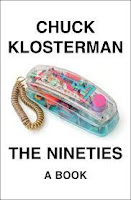
For the past couple of weeks, I’ve been listening to The Nineties by Chuck Klosterman. I’d never heard of him but the book’s cover caught my attention. Couple that with my son’s musical tastes currently residing in the 1990s and I thought why not take a chance with the new book.

It’s a fascinating read and I thoroughly enjoyed. I annotated my audible file with interesting clips and I’ve got the ebook on hold via my library to potentially re-read some passages.

Klosterman focuses on pop culture, politics, TV, music, movies as a means to explain that last decade of the century. It was only by the end that I realized something: I don’t think he mentioned any books. Which got me to thinking about an obvious question:

What are the famous books of the 1990s?


Okay, do something with me. Think about that decade and see if you can recall any titles or authors but do not use the internet. Heck, don’t even look at your bookshelves. Just see if you can come up with any famous books strictly from your memory. I’ll wait.

Okay, so how many did you remember? Truth be told, as I’m writing this, I have not yet turned to Google. I’ve not even turned my eyes to my various bookshelves. In real time, I’ve been thinking about this question, off and on, for about a day, and only in the last few minutes did I remember an author and book that emerged in the 1990s: John Grisham’s The Firm.

I struggled to even remember many books. I went through my mental Stephen King list but could only remember Bag of Bones from 1998. Grisham’s status as the premier writer of the legal thriller instantly brought his other books to my mind. And I think Midnight in the Garden of Good and Evil was a 1990s book. But those were all I can remember.

So, if you’ll excuse me, I’m going to Google now. I suspect I’ll have more than a few “Oh, right! That book!” forehead slaps but such is my memory.

And I’m back, and I’ve slapped my forehead more than once in the category of “How could I have forgotten that book.” Among the titles that slipped my mind are Jurassic Park by Michael Crichton (1990), The Bourne Ultimatum by Robert Ludlum (1990), Truman by David McCullough (1992; my historian cred just went down the tubes), The Bridges of Madison County by Robert James Waller (1993), Men Are from Mars, Women are From Venus by John Gray (1993), Primary Colors by Anonymous [AKA Joe Klein] (1996), and many books by Danielle Steel and Mary Higgins Clark. I used this site to get the Top 10 books per year and not what someone thinks are the important books.

How many did you remember? More than me? That’s good. Heck, I couldn’t even remember all the Stephen King books of that decade. And how many mystery/thrillers did you recall? The presence of Clark and Ludlum tells me that our genres was at least at the table—as was Tom Clancy (more than once) and James Patterson. 

Update: reader Jeremy sent me an email to remind me that Harry Potter was released in 1997 (UK) and 1999 (US) and publishers spent the next 15 years trying to chase the next big young adult craze. He also mentioned that the first Game of Thrones book was published in 1996. That brought Snow Crash (1992) to my memory although I didn't read it until the early 2000s. Ditto for the Potter books (I read them all in 2007).

Here’s a larger question: how many of those books were influential? How many changed things? I’ll come back to the Truman biography. I was in grad school and in 1992, many of my professors grumbled at McCullough’s book because it was too popular. Like the study of history had to be impenetrable to be good. I, for one, appreciate it when a historian writes a popular enough book that it becomes a bestseller (or a Broadway musical). I saw more history books written in McCullough’s style after 1992 than before.


What is the Nevermind of Books?


What about fiction? Is there a Nirvana moment (there was a Before Nevermind and then there was an After Nevermind) or a Matrix moment (same concept) for books? Historically, I’m guessing something like Agatha Christie or Dashiell Hammett (The Maltese Falcon) or Raymond Chandler’s work (The Big Sleep?) or Mickey Spillane (Mike Hammer’s first book) or Ian Fleming (was he the first huge spy writer?) or Tom Clancy (techno-thriller) or Grisham (legal thriller). I guess Grisham in the 1990s can count as the guy who put legal thrillers back on the map (Erle Stanley Gardner’s Perry Mason was king but I can’t think of any other ones other that Scott Turow’s Presumed Innocent in the interim).

Now, I also admit that I also did a more specific search for mysteries and thrillers in the 1990s. Here is that link. This is likely not an end-all, be-all list, but something is obviously apparent if you scan the list: the large majority of top mystery books in the 1990s involve series characters. I counted twelve out of 100 that were not series related. My guess is that a respective list for the 2000s, the 2010s, the 1980s, will reveal the same thing. Series sell. It’s a testament to a certain type of writer who can publish different stories within a genre and not do a series.

This essay is a thought exercise but also a real question. Were there any truly game-changing books published in the 1990s? Did they influence pop culture? If not, when was the last time a book sat in the middle of pop culture and dominated the national conversation or, at least added to the greater conversation? (I’m mainly talking about fiction because there are certainly non-fiction books that have made their mark on society.)

Monday, February 14, 2022

It’s Okay to Adjust Your Goals

Remember a few weeks ago when I wrote a post about finding time to write? The thrust of the piece was that there are lots of little chunks of any given week to devote to writing. I stand by that assertion, but two things happened in the past week. I realized I wasn’t leaving time for all the other things an indie writer needs to do, and I was getting worn down.

When do I edit my stuff? When do I create covers for my stories? When do I do the website upkeep? These activities are crucial to being an indie writer/publisher in 2022 and I simply wasn’t giving myself time to do any of it. Why would I? Doing those things meant I would write less.

But, but, but I have a minimum word count of 1,000 words. How am I supposed to do all that other stuff and still get in my thousand?

I’ve been trying and doing reasonably well. Actually, that may not be entirely accurate. I have been working in the editing and the cover creation, but doing it by sacrificing sleep. The Olympics didn’t help because of the time zone difference, I’d be up watching live coverage prime time through 11pm yet still getting up at 5am. That, of course, wouldn’t last, but it crystalized just how much time in the day I had at my disposal. It is finite and there are things I need to do, and keeping myself healthy is high on the list.

But what about that minimum word count? What about hitting that thousand? Well, if the words are crap and you’re just writing to hit a number, then what’s the point? I intuitively recognized my internal self was stretching out scenes just to meet some arbitrary number. For example, the short story I’ve been working on is nearing 10,000 words. Are they all needed? A critical edit will tell me the truth, but there’s a sense I’ve been padding the story to reach that 1,000/day threshold.

But to do this, to accept that I’d be doing less in the given time allotted to me, I’d have to give myself permission to downshift and try something else. That’s a big mental hurtle for many of us, myself included. We want to be super productive, but if that productivity either ruins our health or delivers sub-par writing that you’re going to have to fix anyway, what’s the point?

Better to be efficient even at a slower pace than the opposite.

So I gave myself permission to drive the writing career at a slower speed. My goal is to create better content at a consistent pace without sacrificing my health, both the body kind and the mental kind.

What also helped me reach this conclusion was this week’s post from Kristine Kathryn Rusch. She links to an article ostensibly about “Covid Cloud” and how we can overcome our concentration issues, but the author, Jessi Gold, makes a point about doing less. “Normalizing doing less feels uncomfortable, vulnerable, and might even make us feel like a failure. This is because we often measure our success by our productivity.”

Yup, that was me. And it’ll still be there, truth be told, but I am trying something different. Still writing everyday, but allowing myself time to breathe and do the other things required of me, like re-reading a novel to determine next steps.

Do y’all ever have moments like this? What do you do?

Monday, February 7, 2022

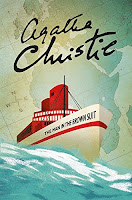
Setting Off For Adventure with Agatha Christie's The Man in the Brown Suit

Well, I’ve finally read my second Agatha Christie novel.

The Man in the Brown Suit (1924) was the January 2022 selection from the good folks over at AgathaChristie.com. It’s part of the Read Christie 2022 project. For the past two years, they’ve done something similar. This year, they’re focusing on Christie’ love of travel and selecting books with that theme.

I didn’t do the challenges the last two years, but opted to read this novel, Christie’s fourth book. Our lead heroine is Anne Beddingfeld, a young woman, on her own after her father passed away. With her whole life in front of her and with her mind swirling with the drive for adventure, young Anne finds all that and then some.

In a London subway station, Anne sees a man look at her in shock right before he plunges over the edge of the platform and dies. An odd-looking man swoops in to examine the body, claiming to be a doctor. But Anne questions the newcomer’s intentions. Couple that with a piece of paper dropped by the supposed doctor and Anne starts to see a mystery.

The mystery leads her to a ship bound for South Africa. On the ship, strange things occur and she’s introduced to a number of other characters. One is Sir Eustace Pedler, a member of Parliament, who brings with him a pair of secretaries, Guy Pagett and Harry Rayburn. Also of note is Colonel Race, supposedly of the British Secret Service, and Suzanne Blair, a married woman who befriends Anne on the voyage.

Lots of things happen on the boat and they continue when they get down to South Africa. It’s fascinating to read what was dubbed a thriller circa 1924 and compare it to what we think of as a thriller nowadays. Like many a mystery story set between the two world wars, there’s a quaintness to this novel. There’s the tendency of the bad guys to expostulate to the heroine, laying out the bad guy plan in detail. There’s the somewhat coincidental nature of some of the plot points, like what happens on the boat at night that just so happens to have Anne present.

Then there’s how the story itself is presented. A prologue shows us a few characters basically told from the author’s point of view. Then the novel switches to the narrative Anne writes herself. Spliced amid Anne’s reminiscences are those of Sir Eustace himself. It’s a clever trick because it enables Christie to show the reader certain things Anne and the others don’t know.

I’ll admit there was a time or two I’d have to think and remind myself which character Anne was referring to. I listened to a well-done narration by Emilia Fox and it wasn’t her fault. It was my own disjointed listening schedule. But by the time I was on the final homestretch, I was deeply into the story and barreled ahead until its conclusion.

And I rather enjoyed learning the identity of the mysterious antagonist nicknamed “The Colonel.” [No, it’s not Colonel Race. Christie obviously didn’t read all those how-to-write-a-mystery books in which you’re not supposed to name characters with similar names or titles.]

I enjoyed it, but it’s certainly not what I think of when I think of Agatha Christie. No Poirot, no Marple. But that’s likely the point of a reading adventure like the one planned for 2022. It looks like they’ll feature books that aren’t always on the top of people’s mind when they list favorites from the Queen of Mystery Fiction. Granted, the February book is Death on the Nile (to coincide with the new movie), a title I do know, but I’m looking forward to the rest of the selections throughout the year.

Thursday, February 3, 2022

David Bowie's Earthling at 25: Still An All-Time Favorite

I didn’t really know what to expect on 3 February 1997 when I bought David Bowie’s new album, Earthling. All I knew or cared about was that there was a new album. Little did I know I would  come to consider Earthling among the Bowie albums to which I return frequently.

I’ll admit, the album, with its drum-and-bass, jungle music had me initially scratching my head. Without the internet, I was unaware that, in the London clubs, there was a new musical style. Like many things in those days, I was introduced to new things via established artists like Bowie experimenting with them. His previous album, 1995’s Outside, saw Bowie experiment with industrial sonic palettes and I mostly enjoyed that album. By that point, I owned all of Bowie’s albums and knew he’d take me on an interesting musical journey. In fact, I’d come to expect it, and he delivered with Earthling.

Many of the tracks on the album came across then as a mishmash of styles, beats, and instruments. Anchored by guitarist Reeves Gabrels, Bowie created various grooves over which he and others could sing, play, and solo. But they are not mere jams like Miles Davis’s electric era. All these tunes are songs, conforming to a logical structure, and meant to be played on the radio or in clubs.

Despite how intense many of these songs sound, Earthling further establishes the basic fact that Bowie, as a singer, is basically a crooner, especially on my favorite track, “Dean Man Walking.” The beat of the song is relentless yet Bowie sings in long, slower, melodic passages. It’s that juxtaposition that really enamors this album to me. I like it when artists I appreciate take a thing—Bowie with drum-and-bass; Sting with Arabic rhythms and structures, Paul Simon with African beats—and put a new spin on it. I almost always do a deeper dive into the source material, but the interpretation is where I start. 

Reeves Gabrels is the co-star of this album. His guitar work is often blistering in its intensity, and I’m not sure I’ve heard a player more in love with the whammy bar than Gabrels. But he, like Bowie, was more interested in creating an atmosphere of music than traditional songs. If there’s a most-blistering moment, it’s the slow buildup during his solo in “Looking for Satellites.” 

Then there’s the brilliant Mike Garson. I’ve loved and enjoyed his piano work on Bowie’s songs since his famous turn on Aladdin Sane. In fact, his presence on many of Bowie’s 1990s albums and in his touring bands is often my favorite part. There’s nothing quite like a furious beat with crunchy guitars over which Garson plays his discordant piano solos (“Battle For Britain (The Letter)”). His solos might sound dissident, but they are nonetheless melodic. Also of note is his trilling up and down the keys at the end of “Dead Man Walking.”

By 1997 and the success of MTV’s Unplugged, going acoustic was all the rage and Bowie was no stranger to stripping down his songs down to their essence and delivering unique takes. He did it for old songs like “Quicksand” and “Scary Monsters” but how would these songs from Earthling sound without all the techno trappings? Turns out, pretty damn good. He revealed the beauty of his music and voice even at the age of fifty. It was during 1997 and the years following that I’d scour record stores hoping for (ahem) bootlegs of shows I couldn’t see, many of which featured the acoustic versions. He performed one on Conan O’Brien’s show, a performance Conan himself re-broadcast when Bowie passed away in 2016. 

One holy grail bootleg was the concert to celebrate Bowie’s fiftieth birthday in January 1997. He performed seven of the nine songs from Earthling, all with guest stars. I got only bits and pieces back then, but courtesy of YouTube, it’s all there.

Speaking of the album’s rather limited track list, it’s not as few as Station to Station’s six, but I appreciate Bowie’s restraint on Earthling. After the previous album’s nineteen tracks, nine seemed like a good number, especially with all the moods they elicit. 

I freely admit I was one of the listeners who discovered Bowie via Let’s Dance. Actually, it was when I had Queen’s Greatest Hits and wondered who the other guy was on “Under Pressure.” But over the years, I have a tremendous fondness for Bowie’s 1990s-era material. His performances in the Earthling era are particularly great. Not only does he play a huge chunk of his new material, he reinterpreted older songs like “The Man Who Sold the World” and “Fashion” with a techno/grungy vibe. In fact, I recently discovered the full concert for the 1997 GQ Awards and thoroughly enjoyed it. Bowie himself called this band, which included the wonderful Gail Ann Dorsey on bass and vocals, among the best he had. The proof is in the music where folks like Gabrels get chances to expand solos and Garson layers over his piano work across all the tunes.

I have purchased this album at least three times. There was the original album, all the special CDs available in random places (like the Earthling in the City CD glued onto an issue of GQ), I bought the double disc in 2004 that included a ton of remixes. Then, just last year, I picked up the Brilliant Adventure box set showcasing the entire 1990s era. 

If you haven’t listened to Earthling in a long time—or perhaps you never have—give it a spin, but do yourself a favor. Don’t just listen via the small speakers on your laptop or phone. Plug in some earbuds or headphones and listen to all the sonic goodness David Bowie delivers on Earthling. It may be twenty-five years old today, but it still sounds fresh and energic, the portrait of an artist trying out new things, constantly looking forward rather than backward. 

Monday, January 31, 2022

The Great February Reset

Do you know the best thing about February is? No, not the holiday. Valentine’s Day is one of my least favorite holidays on the calendar. It has always felt manufactured, like if the folks who sold flowers, chocolates, and greeting cards all got together and invented a holiday to increase their bottom lines.

Actually, one of the best things about February is the chance to reset on any habits you might have already broken.

I suspect you’ve seen all the historical data that tell us many people stop doing their New Year’s Resolutions sometime around 14-19 January.  That's just two weeks. Typically we think of resolutions like going to the gym or talking a daily walk to help us exercise or stop eating a certain food or abstaining from alcohol.

Those are all well and good, but often, we creatives want to start a habit and, in some ways, that can be more difficult, especially if we’ve fallen by the wayside prior to New Year’s Day.

But here’s the thing: a New Year’s Resolution is not a one-and-done. It’s not like if you fall off the wagon sometime in mid January you have failed for the entire year. Let’s not judge an entire 365-day cycle by the actions of a 14 or so days.

I’m a firm believer that every new month is an opportunity to get back into a habit or reinforce one you started the previous month. I resolved to write a 1,000 words a day in 2022 (or reach 365,000 words for the year). I’m happy to say that my streak is intact, but boy, some of those days were a slog, especially with a day job.

In fact, I battled with myself over just how important a streak like this is. To remind myself of the power of streaks, I need only look at the small calendar on the fridge. I had fallen away from taking vitamins every day so I needed to start that back up again. I did the Jerry Seinfeld thing where I put an X on the calendar for each day I took my vitamins. Eight days into the new year, I forgot. Boom! Busted up my streak and my January has a hole in it. Irritation.

But my writing streak is alive. My writing resolution is alive. I hope your resolutions are alive, too.

If they’re not, dedicate the month of February to creating a new habit. It’s only 28 days long, an even four weeks. Chances are high if you maintain that new habit until 1 March, you’ll be good to go. But if not, then let March be your new start date. Heck, let each Sunday be a start date. Just start. Then continue. The rewards will flow to you.

Monday, January 24, 2022

Carving Up Your Hours and Meat Loaf’s Example for Creatives

You don’t find the time to write. You make time to write.

That’s an adage I’ve held onto for years. I firmly believe that if you truly want to write, you will make the time to write. Thus, the excuse of “I would love to write but I just don’t have the time” flies out the window.

But sometimes you have to carve up your time to find those pockets in which you can write. I did a little exercise this week that you might find instructive if you are wanting to find all those extra minutes in your week to get your fingers on the keyboard and your brain into its imagination.

I started a new day job this month and this is the end of week three. Naturally, I now have a new schedule, one that involves three days in the office and two at home. It felt like I had less time to write, so I broke down my days.

Every weekday, I wake at 5am. Yes, I am a proud member of the 5am Writing Club. Have been a morning writing for going on nine years now, and dedicated 5am-er for the past three or four. I find it liberating to have the house to myself, only a single light on over the kitchen table, and just a cup of coffee (two, actually) beside me as I write. Zero internet, zero TV, zero anything other than a psalm a day until the words are out of my head.

I work in the office Tuesday, Wednesday, and Thursday. That means I have a hard stop at 6am so I can get ready for work, jump in the car with the daily smoothie, and drive to work, usually listening to an audiobook (most recently finished Carol Burnett’s memoir).

So, accounting for the waking, exercising, Bible-reading time, I’m left with approximately 45 mins in the morning to write, give or take. Doing the math, 45 x 3 = 135 mins. Since I work from home on Mondays and Fridays, I allow myself an extra 30 minutes. 75 x 2 = 150 mins. That’s 285 mins, or 4.75 hours per week in the mornings to write. Not bad at all.

Side note: I don’t write during Family Time at night.

Then there are the lunch hours at the day job. Accounting for regular meetings going long and, you know, eating, I estimate I have 45 minutes I can spend writing on my Chromebook. That’s another 135 minutes, which bring us up to about 7 hours per week that I have to myself and I can write.

I have more time on Saturdays. I tend to wake at 7am, get the dogs, head out to Shipley’s for do-nuts, come home, cook and eat breakfast. Generally, I get to writing around 8am and the family leaves me alone. On Saturdays in which there are few things to do, I can get two hours easy. Then, it’s Family Time (or Chore Time) so the writing is off the table. Now I’m up to 9 hours, more or less.

Sundays are a tad different. I still wake at 7, but I have a hard stop around 9:30 or so to get ready for church. So let’s call it a good 90 minutes. Now I’m up to 10.5 hours of writing time per week.

All it took was for me to analyze my schedule and see what time I have available. There’s a lot I can do in 10.5 hours. I knocked out NaNoWriMo’s 1,667-word threshold in any of those given time frames, but if it’s slow going, I can get 800 words in any one of those writing sessions (although my daily goal is 1,000).

Here’s where the math is magical. If I can average a 1,000 words an hour, that means I can write approximately 10,000 new words of fiction per week. With a day job. With Family and Chore Time factored in.

And all I basically ever do is wake up earlier than my family and write. Makes me really happy, productive, and helps start the day on a good note.

Now, how does your week break down?

Meat Loaf’s Example and His Challenge


The news broke Friday morning that Meat Loaf passed away. I have an unabashed love for his soaring, Broadway-like anthems. In particular, there is a late-career gem I wrote about back in 2016 that was the first song I went to upon hearing the news. Then I listened it again before playing all the songs I have on my Mac.

In the various comments from folks yesterday, more than one commented on Meat Loaf’s improbably resurgence in the early 1990s. In an era of grunge and rap and early hip-hop, here was Meat Loaf singing about the things he would and would not do for love. The song was over the top, the video was even more over the top, but people ate it up. I know I did. There he was, wearing makeup to give him the appearance of a beast, starring in a mini-movie. Were it anyone else, they would have been laughed at.

But not Meat Loaf. He knew who he was, what his talents were, what kind of music he liked and performed well, and just did all that. He was himself no matter what. Sure, he had some down times, but he kept to his talents. When it worked, it soared. When it didn’t, he kept going.

From the last part of the tweet that announced his death came this challenge: “From his heart to your souls…don’t ever stop rocking!”

That’s his challenge to every creative: Don’t ever stop [making your art].

Saturday, January 15, 2022

YouTube and Old Music: Where Memories and People Meet

Do you ever get lost reading YouTube comments? No, not those. I don’t read those either. I’m talking about the other ones. The good ones. [And yeah, there is a book-related comment at the end.]

There is a fantastic YouTube channel if you enjoy old music. I’m talking stuff from the 1940s-1960s. It is curated by Jake Westbrook (that’s the name of the channel as well) and he collects songs for different moods. Last fall, I discovered him and listened not only to the “Vintage Autumn Music” but thoroughly enjoyed his Halloween playlists. One of the best, interestingly, was his Thanksgiving playlists. He’s got ones for Route 66, summer, and many others.

What I particularly enjoy is reading the comments. If you need a dose of goodness, check these out. More often than not, the commenters praise Jake for the curation, but more importantly, they praise the music. Some are from younger people who never lived when this music was on the radio or TV. They marvel at how good the music remains and lamenting modern music.

A particularly nice sub-set of these comments are from folks who have lost parents or grandparents or other family members. The commenter usually relates a memory this music evokes. One really got to me. It was of a grandchild who played these vintage songs as the grandparent was bedridden. The music calmed the older person, letting them get lost in their memories as they passed from this life into the next.

Cut to more modern music. I’m a huge fan of Frontiers Music. This is a great record label that releases new music by new artist who still like melodic rock as well as older artists who no longer have a home in the big music companies. Think Enuff Z’Nuff or LA Guns. Their hashtag is their motto: #RockAintDead.

Anyway, yesterday, the weekly email featured videos of new releases and one of them was for The Alan Parsons Project’s (with a full symphony) song “Don’t Answer Me.” I LOVED that song as a teenager. It was prompted me to buy the album.

Yet, I hadn’t heard it in a long, long time. Naturally, I clicked on the link and heard a newer rendition with the Israel Philharmonic Orchestra. Oh my was it gorgeous. But that prompted me to return to the original and it’s fantastic pulp-style video.

But it was in the comments associated with the original 1983 version that I again got lost in. Unlike Jake Westbrook’s playlists, I was among the generation who experienced this song when it was new. Now, so many of the comments relate to “I’m 21 and I just found this song and it’s so good” kind of vibe. Or, as you can imagine, ones in which younger people discovered the song in the mom’s stack of CDs or their dad recently passed away and this is the song that helps the commenter remember a recently deceased parent. I went down an Alan Parsons Project rabbit hole, but I also experienced the memories of all the commenters. It was a wonderful trip.

But then I got to thinking about books. While there is certainly not a YouTube for books, where is a site for comments like this? Where is the site where grandchildren can talk about how they read their grandfather’s favorite book as he lay on his deathbed and the grandchild realized how good an old book was?

That is a site I’d love to visit.

Saturday, January 8, 2022

Writing Without Paper: Introduction

Can you be a writer without using paper?

I’m a writer and I use a lot of paper. I make notes on yellow legal pads, I make lists of character names on a giant spreadsheet printed out on an 11x17 tabloid-sized piece of paper. In the past, I have used hundreds of note cards to map out a story. Those note cards would then be pinned to the cork board in my office. And don’t get me started on post-it notes that I’ll use to jot down random pieces of things for the story and post them on monitors, laptops, keyboards, or the desk.

Then there are the drafts. Yes, I know there are folks who write and edit within whatever word process they’re using. I can do that, too, but more often than not, I prefer to print it out and read it that way. Sure, I format the manuscript to be single spaced and I print on both sides of the paper, but still, if I have a 300-page manuscript, that’s 150 pieces of paper.

Suffice it to say, when I’m writing a novel, I simply use a lot of paper. This amount goes up and down depending on the length of the writing project. For shorter pieces, I usually don’t have all the background stuff, but I still have the various drafts with all my marks in green ink.

Late last year, I got to thinking if there was another way, a paperless way, to brainstorm, write, edit, format, and publish stories. I came up with a qualified answer: Yes, I think so, but certain equipment and apps would make this job easier.

Equipment and Apps


First off, I needed a new iPad. Mine was a second generation that basically did nothing for me other than allow me to read comics and ebooks. If this was going to work, I needed new tech.

I purchased a refurbished 2020 iPad Pro with a second generation Apple pencil. Wow. Is this thing amazing. Granted, when you’re coming from a 2012-era iPad, most anything is an upgrade, but I’m particularly impressed by the fact that I can get an entire ‘piece of paper’ on the screen at the same time.

The pencil is super cool and seamless. There is no visible lag at all. Among the coolest things: a simple double tap on the pencil changes the function to the eraser (while another double tap shifts it back to the pen). Thus, without even changing your hand position, you can write, make a mistake, erase, and start writing again in seconds. Tres cool.

I paired my Bluetooth Apple keyboard with the iPad and use the device as my primary means to write. But I do not plan to take the iPad to the office (yet) so I compose in Google Docs. That way, I can sync my Chromebook and bring it to the office. It’s rugged and a single unit so it’s been my preferred in-the-office personal device for over two years now.

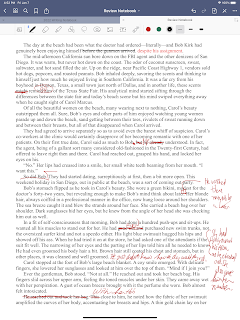
When it comes time to edit the completed file, I use GoodNotes. Not only does it allow me to edit PDFs. It’s really neat to have the iPad in my lap, pencil in hand, and just read and edit the text. It’s pretty much paper-like, but still digital.

This app is good for general note taking. So far this week, I’ve worked on two short stories, completing one and more than halfway through the second. As such, I don’t necessarily need a notebook with character names, etc., but when I start a new novel, this will be the place where I store said notes. It syncs to my phone so when I’m out with my Chromebook, I’ll have my notes. Granted, I can’t use (nor would I have) the pencil with the iPhone, but that’s no big deal.

Here’s a screenshot of page one of the completed short story.


From there, I’ll be able to make those changes in the manuscript and nary a piece of paper will be needed.

Publishing


While I have not yet published anything, I already know how to do that part. I’ll spell it out in a future post.

I have an entire process flow, but I want to test it first, work out any kinks, before I share it.

So, am I the only one who is writing without paper? For you other paperless writers, what are some of your preferred tools and apps?


P.S., Happy Birthday, David Bowie. Still miss you.