Thursday, February 3, 2022

David Bowie's Earthling at 25: Still An All-Time Favorite

I didn’t really know what to expect on 3 February 1997 when I bought David Bowie’s new album, Earthling. All I knew or cared about was that there was a new album. Little did I know I would  come to consider Earthling among the Bowie albums to which I return frequently.

I’ll admit, the album, with its drum-and-bass, jungle music had me initially scratching my head. Without the internet, I was unaware that, in the London clubs, there was a new musical style. Like many things in those days, I was introduced to new things via established artists like Bowie experimenting with them. His previous album, 1995’s Outside, saw Bowie experiment with industrial sonic palettes and I mostly enjoyed that album. By that point, I owned all of Bowie’s albums and knew he’d take me on an interesting musical journey. In fact, I’d come to expect it, and he delivered with Earthling.

Many of the tracks on the album came across then as a mishmash of styles, beats, and instruments. Anchored by guitarist Reeves Gabrels, Bowie created various grooves over which he and others could sing, play, and solo. But they are not mere jams like Miles Davis’s electric era. All these tunes are songs, conforming to a logical structure, and meant to be played on the radio or in clubs.

Despite how intense many of these songs sound, Earthling further establishes the basic fact that Bowie, as a singer, is basically a crooner, especially on my favorite track, “Dean Man Walking.” The beat of the song is relentless yet Bowie sings in long, slower, melodic passages. It’s that juxtaposition that really enamors this album to me. I like it when artists I appreciate take a thing—Bowie with drum-and-bass; Sting with Arabic rhythms and structures, Paul Simon with African beats—and put a new spin on it. I almost always do a deeper dive into the source material, but the interpretation is where I start. 

Reeves Gabrels is the co-star of this album. His guitar work is often blistering in its intensity, and I’m not sure I’ve heard a player more in love with the whammy bar than Gabrels. But he, like Bowie, was more interested in creating an atmosphere of music than traditional songs. If there’s a most-blistering moment, it’s the slow buildup during his solo in “Looking for Satellites.” 

Then there’s the brilliant Mike Garson. I’ve loved and enjoyed his piano work on Bowie’s songs since his famous turn on Aladdin Sane. In fact, his presence on many of Bowie’s 1990s albums and in his touring bands is often my favorite part. There’s nothing quite like a furious beat with crunchy guitars over which Garson plays his discordant piano solos (“Battle For Britain (The Letter)”). His solos might sound dissident, but they are nonetheless melodic. Also of note is his trilling up and down the keys at the end of “Dead Man Walking.”

By 1997 and the success of MTV’s Unplugged, going acoustic was all the rage and Bowie was no stranger to stripping down his songs down to their essence and delivering unique takes. He did it for old songs like “Quicksand” and “Scary Monsters” but how would these songs from Earthling sound without all the techno trappings? Turns out, pretty damn good. He revealed the beauty of his music and voice even at the age of fifty. It was during 1997 and the years following that I’d scour record stores hoping for (ahem) bootlegs of shows I couldn’t see, many of which featured the acoustic versions. He performed one on Conan O’Brien’s show, a performance Conan himself re-broadcast when Bowie passed away in 2016. 

One holy grail bootleg was the concert to celebrate Bowie’s fiftieth birthday in January 1997. He performed seven of the nine songs from Earthling, all with guest stars. I got only bits and pieces back then, but courtesy of YouTube, it’s all there.

Speaking of the album’s rather limited track list, it’s not as few as Station to Station’s six, but I appreciate Bowie’s restraint on Earthling. After the previous album’s nineteen tracks, nine seemed like a good number, especially with all the moods they elicit. 

I freely admit I was one of the listeners who discovered Bowie via Let’s Dance. Actually, it was when I had Queen’s Greatest Hits and wondered who the other guy was on “Under Pressure.” But over the years, I have a tremendous fondness for Bowie’s 1990s-era material. His performances in the Earthling era are particularly great. Not only does he play a huge chunk of his new material, he reinterpreted older songs like “The Man Who Sold the World” and “Fashion” with a techno/grungy vibe. In fact, I recently discovered the full concert for the 1997 GQ Awards and thoroughly enjoyed it. Bowie himself called this band, which included the wonderful Gail Ann Dorsey on bass and vocals, among the best he had. The proof is in the music where folks like Gabrels get chances to expand solos and Garson layers over his piano work across all the tunes.

I have purchased this album at least three times. There was the original album, all the special CDs available in random places (like the Earthling in the City CD glued onto an issue of GQ), I bought the double disc in 2004 that included a ton of remixes. Then, just last year, I picked up the Brilliant Adventure box set showcasing the entire 1990s era. 

If you haven’t listened to Earthling in a long time—or perhaps you never have—give it a spin, but do yourself a favor. Don’t just listen via the small speakers on your laptop or phone. Plug in some earbuds or headphones and listen to all the sonic goodness David Bowie delivers on Earthling. It may be twenty-five years old today, but it still sounds fresh and energic, the portrait of an artist trying out new things, constantly looking forward rather than backward. 
Monday, January 31, 2022

The Great February Reset

Do you know the best thing about February is? No, not the holiday. Valentine’s Day is one of my least favorite holidays on the calendar. It has always felt manufactured, like if the folks who sold flowers, chocolates, and greeting cards all got together and invented a holiday to increase their bottom lines.

Actually, one of the best things about February is the chance to reset on any habits you might have already broken.

I suspect you’ve seen all the historical data that tell us many people stop doing their New Year’s Resolutions sometime around 14-19 January.  That's just two weeks. Typically we think of resolutions like going to the gym or talking a daily walk to help us exercise or stop eating a certain food or abstaining from alcohol.

Those are all well and good, but often, we creatives want to start a habit and, in some ways, that can be more difficult, especially if we’ve fallen by the wayside prior to New Year’s Day.

But here’s the thing: a New Year’s Resolution is not a one-and-done. It’s not like if you fall off the wagon sometime in mid January you have failed for the entire year. Let’s not judge an entire 365-day cycle by the actions of a 14 or so days.

I’m a firm believer that every new month is an opportunity to get back into a habit or reinforce one you started the previous month. I resolved to write a 1,000 words a day in 2022 (or reach 365,000 words for the year). I’m happy to say that my streak is intact, but boy, some of those days were a slog, especially with a day job.

In fact, I battled with myself over just how important a streak like this is. To remind myself of the power of streaks, I need only look at the small calendar on the fridge. I had fallen away from taking vitamins every day so I needed to start that back up again. I did the Jerry Seinfeld thing where I put an X on the calendar for each day I took my vitamins. Eight days into the new year, I forgot. Boom! Busted up my streak and my January has a hole in it. Irritation.

But my writing streak is alive. My writing resolution is alive. I hope your resolutions are alive, too.

If they’re not, dedicate the month of February to creating a new habit. It’s only 28 days long, an even four weeks. Chances are high if you maintain that new habit until 1 March, you’ll be good to go. But if not, then let March be your new start date. Heck, let each Sunday be a start date. Just start. Then continue. The rewards will flow to you.

Monday, January 24, 2022

Carving Up Your Hours and Meat Loaf’s Example for Creatives

You don’t find the time to write. You make time to write.

That’s an adage I’ve held onto for years. I firmly believe that if you truly want to write, you will make the time to write. Thus, the excuse of “I would love to write but I just don’t have the time” flies out the window.

But sometimes you have to carve up your time to find those pockets in which you can write. I did a little exercise this week that you might find instructive if you are wanting to find all those extra minutes in your week to get your fingers on the keyboard and your brain into its imagination.

I started a new day job this month and this is the end of week three. Naturally, I now have a new schedule, one that involves three days in the office and two at home. It felt like I had less time to write, so I broke down my days.

Every weekday, I wake at 5am. Yes, I am a proud member of the 5am Writing Club. Have been a morning writing for going on nine years now, and dedicated 5am-er for the past three or four. I find it liberating to have the house to myself, only a single light on over the kitchen table, and just a cup of coffee (two, actually) beside me as I write. Zero internet, zero TV, zero anything other than a psalm a day until the words are out of my head.

I work in the office Tuesday, Wednesday, and Thursday. That means I have a hard stop at 6am so I can get ready for work, jump in the car with the daily smoothie, and drive to work, usually listening to an audiobook (most recently finished Carol Burnett’s memoir).

So, accounting for the waking, exercising, Bible-reading time, I’m left with approximately 45 mins in the morning to write, give or take. Doing the math, 45 x 3 = 135 mins. Since I work from home on Mondays and Fridays, I allow myself an extra 30 minutes. 75 x 2 = 150 mins. That’s 285 mins, or 4.75 hours per week in the mornings to write. Not bad at all.

Side note: I don’t write during Family Time at night.

Then there are the lunch hours at the day job. Accounting for regular meetings going long and, you know, eating, I estimate I have 45 minutes I can spend writing on my Chromebook. That’s another 135 minutes, which bring us up to about 7 hours per week that I have to myself and I can write.

I have more time on Saturdays. I tend to wake at 7am, get the dogs, head out to Shipley’s for do-nuts, come home, cook and eat breakfast. Generally, I get to writing around 8am and the family leaves me alone. On Saturdays in which there are few things to do, I can get two hours easy. Then, it’s Family Time (or Chore Time) so the writing is off the table. Now I’m up to 9 hours, more or less.

Sundays are a tad different. I still wake at 7, but I have a hard stop around 9:30 or so to get ready for church. So let’s call it a good 90 minutes. Now I’m up to 10.5 hours of writing time per week.

All it took was for me to analyze my schedule and see what time I have available. There’s a lot I can do in 10.5 hours. I knocked out NaNoWriMo’s 1,667-word threshold in any of those given time frames, but if it’s slow going, I can get 800 words in any one of those writing sessions (although my daily goal is 1,000).

Here’s where the math is magical. If I can average a 1,000 words an hour, that means I can write approximately 10,000 new words of fiction per week. With a day job. With Family and Chore Time factored in.

And all I basically ever do is wake up earlier than my family and write. Makes me really happy, productive, and helps start the day on a good note.

Now, how does your week break down?

Meat Loaf’s Example and His Challenge


The news broke Friday morning that Meat Loaf passed away. I have an unabashed love for his soaring, Broadway-like anthems. In particular, there is a late-career gem I wrote about back in 2016 that was the first song I went to upon hearing the news. Then I listened it again before playing all the songs I have on my Mac.

In the various comments from folks yesterday, more than one commented on Meat Loaf’s improbably resurgence in the early 1990s. In an era of grunge and rap and early hip-hop, here was Meat Loaf singing about the things he would and would not do for love. The song was over the top, the video was even more over the top, but people ate it up. I know I did. There he was, wearing makeup to give him the appearance of a beast, starring in a mini-movie. Were it anyone else, they would have been laughed at.

But not Meat Loaf. He knew who he was, what his talents were, what kind of music he liked and performed well, and just did all that. He was himself no matter what. Sure, he had some down times, but he kept to his talents. When it worked, it soared. When it didn’t, he kept going.

From the last part of the tweet that announced his death came this challenge: “From his heart to your souls…don’t ever stop rocking!”

That’s his challenge to every creative: Don’t ever stop [making your art].

Saturday, January 15, 2022

YouTube and Old Music: Where Memories and People Meet

Do you ever get lost reading YouTube comments? No, not those. I don’t read those either. I’m talking about the other ones. The good ones. [And yeah, there is a book-related comment at the end.]

There is a fantastic YouTube channel if you enjoy old music. I’m talking stuff from the 1940s-1960s. It is curated by Jake Westbrook (that’s the name of the channel as well) and he collects songs for different moods. Last fall, I discovered him and listened not only to the “Vintage Autumn Music” but thoroughly enjoyed his Halloween playlists. One of the best, interestingly, was his Thanksgiving playlists. He’s got ones for Route 66, summer, and many others.

What I particularly enjoy is reading the comments. If you need a dose of goodness, check these out. More often than not, the commenters praise Jake for the curation, but more importantly, they praise the music. Some are from younger people who never lived when this music was on the radio or TV. They marvel at how good the music remains and lamenting modern music.

A particularly nice sub-set of these comments are from folks who have lost parents or grandparents or other family members. The commenter usually relates a memory this music evokes. One really got to me. It was of a grandchild who played these vintage songs as the grandparent was bedridden. The music calmed the older person, letting them get lost in their memories as they passed from this life into the next.

Cut to more modern music. I’m a huge fan of Frontiers Music. This is a great record label that releases new music by new artist who still like melodic rock as well as older artists who no longer have a home in the big music companies. Think Enuff Z’Nuff or LA Guns. Their hashtag is their motto: #RockAintDead.

Anyway, yesterday, the weekly email featured videos of new releases and one of them was for The Alan Parsons Project’s (with a full symphony) song “Don’t Answer Me.” I LOVED that song as a teenager. It was prompted me to buy the album.

Yet, I hadn’t heard it in a long, long time. Naturally, I clicked on the link and heard a newer rendition with the Israel Philharmonic Orchestra. Oh my was it gorgeous. But that prompted me to return to the original and it’s fantastic pulp-style video.

But it was in the comments associated with the original 1983 version that I again got lost in. Unlike Jake Westbrook’s playlists, I was among the generation who experienced this song when it was new. Now, so many of the comments relate to “I’m 21 and I just found this song and it’s so good” kind of vibe. Or, as you can imagine, ones in which younger people discovered the song in the mom’s stack of CDs or their dad recently passed away and this is the song that helps the commenter remember a recently deceased parent. I went down an Alan Parsons Project rabbit hole, but I also experienced the memories of all the commenters. It was a wonderful trip.

But then I got to thinking about books. While there is certainly not a YouTube for books, where is a site for comments like this? Where is the site where grandchildren can talk about how they read their grandfather’s favorite book as he lay on his deathbed and the grandchild realized how good an old book was?

That is a site I’d love to visit.

Saturday, January 8, 2022

Writing Without Paper: Introduction

Can you be a writer without using paper?

I’m a writer and I use a lot of paper. I make notes on yellow legal pads, I make lists of character names on a giant spreadsheet printed out on an 11x17 tabloid-sized piece of paper. In the past, I have used hundreds of note cards to map out a story. Those note cards would then be pinned to the cork board in my office. And don’t get me started on post-it notes that I’ll use to jot down random pieces of things for the story and post them on monitors, laptops, keyboards, or the desk.

Then there are the drafts. Yes, I know there are folks who write and edit within whatever word process they’re using. I can do that, too, but more often than not, I prefer to print it out and read it that way. Sure, I format the manuscript to be single spaced and I print on both sides of the paper, but still, if I have a 300-page manuscript, that’s 150 pieces of paper.

Suffice it to say, when I’m writing a novel, I simply use a lot of paper. This amount goes up and down depending on the length of the writing project. For shorter pieces, I usually don’t have all the background stuff, but I still have the various drafts with all my marks in green ink.

Late last year, I got to thinking if there was another way, a paperless way, to brainstorm, write, edit, format, and publish stories. I came up with a qualified answer: Yes, I think so, but certain equipment and apps would make this job easier.

Equipment and Apps


First off, I needed a new iPad. Mine was a second generation that basically did nothing for me other than allow me to read comics and ebooks. If this was going to work, I needed new tech.

I purchased a refurbished 2020 iPad Pro with a second generation Apple pencil. Wow. Is this thing amazing. Granted, when you’re coming from a 2012-era iPad, most anything is an upgrade, but I’m particularly impressed by the fact that I can get an entire ‘piece of paper’ on the screen at the same time.

The pencil is super cool and seamless. There is no visible lag at all. Among the coolest things: a simple double tap on the pencil changes the function to the eraser (while another double tap shifts it back to the pen). Thus, without even changing your hand position, you can write, make a mistake, erase, and start writing again in seconds. Tres cool.

I paired my Bluetooth Apple keyboard with the iPad and use the device as my primary means to write. But I do not plan to take the iPad to the office (yet) so I compose in Google Docs. That way, I can sync my Chromebook and bring it to the office. It’s rugged and a single unit so it’s been my preferred in-the-office personal device for over two years now.

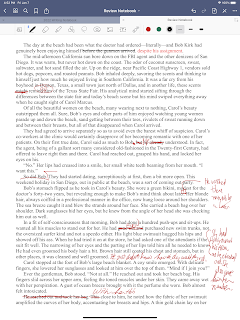
When it comes time to edit the completed file, I use GoodNotes. Not only does it allow me to edit PDFs. It’s really neat to have the iPad in my lap, pencil in hand, and just read and edit the text. It’s pretty much paper-like, but still digital.

This app is good for general note taking. So far this week, I’ve worked on two short stories, completing one and more than halfway through the second. As such, I don’t necessarily need a notebook with character names, etc., but when I start a new novel, this will be the place where I store said notes. It syncs to my phone so when I’m out with my Chromebook, I’ll have my notes. Granted, I can’t use (nor would I have) the pencil with the iPhone, but that’s no big deal.

Here’s a screenshot of page one of the completed short story.


From there, I’ll be able to make those changes in the manuscript and nary a piece of paper will be needed.

Publishing


While I have not yet published anything, I already know how to do that part. I’ll spell it out in a future post.

I have an entire process flow, but I want to test it first, work out any kinks, before I share it.

So, am I the only one who is writing without paper? For you other paperless writers, what are some of your preferred tools and apps?


P.S., Happy Birthday, David Bowie. Still miss you.

Saturday, December 11, 2021

Seasons' Readings

I love Christmas anthologies. I have my small collection. They run the gamut from SF (Christmas Stars) to classic (Dickens Christmas tales; Christmas Classics) to mystery (Crime for Christmas) to scary (Christmas Ghosts; can't find a link; it's the Hartwell/Cramer one) and Sherlock Holmes (Holmes for the Holidays). I've even got my comics covered with A DC Universe Christmas and Lee Bermejo's Batman: Noel

This year, I've added some cozy Christmas tales like Louise R. Innes Death at Holly Lodge, Holiday Murder by Leslie Meier, and another helping of the Andy Carpenter series by David Rosenfelt.

But when it comes to a book you can read for year, I think there is a top dog: The Big Book of Christmas Mysteries. Released in 2013, this 650-page book has something for everybody.

Agatha Christie opens and closes the book, and in between these bookends, all your favorites are here: Arthur Conan Doyle, G. K. Chesterton, Ellery Queen, Donald Westlake, Isaac Asimov, Ngaio Marsh, Rex Stout, and more.

The stories are broken out by themes such as A Modern Little Christmas, A Puzzling Little Christmas, A Pulpy Little Christmas, and A Traditional Little Christmas. If the stories don't get you, the wonderful cover painting, evoking something from the golden age, certainly will.

A collection this large cannot possibly be finished in one season. I don’t even try. Instead, I dip in for the last eight years, reading a tale here and there. 

I always enjoy making new discoveries, even if the discovery is something older.

Have y’all read through this book? If so, what are your favorite stories?

And what are some of y'all's favorite Christmas stories?

Saturday, December 4, 2021

NaNoWriMo 2021 - Post-Game: What’s Next?

NaNoWriMo 2021 is now in the books. How did you do? Did you get to 50,000 words? Did those 50,000 words correspond to the end of your novel? Did you fall short? Don’t worry. I’ve done all those things and more.

This year, I hit a new threshold: I got to 70,063 words in the thirty days of November. That came out to 40.2 hours. Irritatingly, those 70,000 words are not the end of the story, so I kept going. But I allowed myself a new daily goal for December: 1,000 words per day. It’s not quite the benchmark of 1,667 but it’s manageable. It’s helpful, too. I ran into a story wall on Thursday and I needed to brainstorm. It ate up the new words, but I cleared the pathway for the rest of the book (and might’ve even discovered a penultimate scene).

Like I said last week, whatever you did, please celebrate your accomplishment. I know that the physical part of writing is literally sitting in a chair and moving your fingers over the keyboard, but it can take a lot out of you. So no matter if you got to 50K or didn’t, celebrate.

What’s Next?


Well, as I wrote last week, if you want to be a writer, you have to keep writing. Find a new monthly challenge and get a story written. Write a short story per month in 2022. Just keep writing.

But what if you want to publish this NaNoWriMo 2021 book? Author J. Todd Scott on Twitter mentioned this week that his first book was written as part of NaNoWriMo.

What about the book you just completed? Well, do you want to publish it? If so, you can do what I did and publish it an an indie author. Yes, it means you do everything, but you also control everything. You rise or fall based on what you do. It can be daunting, but also rewarding.

First thing, get it edited. Ideally, you’d hire a professional editor, preferably one that doesn’t know you for a completely unbiased review of your book. When you get those changes back, make the changes. You don’t have to make them all. I mean if the editor is telling you the sub-plot needs a complete overhaul, consider why the editor said that, and then make your informed decision. There’s a reason the editor made the comment, but it doesn’t mean the editor is 100% correct. When you’ve made those change, re-read your book and then spot the things you missed.

Get a cover. Unless you know graphic design, hire someone. I used 99Designs to get some of my covers created.

Write a book description. Create your metadata. Determine the price point. Determine your marketing strategy. Format your file. (For this, the company Draft2Digital is recommended because they’ll basically do all the formatting you need for any of the digital marketplaces.) Upload the file to the world.

Then celebrate your accomplishment by throwing yourself a party.

And then? Well, do it all again.

Saturday, November 27, 2021

NaNoWriMo 2021 - Week 4 Encouragement: Congratulations, Honest Assessment, and the Future

Well, as of yesterday, NaNoWriMo 2021 has only four more days. As nice as it was to start the month and our novels on a Monday, we actually have until this coming Tuesday to reach the 50,000-word mark.

I reached that milestone last Sunday, about 36 minutes into my 76-minute writing session (yeah, I kept track of the time and the exact word count). As of yesterday, I’m up to 61,667 words and I still have a bit to go. Not sure how much, but I’m going to keep going until I get to The End. I kept track of the total minutes written so far and they add up to 35.5 hours. It’s moments like this when I superimpose a month’s worth of writing in spurts of 60-75 minutes over a typical day job of 40 hours a week and start to wonder what it would really be like to have a day job in which I wrote fiction for 8 hours a day. I know that it would not be a one-to-one comparison, but I still think about it. Maybe one day.

So, how are you doing? Did you get to 50,000 words? Did those 50,000 words correspond to the end of your novel or do you still have to keep writing to get to The End? Did you fall short? Don’t worry. I’ve done all those things and more.

Depending on your answers, you should do two crucial things.

First, if you finished, CELEBRATE! You have just written a 50,000-word novel. Celebrate. Tell people about it. Post about it on Facebook. Tweet your accomplishments. Open a bottle of champagne. Seriously on that last part, do it. Ever since I completed book 2, I have sprung for a bottle of bubbly to celebrate. It is a monumental thing if you have written a novel, especially if it’s your first.

Second, if you did not finish, do not beat yourself up or chastise yourself. Do not do those things. They do you no good and, in all honesty, they hamper your next writing effort. Believe me. I know this one all too well. It wasn’t until January 2013 when I again looked at the past year of not writing and finally turned myself around. I didn’t chastise myself like I had on previous New Year’s Days. Instead, I analyzed what had kept me from writing. Once those things were identified, I was able to skirt around them, avoid them, and I became a much more productive writer.

Now what?

Well, you’ve got to ask yourself a question. Did you participate in NaNoWriMo 2021 just to say you have written a novel, or did you do it because you want to keep writing stories? If it’s the former, good for you. Print it out, bind it if you want, display it proudly, and mark it off your bucket list. Mission Accomplished.

But if you found you enjoyed the process and kept doing it, you must keep writing. Seriously. Maybe NaNoWriMo 2021 took a lot out of you. That’s okay. Take a break for sure. Revel in your success. But make a plan--today--that you’ll start your next book on a certain day. My suggestion: New Year’s Day.

Now that you know you can write a novel, do it again. What better way to start a new year than with a new novel. I’ve done it the past few years. It’s a great way to get past the inevitable doldrums I often get in January. It’s like the hangover for all the holidays we celebrate the last 62 days of a year. Make a plan to start a book, and then write that next book. I’ll leave it up to you whether or not you decide to make January 2022 into a NaNoWriMo, but make a plan.

Ideally, you’ll finish your next book by 31 January 2022. Then, do it again. The best way to make it as a writer is to keep writing regularly. The ‘regularly’ is the key part. Writing is a muscle. It needs to be exercised to keep it in shape. And here’s the cool part: the more you do it, the easier it becomes.

Even if you don’t do a true NaNoWriMo of 1,667 words a day, shoot for 1,000. That’s the goal of veteran writer Kristine Kathryn Rusch. In two months, you can have your next book written. Or a novella in 31 days.

Just keep writing. Make it a habit. If you do, you’ll discover the joy of writing, the ease of writing, and it’ll likely make you happy.

Right now, revel in your celebration: NaNoWriMo 2021 is almost over. Congratulations. Now, don’t wait another eleven months to write your next book

Saturday, November 20, 2021

NaNoWriMo 2021 - Week 3 Encouragement: Let the Book Breathe and Drive to the Final Week

The third full week of November also counts as the third full week of NaNoWriMo 2021. Still having fun yet? I know I am. I am well ahead of the daily pace of 1,667 words per day. As of yesterday, a daily 1,667 words gets you to 31,673. As of now, I’m only 3,100 words shy of 50,000, a threshold I should reach Saturday (if I have a good writing day) or Sunday for sure.

So I’m pretty jazzed about my progress, and I attribute it to a mantra I apply to NaNoWriMo and every other story I write: let the book breath and be what it wants.

What do I mean by that?

I’ve mentioned before that I set out to write a murder/mystery will elements of romance. Well, as it turns out, my 2021 NaNoWriMo book is more family drama than murder/mystery. Don’t worry. The murder is here, but I opted to write this story in which the corpse does not show up in chapter one. I wanted to set the stage first, to introduce the characters first, give the reader a sense of them all before something bad happens.

And I think I’ve accomplished that. I’m the first reader even though I’m the writer, and here’s a telling comment about my enthusiasm about this story: I haven’t read anything else all month. The story I want to read is the one I’m writing. Getting up at 5am on weekday to write is not a chore. I almost literally jump out of bed, go through a few calisthenics, fill a coffee cup, and start writing. I can’t wait to get back to the story.

I’m using Google Docs and it tends to wig out around the 10,000-word mark. As such, I create a new file every 10,000 words. I’ve let some folks read the first part and the response has been quite positive. It’s a good thing when you, the writer, enjoy a story you are writing. It’s great when someone else likes what you’ve actively working on.

As we turn the corner to the last full week of November (the month ends on a Tuesday) and some of us have days off where we can possibly spend more time writing, keep this thought in mind: it’s more important for you to finish the book than reach 50,000 in November.

Here’s why. By now, you will likely have already established a pattern, a routine for writing. Whatever it is, keep doing it until the book is finished.

If you can conceivably complete the book by the end of November, do it. But, if you don’t think you can make that deadline...but do think you can complete the book a few days after 30 November, then make the adjustment. Because, when you get right down to it, the reason you started NaNoWriMo in the first place was to complete a book. The 50,000-word mark was only a trick, a hack, to get many writers started. Your book may only be 45,000. If so, then congrats! You’ve written a book. Your book may actually not be done until you get to 95,000 or more. Your book is your book. Do your adjustments as you see fit.

But this last full week of NaNoWriMo 2021 is the final major push. I’ve done it before. I’m doing it now. Millions of others have done it.

And you can, too.

Saturday, November 13, 2021

NaNoWriMo 2021 - Week 2 Encouragement: Don’t Sweat a Sub-Par Writing Day

As of yesterday, all the writers doing NaNoWriMo 2021 should have reached the 20,000-word mark. This threshold is based on a daily word count of 1,667 words per day. I’m happy to say that I now sit at 31,777 words.

There are two things at play with that number. One, I’m having a blast writing this novel, a traditional murder/mystery, a genre new to me. The words almost always fly from my brain, through the fingers, and onto the screen with joyous abandon.

Additionally, this is more of a character-driven story than I’ve ever written before. For my thrillers or westerns, there’s almost always a bad guy with a gun shooting at my heroes and they have to react. Not so with this book. It’s contemporary, with people talking about real issues and soon to be solving a crime. It’s odd for me, but I’m sincerely digging it. My initial readers are as well. My wife—a very harsh critic, who reads way more books than I do, and typically does not to read some of my more over-the-top stories—surprised me with her verdict on Part I of the story. It buoyed my day yesterday, especially since I’m going down a new path.

Every day until Wednesday, 9 November, I wrote more than 2,000 words in a day. But Wednesday morning, the words didn’t come in a gusher like the other ones have done. I ended up with only 1,880 words that day, above the baseline of a typical NaNoWriMo day, but less than my personal average. I thought about circling back sometime later in the day to bang out and additional 200 words, but opted not to. I wanted to remind myself, when I look at my spreadsheet with the daily tally, that some days will see fewer words than other days. It’s okay and it’s natural. The same thing happened yesterday, when I reached only 1,900 words.

The exception was Thursday. It was Veteran’s Day and I had the day off. What I ended up doing was working on the book all morning. I kept my typical day-job schedule of getting up from my chair every hour and exercising. Basically, I treated the fiction-writing job as the actual day job. It is what I’d love to do. I closed the laptop at noon to go shopping with the wife having booked 5,268 words.

Lessons for the week


It’s okay not to reach a pace you set for yourself. It’s even okay not to reach the 1,667-word mark everyday as long as you have the end goal in mind.

If you have some extra time this month—like I did on Thursday—take advantage of the bonus time and keep writing and add to the book’s total. Not only will you advance your novel, but you’ll be able to reach a point when you can take off a day from writing, like Thanksgiving. Time management is crucial to finishing a book, and be mindful of all the time you have available to write.

Saturday, November 6, 2021

NaNoWriMo 2021 - End of Week 1 Encouragement: Get Some Sleep

How’s the book coming along?

Today is Day 6 of NaNoWriMo (although for me, it’s still Day 5). If you’ve kept up the daily 1,667 words pace, Day 5 will have you at 8,335 words total.

I’m happy to report that, as of Day 5, I have reached 11,220 words. That's pretty remarkable considering I'm writing in a combined genre brand new to me. I’m actually 2,885 words ahead of schedule, which is fine by me. Remember we have a holiday here in the US on the last Thursday the month. Ideally, I want to be able not to write, although I probably will squeeze in some minutes and words.

The week went pretty well for me this week, writing-wise. I woke at 5am each workday. On Monday, Wednesday, and Friday, I work from home, so I had a nice 85-minute session each of those days.

Tuesday and Thursday was a different story. I go into the office and arrive at 7am. To do that, I have to stop writing at 5:55am. It’s a shorter session, but I bring my Chromebook and finish out the day during my lunch hour.

But I immediately noticed something on Tuesday: I cannot stay up late on Monday. I did, quite by accident, and I really felt it on Tuesday. Wednesday night was different as I went to bed early and made up the sleep time. By now, Friday afternoon, I can feel the lack of sleep. So looking forward to the end of daylight savings time this week. The extra hour of sleep arrives at the perfect time.

So I have two pieces of encouragement for you writers who are on this NaNoWriMo journey

Don’t get too bogged down in the daily weeds. Maintain the overall goal: 50,000. Some days, you’ll blow past the 1,667 mark. Others you may fall short. You can make it up. Don’t lose sight of the end goal: a completed story. In the end, it won’t matter if you didn’t reach your daily goal for a third of the days and exceeded it on the rest. All that matters is a 50,000-word completed novel.

And keep yourself healthy and maintain your sleep schedule. You can’t write if you’re sick or tired.

Until next week, keep writing!