Tuesday, March 26, 2019

100 Things Batman Fan Should Know and Do Before They Die by Joseph McCabe

Billed as "Your unauthorized guide to the comics, the movies, and beyond," author Joseph McCabe has written a fun encyclopedia of Bat-Things that span the decades. The publication date is 2017, so the last entry is the Batman v Superman: Dawn of Justice movie.

I first learned about McCabe's book on the Holy Batcast podcast when host Andy Digenova interviewed the author. The episode was a great one, getting me home one afternoon on my then hour-long commute. I ordered the book the same week, and it's been on my bookshelf ever since.

McCabe list is pretty good, too. Sprinkled throughout various entries are interviews with particular creators and actors. I remember quickly scanning the table of contents to see if some of my favorites made the list. Imagine my glee when I noted two of my all-time favorite Bat-Things were included: the tabloid story of Batman vs. The Incredible Hulk and the animated TV series Batman: The Brave and the Bold. Not only that, but McCabe includes two interviews, one with Diedrich Bader, the voice of Batman for the series, and producer James Tucker. Look, I know and agree that The Animated Series is arguably the best version of Batman on screen, but you can't deny the sheer joy of the Brave and Bold series. If B:TAS is the best, then Brave and Bold is my favorite. Plus, it's named after my favorite Bat-Title.

I suppose you could read this book cover to cover, but it's more fun to pick up and just open the book and read whatever entry on which you happen to land. I have enjoyed the book for over a year now, and I recommend it for every Bat-Fan.

Need another reason to buy it? Paul Dini, one of the creators of Batman: The Animated Series and noted Bat-Author writes the introduction. With that stamp of approval, what more do you need?

Monday, March 25, 2019

Batman 278: Stop Me Before I Kill

Another comic from my long boxes collected back in my youth is Batman 278. Like my recent series examining Batman's Underworld Olympics last week (covering issues 272, 273, 274, and 275), this issue was published in 1976. The cover date is August 1976, but the ads inside the book indicate the street date was likely May 1976.

“Stop Me Before I Kill” was written by David V. Reed with art by Ernie Chua and Tech Blaisdell. The villain in question is someone the characters dub The Wringer. Batman has a partner, but it’s not Robin. The man’s name is Inspector Kittredge from New Scotland Yard. He’s there riding shotgun with Batman on his nightly excursions and he wants to have one of Batman’s more bizarre cases.

Enter the Wringer


I’ll be honest, The Wringer is a bit of a cheesy villain. He wears green leotards with a purple hood/robe with eyes cut out so that the hood can act as a mask. Here's a page where you get both the Wringer and Kittredge.


Batman and Kittredge are presented with a few bizarre clues all dealing with little dolls who walk and talk. It all adds up to a rather interesting conclusion. Surprisingly at one point, Batman crushes the Batmobile into a truck to stop the larger vehicle with no apparent damage to the Batmobile. Must be made of something really hard.

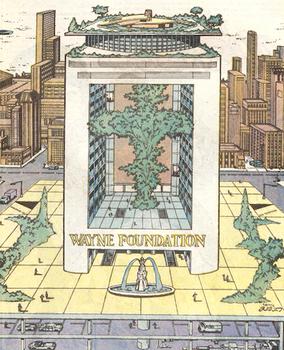
Inspector Kittredge is staying with Bruce Wayne at the mid-70s Wayne foundation penthouse. Always love the way this building was built with huge giant tree in the middle. Of course, if you find the one issue where the breakdown with the tree really is, it’s a series of elevators and walkways. Here's one of the images I remember, with art by Terry Austin.


Naturally, Bruce Wayne is pretty far ahead of Kittredge, but he is not the Bat-God he is nowadays. One of the neatest things is that Bruce Wayne and Inspector Kittredge go to the Bicentennial Expo the Gotham Coliseum. The historian in me as well as the pop culture enthusiast is always fascinated how comics dealt with then real-world events, and the bicentennial was a big deal.

I have to say, the art work is pretty decent. Very kinetic especially with the use of the “grayscale” version of characters to indicate starting position versus the ending position. And of course I love it when the book characters manage a repartee as they’re punching out the bad guys. My favorite line has got to be when The Wringer—who has strong hands—throws what appears to be a lamp base at Batman. The Dark Knight picks up a fireplace poker and swings and hits the lamppost. Batman’s quip “You can pitch them–can you catch?” And Batman says it with a smile. Yes, Batman used to smile!

The closing panels, with Batman’s reasoning, is, frankly, cheesy. But, in 1976, where young readers (the primary audience) were given clues to the capers, it may have been just the type of thing they were looking for.

At the end of the comic book is the Daily Planet/Direct Currents column. This is when you got to read about a few of the titles coming up, the closest thing you had to the internet back then. There is something charming when the titles include Justice League, Hercules, DC Superstars of Space, Kung Fu Fighter, House of Mystery, Metal Men, and Ragman. The trivia quiz for this issue is the following.

Villains are all the rage these days so let’s test your knowledge on some of ours. Do you know the real names of:

The Riddler
Mirror master
Tara man
The Mad Hatter
The Joker

Again, the audience was young, and for them to know the answers to these questions meant they'd have to read Batman comics regularly. Yeah, it was a means to get the kids to part with more of their dimes, but it also built a family.

Still, I wonder what the answer was to the Joker's originally identity? The 1989 Batman movie gave the Joker a name, but The Killing Joke graphic novel did not. I suspect the new movie with Joaquin Phoenix will attach a name to the man who ultimately becomes The Clown Prince of Crime. I, for one, prefer anonymity. To switch comic companies for a second, if anyone could wear the Spider-Man suit, then could anyone become the Joker?

Sunday, March 24, 2019

Happenstance TV Watching

Recently, a Facebook friend of mine posted the following update:

That moment when you spend two hours scrolling thru Netflix and Hulu looking for something to watch... half watch a few things... scroll some more... end up watching a depressing episode of Black Mirror... yeah... and then you think... I should have listened to the end of that podcast that I was listening to yesterday on the way home from work.

I'm a Gen-Xer. That means I grew up with antenna TV broadcasting three networks, PBS, and a handful of UHF channels. Here in Houston, we had only channel 39 and channel 26 until channel 20 showed up in the early 80s. Unless it was approximately one or two in the morning, all the networks broadcast material. You may have not liked what they were broadcasting, but you ended up on something.

Yes, the choices were predetermined for you, but there was always something *on.*

With on demand television, you are the network.

Yes, you don't have everything you might conceivably want, but there is so much content, you cannot possibly consume everything. One might argue that there is too much content, but that's merely a personal preference. Even back in the day, with only, say, the six TV channels Houstonians had by 1982, you couldn't watch everything on those six channels. Even with a VCR. Now with the advent of on demand TV watching--a wonderful concept especially, when two shows air at the same time--you can watch TV exactly when you want to.

But there's a trade-off.

What you don't get with on demand TV is happenstance watching. I'm still a cable subscriber so I have way more channels than I truly need. But it's always on. When I channel surf--rare these days because my TV consumption has shrunk considerably--I flick channels until I find something I want to watch. But along the way, I see all the other things being broadcast. I might note Raiders of the Lost Ark is on TBS and just stop to see what part they're up to. Or slow and see what episode of Family Ties or Friends is being shown at that moment. Or, because I'm a historian, watch a few minutes of some World War II documentary.

And I've been known to think I wanted to watch one thing, but then get sucked into something completely different just because I happened to see it was on.

You get the idea. Where there's always something on and you merely have to find it. You have the opportunity to stumble onto something you likely would not have selected had you been on one of the on demand streaming services.

Shrug. I know this is all personal preference, but my friend's Facebook post just got me thinking.

What about y'all? Do you prefer the modern on demand experience, happenstance TV, or a mixture? Despite the tone of this piece, I'm quite happy with the mixture.

Saturday, March 23, 2019

Year of an Indie Writer: Week 12

One event dominated this week. Another was just fun.

BATMAN's UNDERWORLD OLYMPICS


Being the Bronze Age kid I was growing up, the comics of the 1970s are the ones that shaped what I like about comics. The Jim Aparo Batman is my favorite Batman. He's the one I think of almost always first when I hear the Caped Crusader's name.

I own a ton of comics and I started re-reading some of the Batman titles I have, and a small run of four issues caught my attention. Published in 1976 to coincide with the Olympics that year, the Underworld Olympics find criminals from all over the world converging on Gotham City to try and best Batman.

Yeah, really.

I read these four issues (272-275) and, naturally, I wrote about them. Here are the links.

Batman 272
Batman 273
Batman 274
Batman 275

A BOWIE CELEBRATION


Wednesday night here in Houston, my wife and I were treated to something very special. A group of folks from David Bowie's touring bands now put on shows that showcase and marvel at the music of the Thin White Duke. Spearheaded by pianist Mike Garson, A Bowie Celebration is just that: a celebration. No, it isn't a tribute band, so don't think that. Heck, even writing those words does this group an injustice. These are professional muscians interpreting Bowie's music but adding their own individual spins on the songs.

It truly was something special. How special? Well, the length of my review pretty much says it all.

A Bowie Celebration Exceeds Expectations

PUBLISHING UPDATE


I am readying the next story that'll be published on 1 April. I am readying the next story that'll be published on 1 April. By this time next week, I'll have the description ready. Boy, sometimes these are tough. One book among many I use to help is Dean Wesley Smith's HOW TO WRITE FICTION SALES COPY.

I'm also looking ahead to May when the third Calvin Carter novel, AZTEC SWORD, will be released to the world.

READING 


Here in Houston, if you look past the giant plume of black, chemically laced smoke, the week was one the chamber of commerce wishes would happen more often. The sun was bright, the sky mostly clear of clouds, and the temperatures ranged from the uppers 70s to the low 80s.

It was picture perfect. (Truth be told, I'm sitting outside my office on a picnic bench, table umbrella shading my screen, and loving that winter is finally in our rear-view window.)

With the change of seasons comes a change in what I prefer consuming. When the sun's out, I like action/adventure stories. Tales bigger than life. Beach reads, if you will.

I'm still reading Brian Daley's HAN SOLO AT STARS' END for my science fiction book club. And APOLLO 8 is still on my Audible.

But the book I will be finishing this week is the latest by "Richard Castle." CRASHING HEAT is the latest (last?) inspired by the TV show, "Castle." We all know who the real-life author behind the Richard Castle moniker is, and his prose is effortless. I learn a lot from how he structures a story, breaking down the book. I'll do it for CRASHING HEAT as well as soon as I complete my initial read.

MAGAZINE ARTICLE OF THE WEEK


The cover story of the March edition of TEXAS MONTHLY features the genesis of Buc-ee's, the chain of stores dotting the Texas landscape that have become destination spots for all travelers. I really enjoyed learning of its origins as well as the man behind the empire.

Friday, March 22, 2019

A Bowie Celebration Exceeds Expectations

David Bowie may be gone from this earth, but his music lives on. And Wednesday night in Houston, the musicians and the audience in the Heights Theater were enveloped in his spirit.

Expectations Were High Yet Open


As soon as the Houston date was announced, I snagged a couple of tickets to "A Bowie Celebration." But I read no reviews. I wanted to go into show as clean as possible. I wanted the experience to be like it was for me, back in 1987, when I first saw David Bowie and had no idea about the setlist.

That proved to be the best decision I made. I was thoroughly entertained.

The brainchild of Mike Garson, David Bowie's longtime pianist, A Bowie Celebration gathers members of Bowie's longtime bands—including Carmine Rojas and Earl Slick from the 1983 Serious Moonlight Tour (two names I memorized by listening over and over to the recorded FM broadcast back in the day)—to tour and play songs from Bowie's vast array of songs from all eras of his career. Bowie might be linked with his lead guitarists over the years--Mick Ronson, Slick, Adrian Belew, Carlos Alomar, Peter Frampton, and Reeves Gabrels--but for my money, Garson's piano is the secret ingredient. He's the one enhancing everything from "The Lady Grinning Soul" to "The Heart's Filthy Lesson," to say nothing of the spectacular piano solo on "Aladdin Sane."

To sing the songs of one man, Garson recruited four vocalists, all of whom brought something special to their performances. Bernard Fowler has sung with The Rolling Stones for thirty years. His voice has an incredible range, able to hit the high notes while going very deep, all with crystal clarity. Gaby Moreno is a singer from Guatemala whom I didn't know before last night, but will be looking for some of her own music as of today. I knew Corey Glover as the lead singer from the great band Living Colour and man was he fantastic.

And, of course, there was Texan Charlie Sexton. I first saw him in 1987 when he performed with Bowie on the Glass Spider Tour. He was a member of the band last night, playing guitar and singing. Interestingly, with his high cheek bones, dark-colored rock star hair laced with gray, he somewhat resembled Bowie himself. Like an American cousin.


The Heights Theater Was The Perfect Venue


The Heights Theater, as its name implies, is a converted movie theater. For those of y'all who don't live in Houston, The Heights is like its own city, just to the north and west of downtown. When you drive up and down its streets, you can disappear and almost think you're in a small town. And in the 1940s. Which made the Heights Theater an excellent venue for this concert. Seating approximately 300, just about every seat was filled, and folks were standing along the walls. Bar tables with chairs occupied the front area. My wife and I were along the balcony, probably twenty feet from the stage, with a clear view of the piano keys. Of all the things I wanted to see, Garson's hands playing the keyboard was top on the list.

The eclectic mix of people sported more gray hairs than your typical rock concert, but every age was represented. The Heights being known for its artistic flair, the members of the audience did not disappoint. Not only did you have folks like my wife and I—suburban parents who haven't lost what it means to go out on a week night—but there were also folks you could tell were rock stars, albeit of the local variety. Heck, I even saw one woman dressed in a sequined white leotard with a red lightning bolt a la the cover of Aladdin Sane.

Bernard Fowler's Dramatic Voice


Five minutes after eight, Garson emerged from the back and walked on stage. He introduced himself, talked about the project, then sat at his piano to play "Bring Me the Disco King," from 2003's Reality album. Bernard Fowler came out to center stage and approached the microphone. This was it. This was the moment I had been waiting for. How would he interpret this song? Would he try to caricature Bowie or make the song his own?

The latter was the answer, and set the tone for the entire evening. Bowie was often a crooner. Think of "Absolute Beginners," "Wild is the Wind," or "Life on Mars." “Disco King” has only piano, minor drums, and voice. Fowler took this song and made it his own, adding wonderful inflection and emphasis not present in the studio version, breathing new life into the music. Make no mistake: this band is not a tribute band. These are musicians who played with Bowie, knew him, worked in the studio with him, and toured the world with him. They are channeling him but, in keeping with Bowie's adventurous spirit, this was not a rote concert.

The full band came out as the song finished. The three backup singers—one of whom played bongos and one was Corey Glover (that’ll tell you the depth of talent when you have someone of Glover’s caliber singing backup for most of the show)—stood on a small riser stage right. Carmine Rojas on bass occupied his own riser stage left. Garson's piano was up front on the right. Slick assumed his station in front of Rojas, while Sexton stood next to the piano. With the full band in place, they belted out "Rebel Rebel." If "Disco King" was the contemplative template for some of the obscure songs, then the rousing rendition of "Rebel Rebel" was the loud anthem when the gathered audience could clap and sing.

Corey Glover Soars


I'll admit I didn't know what Corey Glover looked like, although the multi-colored, multi-striped suit and colored hair peeking out from under his stylish hat should have been the giveaway. But when he stepped up to belt out "Young Americans," I had no way of knowing just how powerful this man's voice was. Coming just after "Fame," this sister song from the 1974 album showcased Glover’s incredible range. On the famous line "Ain't there one damn song that can make me break down and cry," Bowie always stopped the song and delivered that phrase with gusto. Glover blew the roof off the theater. It alone elicited cheers.

When Sexton picked up a 12-string guitar and with "Young Americans" out of the way, there was only one song that fit the bill: "Space Oddity." Haven't heard this one since 1990 when Bowie played it on his Sound + Vision Tour. Even here, Sexton did not merely mimic the Thin White Duke. Dressed in a sleek black suit with matching scarf, Sexton rocked up the traditionally slower tune, giving it that special something in this, the song's fiftieth anniversary.

Speaking of rocking things up, "Lazarus," from Bowie's last album, “Blackstar,” transformed from the dirge-like jazz number of the original to a guitar-heavy intense song. Slick, whose amps were always on top of the mix, and Sexton traded off guitar licks on an extended solo section. "Ashes to Ashes" took on the vibe from the 2000 live set "Bowie at the Beeb" and Garson threw in a keytar solo with spacy, 1980-era synth sounds.

Gaby Moreno’s Operatic Singing


Gaby Moreno took center stage as the opening drum beats of "Five Years" thundered in the theater. Again, she interpreted the song in her own way, adding newer notes to the established flow of the song. But as the song neared its end, she let loose an extended single note, high in the register, and near operatic in tone. She held it so long, cheers erupted before she finished the note. Incredible. Her onstage role continued a bit later in a duet of the song "Time" with Sexton. The dichotomy of the young Moreno and the older Sexton each taking turns with lines like "Time, he's waiting in the wings" and "You are not evicting time" took on new meaning.

Going into the show, I honestly expected Garson to break out the song "Aladdin Sane" and duplicate his piano solo. He didn't, but to make up for it, his piano showcase was on the rarity "Sweet Thing/Candidate" from 1974's “Diamond Dogs.” After Fowler crooned out the main verses, Garson took over. Musically pared down to bass and drums, Garson's piano soloing was exquisite.

A Triptych for the Ages


After a rousing, hard-edged rendition of "Let's Dance"—where Sexton and Slick again traded guitar solos—it was time for a trio of songs to close out the main set. "Under Pressure" got it started. This song took on added meaning after Bowie's death. I got emotional with the ad-libbed words Fowler spoke in "Disco King," but with "Under Pressure," the tears almost escaped, despite me singing along. With Fowler and Glover trading verses (rather than each man taking a single part), the words assumed greater meaning, especially as they often sang arm-in-arm. The entire audience was singing along now, and it was cathartic.

Next up was the crowd-pleasing "Suffragette City." With the audience already on its feet singing at the tops of its collective lungs and Glover actually in the audience leading the song, you know what was coming when we got to the "Wham Bam, thank you ma’am" line. Everyone belted out the words, fists raised. The old building's seams probably cracked at that point. "All the Young Dudes," closed out the main section. Written early in Bowie's career, it's a fitting song for a crowd sing-a-long. Many in the audience swayed with the beat, mesmerized by the finale.


Closing Out With Heroes


As the band took a short break, I leaned over to my wife and asked her opinion about the last song. To my mind, there could only be one.

"Heroes" started and it served a fitting close for the night. With the full band jamming, Fowler's powerful voice heralded into the theater, filling the venue. He held up his index finger while singing "just for one day." The audience got the message and did it with him every subsequent time.

With a final group bow, the evening was at a close.


Afterglow 


As the lights came up, everyone beamed with happiness and excitement, knowing they'd been a part of something special. Fans on the floor came up to the stage to say hello to the band. The musicians gratefully talked with everyone. It was like a family party. My wife and I found the other couple we chatted with before the show. Their grins were radiant. Before the show, I was hesitant to buy a concert t-shirt. My wife convinced me otherwise. We drove home under the full moon—a serious moonlight? —talking about the experience, the musicians, and a vow from her to find her Charlie Sexton cassette.

The Music of David Bowie Lives On


I've been a fan of Bowie since 1983 when I figured out who that guy was singing "Under Pressure" with Queen. He is one of my four favorite rock acts of all time. I loved his willingness to change styles, taking some current trend in music and putting his own unique spin on it. His 90s era is quite underappreciated. And, in 2016, while the sounds of his new record was only two days old, his death hit me hard. It was awhile before I could listen to his music again without sad emotions.

That time has passed. Honestly, I've been listening to Bowie's music with great happiness for a long time now, even a renewed interest in his 80s material thanks to the most-recent box set. And, as much as I fist-pump in the car while driving in Houston traffic, nothing compares to the splendor of last night's show.

If you enjoy consummate music professionals at the top of their game, this show is for you. That those same pros are intimately familiar with the music of David Bowie, their love and appreciation for him shines through in their playing. The performance last night ranks as one of my all-time favorite shows.

In short, A Bowie Celebration is a must-see event, a one-of-a-kind musical experience worthy of the man himself. And, for just one day, David Bowie was again alive.

Thursday, March 21, 2019

Batman’s Underworld Olympics ’76: Part IV

Batman_275
Batman 275 sports a decent cover, but a fantastic splash page.


I’ve always loved Batman images that use his cape as a framing device. You’ll see also, in the upper right corner, the logo for this four-issue fun of the Underworld Olympics ’76. And here we are at the final story.

The opening few panels are basically a pre-credits sequence of a James Bond movie. It sets up Batman’s continual frustration with this gang of criminals who are conducting odd activities that add up to nothing. We get a shot of our ringleader addressing the crowd and even the updated scorecard:

South America: 20 (in Batman 272)
Europe: 50 (in Batman 273)
Afro-Asian: 33 1/3 (in Batman 274)
North America: …well, it’s their turn now!

They have a big problem. The end of their assignment is to take place on the Tompkinsville Ferry at midnight, but budget cuts have cancelled that route. What are they to do? They complain. The liaison says they can forfeit. “Forfeit? That’s a laugh!” cries a dude who looks like a hippie. Well, our North American team concocts a daring scheme: they rob some fellow criminals of their cash reserves. Next thing you know, the mayor is on TV announcing that an anonymous group has donated a million dollars to get the Tompkinsville Ferry up and running again. Viola! The North Americans are in business.

And Bruce Wayne is in a pissy mood. When he reads that an historical key was stolen from City Hall, he knows it’s the work of this group. Alfred reminds him that the Wayne Foundation Benefit Soccer Game is that evening and they go. In a jarring couple of panels set at the game, Alfred starts to tell Bruce the differences between a soccer field and a football field. Now, what this really is is a chance for David V. Reed, the writer of these issues, to feed some useful information to the kids reading the book.* But what happens is that Bruce snaps at his manservant. “Alfred, I invited you here because it’s your national pastime…but please don’t instruct me. I played soccer in college.” Then, in the next panel, Bruce’s thought balloon is this: “I came to relax…and he’s driving me nuts! Ah, there’s my chance—” The ‘chance’ is two young ladies. Ah, the 70s!

But before Bruce can sashay over to the ladies, some goons emerge from under the field and disrupt the game. Reminded me of the circus scene in “Batman Forever.” Batman shows up and fights them, but not before one of them toss the soccer ball into the net of a guy on a motorcycle who gets away. In a funny series of panels without any dialogue, a disgusted Batman watches the cyclist roar away…and he takes out his frustration with a swift kick on a remaining goon who isn’t quite unconscious.

Back at the Batcave, Batman fetches the Whirlybat! This issue is cover dated May 1976 so I’m not sure how long it had been since the Whirlybat was in use, but it certainly wasn’t in this story arc. Batman actually is shown taking the tarp off the device that is essentially a helicopter attached to a chair. I actually found an image from the internet.

Batman #275 - Page 22
Okay, maybe it’s the adult version of myself looking at this, but wouldn’t the cape get snagged in the rotors? Ah, fooey! The image looks good.

Aloft now, Batman, complete with headphones, makes his silent patrol over the river. He spots the ferry and two motorboats in pursuit. He spots the two drivers as two of the goons from the soccer stadium…but can’t name them. [Sidenote: when he met Amba Kadiri *from India* last issue, he knew who she was, but he doesn’t know some North American bad guys?] He takes out the hippie and tethers that guy’s boat to the ferry. Then he uses the Whirlybat to get onto the ferry itself. There, the rest of the North Americans are in the process of lashing the wheel in place to head straight for a buoy. Batman frees the wheel and turns the ferry, but the trailing boat hits it. “Then, for one frightful instant, night becomes day…” reads the textbox.

But Batman isn’t done. He spots the other trailing boat turning around and leaving. In the Whirlybat, he follows that guy and actually snags him with a retractable line. Which brings us to the last few panels of this issue and this story arc. The leader awards the North Americans 90 points, winning the entire Underworld Olympics. As all bad guys like to do, he calls Commissioner Gordon to boast. Gordon’s nonplussed because he’s got a cadre of cops stationed outside the headquarters of the Underworld Olympics! Boom!

As in all issues of this run, the story ends with Batman and Gordon talking about the case. They make the observation that all of these events rarely had any profit to them. Gordon likes the irony of it. Batman, on the other hand, wonders “about the fiendish brain who dreamed and planned and arranged and organized the Underworld Olympics of ’76!” Indeed, Batman. This guy, who never got a name, would be an interesting person to return to and study. I’m not sure he ever was.

Thus ends the Underworld Olympics of 1976. It was a fun, goofy, somewhat preposterous storyline, but not without its charms. The Whirlbat! Tons of deductions. Lots of Bruce Wayne. This story was certainly a product of its time when kids read comics, but it was enjoyable if you didn’t think too much and just had a good time.

*I’ll say this about the comics of my youth: they would always try and teach something to kids. Whether it was Alfred’s description of the differences between a soccer field and football field or that the million dollars cash was from a mobster-run numbers game, the writers (adults obviously) would write their story and the editors would either let the content sail through or add little info dumps scattered throughout the issues. They didn’t always pander to kids. That’s a great thing and probably taught some neat facts to kids along the way. Not sure that’s there anymore. Too bad.

Wednesday, March 20, 2019

Batman’s Underworld Olympics ’76: Part III

First, in Batman 272, the South Americans had a go at the Underworld Olympics and Batman shut them down. Next came the Europeans. Now, in Batman 274, it is the turn of the Afro-Asian bloc. Yeah, that’s the term used in 1976 to group African and Asian criminals in the “Gotham City Treasure Hunt.”

Now, that title pretty much tells  you all you need to know about this issue. The unnamed leader allows Amba Kadiri—the villain on the cover—to select the challenge. This time, we’re in Da Vinci Code territory. They get a clue in the form of a coded poem which references “the vault of ancient learning.” That leads the A-A team to the Gotham library. There, they burn the wax seal which reveals the next hidden clue. (Let’s not ask how the bad guys knew this. Actually, let’s not ask any questions, shall we, and just enjoy the tale.)

On patrol, Batman hears the police band report and races to the library. He takes out the two A-A members quickly. One of the guys tries to torch Batman but the Dark Knight Detective quickly takes off his cape and smothers that guy. I’ve always loved when Bats does that. He takes the damaged book, the torch, and the chain back to the Batcave for some tests and ruminations.

Batman #274 - Page 12Here, we get one of my favorite things: Bruce Wayne, in the batsuit, but with the cowl down. Not sure why I like this so much, but always have. Probably something along the lines of the “man” part of Batman.

The prisoners are transferred on live TV (!) and they give hand signals to the remaining members of the team. They see the signs and decode them. Batman sees the signs and doesn’t know what to make of them, but his deductions takes him to the Gotham Aquarium where he meets Amba Kadiri. She’s got razors for fingernails. The pair fight and she slices off part of Batman’s cape. Her costume is actually pretty good. It’s less a costume than a body glove. Very efficient. But Batman gets the drops on her and she surrenders…much too easily. Batman has been decoyed. You see, the rest of A-A team are at this very moment secreting some additional pieces of the treasure hunt.

The theft shows up in the morning papers and Bruce is none too happy about being fooled. He actually snaps at Alfred before walking the streets, oblivious to everything, lost in thought. Finally, that night, Batman arrives at the Cinema Palace and the film festivals because “the more bananas it [his deduction] sounds, the more I believe it.” Yeah, Batman said “bananas.” Well, he takes out the rest of the A-A gang, including this line “Uncle Batman wants you.” Whew!
Batman #274 - Page 31
In the closing panels, Batman and Gordon are discussing the events. Batman actually namedrops “underworld Olympics” which made me roll my eyes. He correctly identifies the remaining group: the North Americans. But that’s in the next issue.

Tuesday, March 19, 2019

Batman’s Underworld Olympics ’76: Part II

When we last left our hero in Batman 272, Batman stood in Commissioner Gordon’s office and pondered why all the hoods he had bagged were from South America. Little does he know that now, the Europeans have a go at the Dark Knight Detective.

In Batman 273, we have “The Bank Shot That Baffled Batman.” The cover is an oddball cover to be sure. The modern Batman would never have allowed himself to get into a position like that, but that’s also why I love the 70s version of Batman because he’s often more human.

This story not only gets the 1976 Olympic vibe, but it also deals with the American Bicentennial. In the opening panels, some reenactors are rehearsing their part of the upcoming celebration. They have a colonial cannon and are supposed to keep the redcoats at bay. But the redcoats have live ammunition. In the ensuing excitement, the cannon is stolen.

Interestingly, the first we see of Batman, he’s in the JLA satellite standing watch. Cut to Underworld Olympic HQ and our announcer. He informs the betting crowd that the Europeans have successfully completed phase 1 of their assigned tasks. Phase 2 involves a theft from the bank…in which Bruce Wayne happens to be working. During the heist, it’s Wayne who sees the action and, in no time, has already changed clothes and swoops in as Batman. With swift action and funny dialogue, Batman narrates his take-down of the goons, but one of them gets away with the safe deposit boxes.

A highlight of this issue is Batman being a detective. Of the 20 pages of action, only four show Batman actually punching bad guys. The rest of the time, he’s figuring out the clues and following leads. One of those clues gets Batman to a warehouse (natch) where…he’s bonked on the head from behind. Again, love the 70s version, because you know modern Batman would have taken out that goon. When Boris the Russian bad guy explains to his pals how he was able to get the drop on our hero and snatch the missing safe deposit box from under Batman’s nose, he merely said he followed Batman. Really? Did he swing through the skies on ropes? Oh well, it was the 70s.

The next day, Bruce Wayne makes an appearance at the bank to watch the “owners” of the boxes arrive. Turns out Bruce notes the heels of a man named Boris being the exact type of heels from the goons he smacked down last night. Soon, he’s back into Batman garb and, using Bruce Wayne’s keys—and Batman actually says “Very convenient having Bruce Wayne’s keys! Save time” Why does he do this? It’s all his stuff—he sneaks into the safe deposit vault. There, he picks the locks of every box registered to the two shady characters. It’s all a bunch of sectioned and machine metal pieces.

Are you ready for what comes next? Batman actually puts together…the stolen cannon. In the bank vault. Yes, really. He determines the projectile is hollow so he paints it with an invisible coating of uranium nitrate that he just happens to carry…on his utility belt? He calls Alfred and asks him to track the trajectory of the projectile when it’s fired. And then Batman disassembles the entire cannon and puts all the pieces back into their respective boxes.

Pretty riveting comic reading, I know, but the action picks back up when the goons return, build the cannon, insert the stolen loot into the hollow projectile, shoot it, blow a hole through the bank vault, and only then does Batman make his entrance. Gotta love it, right? He dispatches these bad guys, then goes to where the projectile landed and takes out those guys, too.

Darn that Batman. He keeps screwing up the Underworld Olympics! The Europeans did all they were asked to do, earning them 80 points, but the leader deducted 30 because the entire European squad was captured by Batman. So, if you’re keeping score at home, it’s South America with 30 and Europe with 50. In the closing panel, Batman wonders what’s next for Gotham. What’s next? Why nothing less than the “Gotham City Treasure Hunt.”

As I wrote before, the whole concept is goofy, but seeing Batman actually use his brains more than his fists was great. I enjoy re-reading these older stories not merely for the nostalgia or the ads but for a more human Batman. Again David V. Reed penned the story and Ernie Chua and Frank McLaughlin created the art. This Batman is still drawn in the more slim style of Neal Adams, but with a larger upper body. Almost like a swimmer, say, the way American swimmer Nathan Adrian looks. I’m beginning to think I may read more issue past this four-part run.

Monday, March 18, 2019

Batman’s Underworld Olympics ’76: Part I

[Batman turns 80 this month. Next week, issue 1,000 of Detective Comics will be published. To get in on the Bat-anniversary festivities, this week, I take a look at a run of four stories published in 1976.]

No matter the year, everyone likes to jump on the Olympics bandwagon. Be it Citibank or Coke or McDonald’s in 2016, every business wants a bite at Olympic golden advertising. Well, back in 1976, DC Comics put Batman in the mix.

With a cover date of February 1976—which probably meant a late 1975 newsstand appearance, especially considering the ad for the treasury edition of “Christmas with the Super Heroes”—Batman issue 272 has the title of “The Underworld Olympics ’76.” That title ended up covering four consecutive issues. Considering I’ve been watching the Olympics for a week now, I thought it would be a great time to read these books.

In the opening panels, Batman arrives at the Gotham airport and nabs a smuggler. He even schools the cops on what to look for. Unbeknownst to the Dark Knight, that was merely a ruse to let other folks slip into the city. Said folks were the South American contingent. No sooner than a mere flip of a page and we learn they are the last team to join the First International Crime Olympics. The unnamed chairman has four envelopes, each containing a crime to be committed. And there’s a point system involved complete with various deductions. The South American pick first and the games are off.

Now, before I got any further, I’ll admit that yes, this is a goofy concept. I won’t disagree if that’s the first thing you thought of when you read the title of this blog. David V. Reed penned the story while J. L. Garcia Lopez and Ernie Chua handled the art. If you can get beyond the goofy concept, the story ain’t half bad…provided you accept the premise.

If there’s one thing I love about 1970s-era Bruce Wayne it was him playing up his debonair alter ego. The victim of the South Americans’ event is hosting a swanky party, and Bruce is there chatting with a provocatively dressed woman. As one tends to do when one is a millionaire playboy. But he deduces the host’s quick exit is not on the level and, dressed as Batman, takes *his own car*. Any observant party goer might ask “Hey, why is Batman driving Bruce Wayne’s car” but that’s neither here nor there. Suffice it to say, Batman is too late to prevent the host/victim from death.

But he isn’t too late to take on the two South Americans in hand-to-hand combat. Bats wins, of course, and the South Americans are arrested. Bummer, because that counts as a deduction. (Just go with me here.) Batman is in full-on detective mode, questioning each piece of this rather bizarre puzzle. The Underworld Olympic Committee (because that’s what they are, right?) have spotters in the field (seriously) and the presence of Batman complicates matters. Cut to panels of other criminals, back at Underworld Olympics HQ, placing new bets.

I hope they bet on Batman. No sooner does he track an electronic bug to Gotham’s “Central Park” that he walks into an ambush. He catches the “olympians” red-handed and puts them away. Too bad, because that just means more deductions. And that leaves Batman to wonder why all the bad guys he put in jail are all from South America.

In an era where multi-issue story arcs were either rare or nonexistent, the Underworld Olympics run is unique. I just wonder how good it is, or if “goofy” will be the watchword of the arc. I’ve only read the first story, but I’ll be back tomorrow with a review of Batman 273 where the Europeans try for “The Bankshot that Baffled Batman.”

Sunday, March 17, 2019

Batman Beyond

A few weeks ago on the Fatman Beyond podcast, Kevin Smith and Marc Bernardin discussed the idea of a Batman: Beyond live action movie. The key to this movie making a billion dollars, according to Smith, was to cast Michael Keaton as the older Bruce Wayne.

The idea is intriguing.

For those who don't know, the animated series "Batman: Beyond" takes place in the future where Bruce Wayne's aged body can no longer keep up with the demands of being the Caped Crusader. This despite a robotic suit. You see, Bruce knew he was losing a step, so he created a cybernetic suit to enhance his strength, including the power of flight. Plus, it's a kick-ass look.


Well, when Bruce-in-the-New-Suit fails, he gives up the mantle forever. Twenty years later, when teenager Terry McGinnis encounters an elderly Bruce Wayne, he also discovers the old man's secret. Terry has his own problems, namely with his dad's murder by Derek Powers, current CEO of the Wayne-Powers company. So he does what every teenager would do.

He steals the Batsuit.

And he's having a jolly old time, fighting the bad guys, including the one who killed his father, when a voice appears in his headset. It's Wayne, and he's pissed. He demands Terry bring the suit back. Terry agrees, but only after he takes care of business.

By the end of the pilot episode, Bruce and Terry have worked out an agreement: Terry becomes the new Batman, but only under Bruce's tutelage.

Thus, we have a new series. It ran for three seasons as part of a Saturday morning line-up starting in 1999. Focusing on teenaged life but with a science fiction bent, Beyond brought  a whole new Rogue's Gallery to the mix. Inque was a great one. Do you remember the T-1000 bad guy Terminator from T2: Judgement Day? Well, Inque is pretty much like that, but black. And not a robot. Powers of course. And the Royal Flush Gang are also great.

The vibe of Beyond's future is an 80s high school movie crossed with Blade Runner. Gotham City really reflects this look.


There's always teenager stuff in every episode, including some of the villains. In episode 4, a scrawny kid who gets pushed around by his dad and the tough kids at school, becomes fused with a giant robot. Now, he gets to be the tough guy. And Batman has to save him. It's exciting, but with Beyond being a cartoon for kids, the violence was only cartoony with little to no death.

Terry was a great character. He brought a zippiness to the banter between him and Bruce. He was impressed by Bruce's history, but not star-struck. He was an outsider. Well, he was an outsider until the unofficial series finale as part of the "Justice League Unlimited" episode entitled "Epilogue" when it was revealed...

Nah. I'm going to spoil that ending. You'll have to learn it for yourself. You can look it up now on the internet or just watch Batman: Beyond. I've started rewatching the series. I'm up through episode four now, mostly on Saturday mornings, with either my Shipley's do-nuts or a bowl of cereal.

In an era where Spider-Man: Into the Spider-Verse gives us a glimpse of a future with that hero, I think Smith and Bernardin are onto something. And, with the new Batsuit completely covering the human wearing it, you can now have the mantra that anyone could be Batman.

Saturday, March 16, 2019

Year of an Indie Writer: Week 11

This was almost Week 3 redux.

QUIET TIMES


Back in Week 3, I mentioned that there would be down weeks. It happens in just about every profession you can imagine, and it certainly happens in the writing life.

It was Spring Break here in Houston. Fewer people were actually in the office at my day job and the traffic was wonderfully light. Except for Monday when I took the day off, I woke at my usual 4:45 am (getting used to daylight saving time means no 4:30 for this week), exercised, and then wrote. It made for a quieter-than-normal week.

And it was nice.

ANTIQUING FOR RECORDS


On the day off, the family and I traveled north of Houston to Spring and the giant antique store up there. A few years ago when we last went, a book dealer with shelves was there. Well, it's not there anymore, but that was okay. There were about five dealers with hundreds of records.

And we looked through most of them.

I came away with only one LP: Chicago XI, Terry Kath's last. The wife purchased two, while our boy took home four. Yup, the teenager bought more records than his parents combined. Go figure.

It's a funny thing when you have a teenager and he wants a turntable. Now our game room/his fun room has a turntable to go with the stereo system. We can all jam to records while playing video games.

DON'T BE AFRAID OF WHERE YOUR STORY GOES


The new Ben Wade story is inching its way up to novella territory. Novelette for sure. It's up to Chapter 10 and I've got the big finale to finish with the obvious denouement afterwards. What struck me during the process of this story is that it's definitely not like the three Wade novels I've already finished. I mentioned in week 7 this novella is written in third person, not the usual first person POV. That's just a prose choice. What I'm finding interesting is the style. It's a shade darker than the three novels. Things happen that actually move Wade along in his character development.

It also means I'll have to publish Novel #3 first before this story goes out into the world.

Which means I'll need another short story ready for 1 April.

CASTLE IS NOW TEN YEARS OLD


The big news this week was one I actually missed last Saturday.

"Castle," one of my all-time favorite TV shows, turned ten on 9 March. I wrote a lengthy post about it, and received some of my best feedback. I got lots of comments from folks over on my main author blog. It was really nice to revisit all that I love about this show.

BOOK OF THE WEEK


Speaking of Castle, out of the blue, a new Richard Castle novel, CRASHING HEAT, was published on Tuesday. I had pre-ordered the audio and started listening on day one. Within seconds, I was back in the groove with Niiki Heat, Jameson Rook, the prose of "Richard Castle," and the narration of Robert Petkoff. He's got a great knack of getting the nuances of Fillion's voice without actually mimicking him.

The Castle novel put APOLLO 8 on the back burner for a couple of days, but I got back to it yesterday. What I enjoy about simultaneously listening/reading both non-fiction and fiction is being able to go back and forth depending on my mood.

In the chapter I listened to yesterday, the mission of Gemini 7 was described. Can you imagine spending two weeks in space inside a capsule little bigger than a Volkswagon? Yeah, I can't either.

MOVIES OF THE WEEK


I saw both Captain Marvel and Bohemian Rhapsody this week. I reviewed them both.


How was your week?